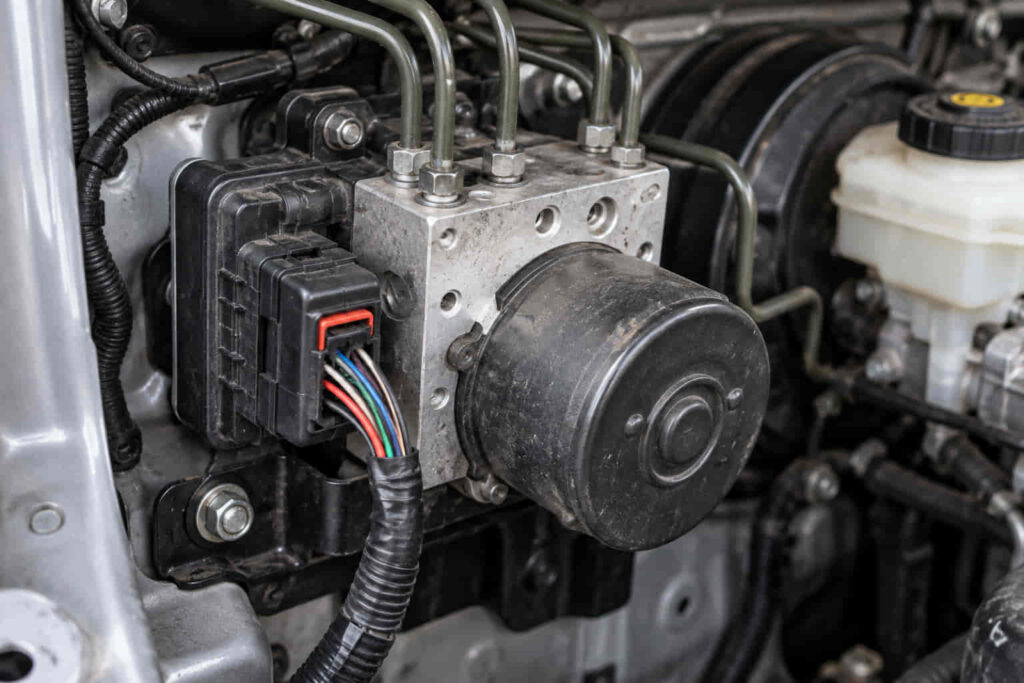
The Toyota C0215 code indicates a fault detected within the wheel-speed-related circuit monitored by the vehicle’s skid control system. C0215 should not be treated as automatic proof that the wheel speed sensor itself has failed. The fault can involve the sensor or another part of the signal path, so the circuit, electrical connections, related components, and vehicle-specific diagnostic information need to be checked before any part is replaced.
Wheel speed information is important because Toyota’s brake and stability control systems use it to determine how individual wheels are rotating. When the skid control ECU detects an abnormal condition in the monitored signal, it can store C0215 and illuminate warning indicators associated with systems such as ABS, VSC, or TRAC. The exact warning-light combination and system response depend on the Toyota model, model year, and fault condition.
Correct diagnosis therefore starts with reading the complete DTC set and confirming the vehicle-specific definition of C0215. The technician can then inspect the relevant sensor circuit, wiring, connectors, signal behavior, and related mechanical conditions according to the applicable diagnostic procedure. This guide explains what Toyota C0215 means, what can cause it, which symptoms can appear, how to identify the root cause, and how to repair the fault without replacing parts unnecessarily.
What Does the C0215 Code Mean on a Toyota?
The Toyota C0215 code means the skid control system has detected an abnormal condition in a monitored wheel-speed-related circuit or signal. Wheel speed information allows the skid control ECU to determine how individual wheels are rotating and use that information when controlling functions associated with the Anti-lock Braking System (ABS), Vehicle Stability Control (VSC), and Traction Control (TRAC). When the expected signal is missing, abnormal, or otherwise fails the applicable diagnostic criteria, the control system can store C0215.
C0215 identifies a diagnostic condition rather than confirming that one specific component has failed. A wheel speed sensor is part of the diagnostic path because it generates information used to determine wheel rotation, but the signal must also travel through an electrical circuit before the control module can interpret it. A problem affecting the sensor, wiring, connector, or another relevant part of that signal path can therefore produce a condition that requires further testing.
The distinction between a DTC and a confirmed component failure is important when repairing C0215. A scan tool reports the condition recognized by the control module; it does not physically test every component involved in producing and transmitting the wheel speed signal. Replacing a wheel speed sensor solely because C0215 is stored can therefore leave the original problem unresolved if the actual fault is located elsewhere in the circuit.
The exact interpretation should also be confirmed against diagnostic information for the specific Toyota being repaired. Model year, brake-control configuration, electrical layout, and other vehicle specifications can change the applicable test procedure. C0215 provides the starting point for diagnosis, while vehicle-specific testing determines which component or circuit condition actually caused the code.
What Causes the C0215 Code on a Toyota?
Toyota C0215 can be caused by a fault that prevents the skid control ECU from receiving the expected wheel-speed-related signal through the monitored circuit. The root cause can exist at the sensing point, within the electrical path carrying the signal, or in another related condition that changes the information received by the control module. Diagnosis must establish which part of this path is abnormal before a repair is selected.
A wheel speed sensor becomes a primary diagnostic consideration when its output does not correspond with the wheel’s actual rotation. The skid control ECU relies on wheel speed information to compare wheel behavior and perform its control functions. If the sensor cannot provide the expected information under the conditions monitored by the system, the ECU can recognize the abnormality and store a related DTC. The sensor should still be tested rather than automatically replaced because an abnormal signal does not prove that the sensor itself created the problem.
Wiring and electrical connections can create a similar fault condition. An open circuit, damaged wiring, poor terminal contact, corrosion, or another electrical defect can interrupt or distort the path between the sensing component and the control module. From the ECU’s perspective, a signal lost because of damaged wiring can resemble a signal that is absent because of a defective sensor. Circuit inspection and electrical testing are therefore necessary when the applicable diagnostic procedure points toward this path.
Related mechanical conditions can also matter when they affect how wheel rotation is detected. The sensing system depends on a predictable relationship between the sensor and the rotating components from which wheel-speed information is derived. Damage, contamination, excessive movement, incorrect installation, or another physical condition in this area can change signal behavior even when the electrical portion of the sensor remains functional. The relevant components must be inspected according to the design used on the specific Toyota.
The most reliable way to determine the cause is to connect the DTC with actual diagnostic evidence. Scan data can establish whether a wheel-speed value behaves abnormally, physical inspection can reveal visible damage or connection problems, and electrical or signal testing can determine whether the relevant circuit operates within specification. These findings separate a verified sensor failure from a wiring, connection, signal-generation, or related mechanical problem.
There is therefore no universal part that should be replaced whenever Toyota C0215 appears. The correct repair depends on the verified root cause of the abnormal wheel-speed-related condition. Identifying that cause before replacing components reduces unnecessary repairs and provides a measurable basis for confirming that C0215 has actually been resolved.
Read more: Toyota C1201
What Symptoms Can Appear With Toyota Code C0215?
The main symptoms associated with Toyota C0215 are warning lights from the brake or stability-control systems and possible changes in electronically controlled ABS, VSC, or TRAC functions. The exact symptoms depend on the Toyota model and the condition responsible for the abnormal wheel-speed-related signal. C0215 does not create one identical set of driving symptoms on every vehicle.
An ABS warning light is an important visible symptom because wheel speed information is used by the anti-lock braking system to monitor wheel behavior. ABS operation depends on identifying differences in wheel rotation during braking so the system can respond when its control criteria are met. An abnormal wheel speed signal can interfere with the information required for that process, causing the control system to record a fault and warn the driver that the system requires attention.
VSC and TRAC warning indicators can also appear when the affected Toyota uses wheel speed information for stability and traction functions. These systems need reliable information about wheel behavior to determine whether electronic intervention is required. If one monitored signal becomes unavailable or unreliable, the skid control ECU can change the operation of related functions rather than continue using data it has identified as abnormal.
C0215 does not necessarily mean that the driver will notice poor engine performance, difficult starting, or another engine-related symptom. Its diagnostic context is different from an engine-control code because the relevant information concerns wheel-speed monitoring and brake or stability control. This distinction helps narrow diagnosis toward the affected system rather than treating every illuminated dashboard warning as evidence of an engine problem.
Normal vehicle movement also does not prove that the C0215 condition has disappeared. A driver may be able to accelerate, steer, and use the conventional braking system without an obvious change while an electronically controlled assistance function has recorded a fault. The warning indicators and diagnostic data should therefore be evaluated even when the vehicle appears to drive normally.
Why Do the ABS, VSC, or TRAC Lights Come On With C0215?
ABS, VSC, or TRAC warning lights can come on with Toyota C0215 because these systems depend on wheel speed information to perform their electronic control functions. A single abnormal wheel-speed-related signal can affect more than one function when the same information is shared or used across the skid control system.
The relationship begins with wheel rotation. A wheel speed sensing system provides information representing how fast a wheel is rotating, and the skid control ECU processes that information together with other relevant inputs. ABS uses wheel behavior during braking, while traction and stability functions use wheel-related information as part of determining whether corrective control is required. Reliable wheel speed data therefore has value beyond one dashboard warning light.
When the control system determines that the relevant signal does not meet its diagnostic criteria, continuing to rely on that information could make electronic control calculations unreliable. The ECU can respond by storing a diagnostic trouble code and changing the availability or operation of functions that depend on the affected information. Their warning indicators communicate that system status to the driver.
Several illuminated warning lights consequently do not prove that several independent components have failed. The ABS, VSC, and TRAC indicators can be connected through their dependence on related vehicle data and control architecture. Diagnosis should identify the original abnormal condition rather than assuming that each warning light requires a separate replacement part.
This relationship also explains why repairing the verified C0215 root cause can resolve more than one warning indication. If the fault is caused by a defective sensor circuit, electrical connection, signal-generation condition, or another verified problem, correcting that fault restores the information required by the affected control system. The codes can then be cleared and the vehicle rechecked to determine whether the warning lights remain off and the DTC stays absent.
How Do You Diagnose Toyota Code C0215?
Diagnosing Toyota C0215 starts by confirming the code with a scan tool, recording all related DTCs, and determining which wheel-speed circuit and diagnostic conditions apply to the specific vehicle. The objective is to identify why the skid control ECU detected an abnormal wheel-speed-related condition rather than immediately replacing the sensor associated with the code description.
The complete scan should be recorded before any codes are cleared. Other ABS, VSC, TRAC, communication, or electrical DTCs can provide additional context and reveal whether C0215 is an isolated fault or part of a broader problem. Available freeze-frame or diagnostic data should also be preserved because it can show the conditions present when the control module detected the malfunction. Clearing the codes before recording this information can remove evidence that is useful when diagnosing an intermittent fault.
Visual inspection should follow the scan results and the applicable Toyota diagnostic information. The relevant wheel-speed sensor area, wiring harness, connectors, and nearby components should be checked for physical damage, loose connections, corrosion, contamination, incorrect installation, or evidence that wiring has contacted a moving component. A visible defect can establish a useful diagnostic direction, but visual inspection alone does not confirm that an electrical circuit or sensor is functioning correctly.
Live wheel-speed data can provide additional evidence when the scan tool and vehicle support it. Wheel-speed values can be observed while the wheels rotate under appropriate test conditions to determine whether one signal behaves differently from the others. A value that remains absent, changes erratically, or does not correspond with actual wheel rotation provides a reason to investigate that signal path further. Live data identifies abnormal behavior, but additional testing is still required to determine whether the sensor, wiring, connection, or related physical condition caused it.
Electrical testing should then follow the vehicle-specific diagnostic procedure. Depending on the sensor and circuit design, diagnosis can involve checking circuit continuity, power or ground conditions, terminal integrity, resistance, voltage, or signal behavior. The required measurements and specifications should come from information applicable to the exact Toyota model and model year because sensor designs and expected values are not universal across the Toyota range.
Related mechanical conditions should also be inspected when they can affect wheel-speed detection. The sensing process depends on a stable physical relationship between the sensor and the rotating components used to generate wheel-speed information. Damage, excessive movement, incorrect positioning, contamination, or another physical abnormality can alter the signal received by the ECU even when the sensor’s electrical circuit is intact.
A C0215 diagnosis is complete only when testing identifies a fault that explains the abnormal signal detected by the control system. A stored code points toward the diagnostic area; measured evidence identifies the failed condition. This distinction prevents unnecessary sensor replacement and provides a clear basis for choosing the correct repair.
How Do You Fix the C0215 Code on a Toyota?
Fixing Toyota C0215 requires correcting the verified fault in the affected wheel-speed-related system, then clearing the DTC and confirming that the code does not return. The required repair depends on what diagnosis proves to be defective, so replacing a wheel speed sensor without testing is not a universal solution for C0215.
A wheel speed sensor should be replaced when testing confirms that the sensor cannot provide the required signal and the rest of the relevant circuit has been verified. This confirmation matters because a functional sensor cannot compensate for an open circuit, damaged connector, poor terminal contact, or another fault that prevents its signal from reaching the control module. Replacing the sensor in that situation adds cost without correcting the condition detected by the ECU.
When testing identifies damaged wiring or an electrical connection problem, the repair should restore the integrity of that circuit. The repaired wiring and terminals must provide a stable electrical path under normal vehicle operation rather than merely pass a temporary visual inspection. Wiring near wheels and suspension components operates in an environment exposed to movement, moisture, debris, and vibration, making physical condition and connection quality relevant to a lasting repair.
A related mechanical problem should be corrected when diagnosis demonstrates that it is interfering with wheel-speed detection. The sensor relies on the physical components around it to produce or detect information that accurately represents wheel rotation. Replacing an electrically functional sensor will not correct an abnormal signal if the verified cause exists in the component or physical relationship used to generate that signal.
The diagnostic codes should be cleared only after the identified problem has been repaired. Clearing C0215 before the repair can temporarily remove the warning indication, but the skid control ECU can store the code again once it detects the same abnormal condition. A reset is therefore a diagnostic or verification action, not a substitute for fixing the fault.
Repair verification should include another scan and confirmation that the relevant wheel-speed information behaves correctly under applicable operating conditions. The vehicle can then be operated or road-tested according to the appropriate procedure and scanned again for returning DTCs. ABS, VSC, or TRAC warning-light status should also be checked because these indicators can reflect whether the affected control functions continue to recognize a malfunction.
The repair is successful when the verified root cause has been eliminated, the relevant wheel-speed signal operates correctly, and C0215 does not return after the system monitors the repaired condition. This evidence-based process is more reliable than judging the repair solely by whether a dashboard warning light disappears immediately after clearing the code.
Can You Drive a Toyota With the C0215 Code?
Whether you can continue driving a Toyota with C0215 depends on the underlying fault, the warning lights that are illuminated, and how the braking and stability-control systems are behaving. C0215 identifies a fault condition associated with wheel-speed-related information, but the code alone does not establish the complete mechanical condition of the vehicle. Driving safety should therefore be evaluated from the actual symptoms and diagnostic findings rather than from the code number by itself.
A Toyota with C0215 may still accelerate, steer, and respond to the brake pedal without an obvious change during normal driving. This does not confirm that all electronically controlled braking and stability functions are operating normally. ABS, VSC, and TRAC depend on reliable vehicle information to determine when electronic intervention is required, so a fault involving wheel-speed data can affect functions that may not become noticeable until specific driving conditions occur.
The situation requires greater caution when C0215 appears with abnormal braking behavior, additional brake-system warnings, or another symptom that affects vehicle control. These conditions provide more information about immediate risk than C0215 alone. A vehicle showing a significant change in braking behavior should not be treated the same as a vehicle that has only stored a DTC with no noticeable operational change.
C0215 should therefore be diagnosed promptly even when the Toyota appears to drive normally. The scan results and physical testing can establish whether the fault is limited to a sensor or electrical signal path or whether another condition requires more immediate repair. The underlying fault, rather than the presence of C0215 alone, determines the appropriate response.
How Much Does It Cost to Fix Toyota Code C0215?
The cost to fix Toyota C0215 depends on the verified root cause because the code can lead to different diagnostic and repair procedures. There is no single accurate C0215 repair price that applies to every Toyota. The final cost is determined by diagnostic labor, the component or circuit that actually failed, the required parts, and the labor needed to complete and verify the repair.
A wiring or connector fault creates a different repair requirement from a confirmed wheel speed sensor failure. A damaged section of wiring may require circuit repair and terminal work, while a failed sensor can require component replacement. A mechanical condition affecting wheel-speed detection can create another repair path entirely. Quoting the cost of a wheel speed sensor before identifying the root cause therefore assumes a diagnosis that testing has not yet confirmed.
Vehicle configuration also affects repair cost. Parts, component accessibility, labor time, and diagnostic procedures can differ between Toyota models and model years. A component that can be accessed directly on one vehicle may require additional disassembly on another. For this reason, a useful estimate should identify the exact vehicle and verified repair rather than rely only on the C0215 code.
Diagnostic labor is part of the repair process because testing prevents unnecessary component replacement. Spending time confirming whether the fault exists in the sensor, wiring, connector, signal-generating components, or another relevant area can reduce the total cost when it prevents a functional part from being replaced. The most accurate C0215 repair estimate can therefore be produced after the fault has been isolated and the required repair is known.
Can You Clear or Reset Toyota Code C0215?
Toyota C0215 can be cleared from diagnostic memory with compatible diagnostic equipment, but resetting the code does not repair the fault that caused the skid control system to store it. If the abnormal wheel-speed-related condition remains present, the ECU can detect it again and store C0215 after the relevant monitoring conditions are met.
The complete diagnostic information should be recorded before C0215 is erased. Stored and related codes can establish the context of the fault, while available scan data can provide information about system behavior when the malfunction was detected. This evidence is especially useful when an electrical connection or signal problem occurs intermittently and is not present during the initial inspection.
Clearing C0215 becomes useful after the verified root cause has been repaired. Removing the stored code at that point allows the system to monitor the repaired condition again without the previous DTC remaining in memory. The vehicle can then be operated under appropriate conditions and scanned again to determine whether the control system detects the same malfunction.
A warning light that turns off immediately after a reset does not confirm a successful repair. The control module may simply not have completed the monitoring conditions required to detect the fault again. A reset clears diagnostic information; a repair eliminates the condition that generated that information. C0215 should therefore be cleared as part of verification rather than used as the primary method of fixing the problem.
Why Does Toyota C0215 Come Back After You Clear It?
Toyota C0215 comes back after being cleared when the skid control system detects the qualifying fault condition again. Erasing the code does not disable system monitoring, so the ECU continues evaluating the relevant wheel-speed-related information after the reset. If that information again meets the criteria for a malfunction, C0215 can be stored again.
A code that returns shortly after clearing can indicate that the abnormal condition is continuously present or is reproduced as soon as the affected system begins operating. For example, a persistent circuit fault can remain detectable every time the control module checks the relevant signal. The diagnostic process should then focus on confirming the active condition rather than repeatedly clearing the DTC.
A code that returns only under certain operating conditions requires a different diagnostic approach. Intermittent wiring contact, connector movement, vibration, changes in wheel rotation, or another condition affecting signal behavior can allow the system to operate normally during one test and fail during another. Scan data and vehicle-specific testing become important because the technician needs to reproduce or capture the abnormal condition before identifying its source.
Repeated resets can make this process less efficient when diagnostic information is erased before it is recorded. The better sequence is to capture the complete DTC set and available data, identify the affected signal path, reproduce the fault when necessary, test the relevant components, and repair the verified cause. C0215 can then be cleared once the repair is complete.
A C0215 code that returns after a repair indicates that the original fault was not fully eliminated, another relevant fault remains, or the initial diagnosis did not identify the complete cause of the abnormal condition. The returning code should therefore be treated as new diagnostic evidence. The objective is not to keep C0215 erased from memory, but to restore the wheel-speed-related information to a condition in which the ECU no longer detects the fault.
Which Toyota Models Can Have the C0215 Code?
The C0215 code can appear on Toyota vehicles whose skid control systems use this DTC for the applicable wheel-speed-related fault condition, but the exact definition and diagnostic procedure must be confirmed for the specific model and model year. The presence of C0215 establishes a diagnostic starting point; it does not establish that every Toyota displaying the code has the same failed component.
Vehicle identification matters because Toyota uses different brake-control systems, wheel speed sensor designs, electrical circuits, and component layouts across its vehicle range. These differences can also exist between generations of the same model. A diagnostic test, electrical specification, connector location, or repair procedure applicable to one Toyota should therefore not be assumed to apply to another solely because both vehicles store C0215.
The model year is particularly important when using service information. A Toyota model can undergo changes to its braking electronics, wiring, sensors, wheel hubs, or control modules during its production life. These changes can alter how the relevant wheel-speed information is generated, transmitted, monitored, and tested. Matching the diagnostic procedure to the exact vehicle prevents specifications from another configuration from producing a false diagnosis.
The complete DTC set provides another layer of vehicle-specific context. C0215 accompanied by another brake-control or electrical code can require a different diagnostic path from an isolated C0215. Related codes can indicate whether the technician should investigate a single signal circuit or determine whether a broader electrical or control-system condition is present. The codes should therefore be interpreted as connected diagnostic evidence rather than independent instructions to replace components.
The same principle applies to parts replacement. A wheel speed sensor, wiring harness, connector, wheel-related component, or control component should only be repaired or replaced when testing confirms that it is responsible for the abnormal condition. Choosing a replacement part based on a C0215 search result from another Toyota model can lead to an incorrect repair even when the displayed code number is identical.
For model-specific troubleshooting, the most useful diagnostic context combines the Toyota model, model year, applicable powertrain and brake-system configuration, C0215, accompanying DTCs, and observed symptoms. The more accurately the vehicle and fault condition are identified, the more precisely C0215 can be diagnosed. The general repair principle remains the same: confirm the vehicle-specific code definition, test the affected system, identify the root cause, repair the verified fault, clear the DTC, and confirm that C0215 does not return.