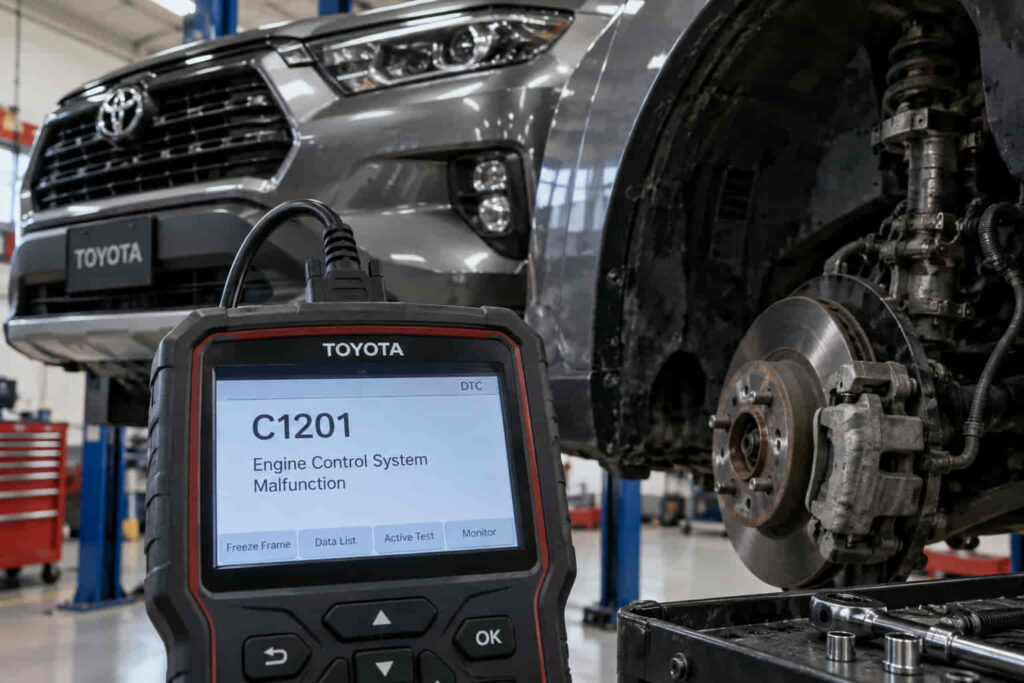
The Toyota C1201 code indicates that the vehicle’s skid control system has received information about a malfunction in the engine control system. C1201 does not, by itself, identify a specific failed component that should be replaced. On many Toyota applications, the code appears because the skid control ECU recognizes an engine-control problem and changes the operation of systems such as Vehicle Stability Control (VSC) and Traction Control (TRAC).
This relationship explains why C1201 may appear alongside the Check Engine, VSC, or TRAC warning lights. It also means that replacing an ABS or stability-control component simply because a scanner displays C1201 can lead to an incorrect repair. The other diagnostic trouble codes stored in the vehicle are critical because they can identify the engine, electrical, sensor, or control-system fault that triggered the condition associated with C1201.
Diagnosing Toyota C1201 therefore starts with scanning all relevant control modules and identifying accompanying trouble codes before clearing anything. This guide explains what C1201 means, what can cause it, which symptoms can occur, how to diagnose the underlying fault, and how to fix the problem correctly rather than simply erasing the code.
What Does the C1201 Code Mean on a Toyota?
The Toyota C1201 code means the skid control ECU has detected information indicating a malfunction in the engine control system. The code is associated with the relationship between engine control and Toyota’s vehicle stability functions rather than automatically identifying a defective ABS, VSC, or TRAC component. When an engine-control fault affects information used by these systems, the skid control ECU can store C1201 and alter stability or traction-control operation.
This distinction matters because C1201 is not sufficient evidence that one specific component has failed. A diagnostic trouble code identifies a detected condition within a defined system context; it does not automatically prove which sensor, actuator, wiring circuit, or control module caused that condition. For C1201, the diagnostic context includes communication between the engine control system and the skid control system. The underlying malfunction can therefore be represented by another DTC stored at the same time.
This is also why C1201 can appear together with the Check Engine, VSC, or TRAC warning lights. Toyota’s stability and traction functions depend on information from multiple vehicle systems to determine when intervention is required. When a relevant engine-control malfunction is detected, the vehicle can restrict or disable related stability functions and illuminate their warning indicators. The driver may consequently see several warning lights even though the original problem began within one system.
C1201 should therefore be interpreted together with every other stored and pending DTC. If a scan returns C1201 plus an engine-related code, the accompanying code can provide more specific information about the malfunction that needs diagnosis. Clearing C1201 alone removes the stored code from memory but does not repair the condition that caused the control system to record it.
What Causes the C1201 Code on a Toyota?
Toyota C1201 is commonly triggered when the skid control ECU receives information that an engine-control malfunction has been detected. The practical cause of the C1201 condition must therefore be determined by examining the accompanying diagnostic codes and the system in which the original fault occurred. Treating C1201 itself as the root cause can send the diagnostic process toward the wrong component.
An engine-management malfunction is an important diagnostic path because the engine control module monitors systems that influence engine operation and communicates relevant status information to other vehicle controllers. When the ECM detects a fault and stores its own DTC, the stability-control system can respond to that engine fault by recording C1201. In this situation, C1201 is part of the vehicle’s response to the original malfunction rather than proof of a second independent mechanical failure.
Electrical faults also need to be considered when the accompanying codes or vehicle-specific diagnostic procedure point in that direction. Wiring damage, poor electrical connections, abnormal supply voltage, or communication problems can interfere with the signals exchanged between control systems. The correct test depends on the additional DTCs and the Toyota model being diagnosed, so electrical components should be tested before they are condemned and replaced.
The accompanying DTCs provide the most useful path to the actual cause. For example, if C1201 appears with another code that identifies a specific engine-control circuit or monitored condition, diagnosis should move toward that code and its prescribed tests. The technician can then inspect the relevant circuit, connector, sensor, actuator, or operating condition instead of assuming that the skid control ECU is defective.
For this reason, there is no single replacement part that fixes every Toyota with C1201. The same C1201 code can exist in different diagnostic contexts depending on the vehicle, model year, powertrain, and other stored codes. The correct repair is the repair that eliminates the verified underlying malfunction. After that fault is corrected, the codes can be cleared and the vehicle rechecked to confirm that C1201 does not return.
Read more: Toyota P2238
What Symptoms Can Appear With Toyota Code C1201?
The most noticeable symptoms associated with Toyota C1201 are warning lights for the Check Engine, VSC, or TRAC systems, while the actual driving symptoms depend on the underlying fault that triggered the code. C1201 does not represent one specific mechanical failure, so two Toyota vehicles storing the same code do not necessarily behave in the same way. One vehicle may appear to drive normally with warning lights illuminated, while another may have engine-performance symptoms caused by an accompanying engine-control fault.
The VSC or TRAC warning light can appear because these systems depend on information shared between multiple control modules. Vehicle Stability Control is designed to help manage vehicle stability, while Traction Control manages wheel traction under relevant driving conditions. When the skid control ECU receives information indicating an engine-control malfunction, operation of these functions can be restricted and their warning indicators can illuminate. The warning lights therefore provide information about system status; they do not prove that the VSC or TRAC hardware itself has failed.
A Check Engine light is especially important when C1201 is accompanied by an engine-related DTC. The engine control module monitors numerous operating conditions and records diagnostic codes when a monitored condition falls outside its expected parameters. If one of those faults causes the skid control system to store C1201, the engine DTC provides a more specific diagnostic direction than C1201 alone. Engine symptoms such as abnormal running should consequently be evaluated in relation to those additional codes rather than attributed directly to C1201.
The absence of obvious driving symptoms does not make the code irrelevant. A Toyota can store C1201 and illuminate warning indicators while continuing to start, accelerate, brake, and steer without an immediately noticeable change. The driver should still have the vehicle scanned because a warning-light combination indicates that one or more control systems have detected a condition requiring diagnosis. The scanner data is more useful than the number of illuminated warning lights for determining where that diagnosis should begin.
What Other Trouble Codes Should You Check When C1201 Appears?
Check every stored and pending diagnostic trouble code when Toyota C1201 appears because an accompanying DTC can identify the system responsible for the underlying malfunction. C1201 should not be isolated from the rest of the scan results. Reading only this code removes diagnostic context and increases the risk of repairing a system that is responding to another fault rather than causing it.
The diagnostic relationship can be understood as C1201, accompanying DTC, affected system, and verified root cause. C1201 establishes that the skid control system has recognized a relevant fault condition, while another code may narrow the problem to a specific engine-control function, electrical circuit, sensor signal, actuator, or monitored operating condition. Diagnosis then follows the more specific code using the appropriate Toyota procedure and physical tests.
Stored and pending codes should both be recorded before anything is erased. A stored code confirms that the control module has recorded a qualifying fault, while pending information can reveal a condition that has been detected but may not yet have satisfied all criteria required for a confirmed code. Freeze-frame and other available scan data can also preserve useful operating conditions from the time a fault was detected. Clearing the vehicle before recording this information can remove evidence that helps reproduce and identify an intermittent problem.
The order of diagnosis also matters when several codes appear simultaneously. A technician should determine how the codes relate to one another rather than replacing one component for every code displayed by the scanner. A single underlying malfunction can influence more than one control system and produce multiple diagnostic entries. Repairing the verified primary fault can therefore resolve the conditions responsible for additional codes without separate component replacement.
Specific accompanying codes should only be interpreted according to the Toyota model, model year, engine, and applicable diagnostic information. A code combination observed on one Toyota should not automatically be treated as having the same root cause on every Toyota vehicle. The strongest diagnostic evidence comes from the complete scan result combined with vehicle-specific testing, not from C1201 alone.
How Do You Diagnose Toyota Code C1201?
Diagnosing Toyota C1201 starts by scanning all relevant control modules and recording the complete set of stored and pending trouble codes before clearing any data. C1201 alone does not identify a component that should be replaced, so the first objective is to determine whether another DTC provides a more specific path to the underlying malfunction. The scan should preserve the diagnostic context that existed when the vehicle detected the problem.
The accompanying codes should then be evaluated according to the system they represent and their relationship to C1201. When an engine-control DTC is present, diagnosis should focus on the condition identified by that code rather than assuming that the skid control system itself has failed. This creates a logical diagnostic sequence: identify the relevant DTC, determine the affected system, perform the required tests, and verify the actual fault before replacing a component.
Available scan data can provide additional evidence. Freeze-frame information can show operating conditions recorded around the time a fault was detected, while live data can be used to evaluate relevant signals during diagnosis when supported by the scan tool and vehicle. This information becomes particularly useful when the fault is intermittent because the vehicle may operate normally when it reaches the workshop even though a malfunction was detected earlier.
Physical inspection should follow the evidence provided by the DTCs. If the diagnostic path points toward an electrical circuit, the relevant wiring, connectors, power supply, ground, and component signals should be tested as required rather than visually inspected and assumed to be good. A damaged wire, poor connection, abnormal voltage, or component fault can only be confirmed when the applicable test demonstrates that the circuit or component is operating outside specification.
Vehicle-specific information is essential before making a final diagnosis. Toyota uses different engines, control modules, electrical layouts, and system configurations across models and model years. The diagnostic procedure for a particular code combination can therefore require tests that do not apply to another vehicle carrying the same C1201 code. The vehicle identification, model year, engine configuration, accompanying codes, and applicable Toyota diagnostic procedure should all be established before a repair decision is made.
A successful C1201 diagnosis ends with a verified root cause, not simply with a cleared warning light. If testing identifies the fault responsible for the accompanying DTC and establishes its relationship to the C1201 condition, the technician has evidence for the next repair step. If testing does not establish that relationship, further diagnosis is required before parts are replaced.
How Do You Fix the C1201 Code on a Toyota?
Fixing Toyota C1201 requires repairing the verified underlying malfunction, clearing the diagnostic codes, and checking whether the fault returns. There is no universal C1201 replacement part because the code does not by itself prove that a particular sensor, control module, wiring harness, or mechanical component has failed. The repair must correspond to the root cause established during diagnosis.
When C1201 appears with a more specific engine-control DTC, the condition represented by that accompanying code should be diagnosed and repaired according to the applicable procedure. If testing confirms an electrical problem, the repair should address the verified circuit defect. If testing confirms that a monitored component is defective, that component can be repaired or replaced as appropriate. This evidence-based approach prevents the common mistake of replacing ABS, VSC, or other control-system parts solely because C1201 is present.
Parts should not be replaced on the basis of a trouble-code description alone. A scanner reports what a control module detected; it does not physically inspect the component named in a diagnostic path. The same abnormal signal can originate from the component itself, its wiring, a connector, its electrical supply, or another condition that changes the monitored value. Testing separates these possibilities and prevents an unnecessary replacement from leaving the original fault unresolved.
Clearing the codes is appropriate after the verified repair has been completed. Erasing C1201 before repairing the underlying malfunction only removes stored diagnostic information and can temporarily turn off warning indicators. Once the control modules monitor the same condition again, C1201 or its accompanying codes can return if the original fault remains.
The final step is repair verification. The vehicle should be re-scanned after the repair and operated under the conditions required to determine whether the relevant fault is detected again. Warning-light status, returning DTCs, and applicable scan data provide evidence of whether the repair resolved the problem. A repair is confirmed when the underlying malfunction no longer meets the conditions that caused the relevant codes to be stored, rather than simply because C1201 disappeared immediately after the scanner cleared it.
This distinction between clearing and repairing is central to troubleshooting C1201. Clearing a code changes stored diagnostic information; repairing the vehicle changes the condition that caused the diagnostic information to exist. The objective is therefore not merely to make C1201 disappear from the scanner, but to identify and correct the fault that caused Toyota’s control systems to record it.
Can You Drive a Toyota With the C1201 Code?
Whether you can continue driving a Toyota with C1201 depends on the underlying fault and the warning lights or symptoms that appear with the code. C1201 alone does not describe the mechanical condition of the vehicle well enough to determine that it is safe to drive. The accompanying DTCs, warning indicators, and changes in vehicle operation provide more useful evidence for making that decision.
A Toyota may continue to start and drive normally while C1201, the Check Engine light, and a VSC or TRAC warning are present. Normal engine operation does not mean that every related control function is available, however. The stability or traction-control system can change its operation when another control system reports a relevant malfunction. A driver should therefore not assume that normal acceleration, steering, and braking automatically mean the condition can be ignored.
Driving becomes a greater concern when C1201 appears with significant engine-performance problems, abnormal braking behavior, multiple critical warning indicators, or another symptom that affects vehicle control. In that situation, the decision should be based on the actual malfunction rather than C1201 itself. Continuing to drive without identifying the root cause can allow an existing problem to remain active and can make diagnosis more difficult if additional symptoms develop.
The safest diagnostic approach is to scan the vehicle before deciding how serious C1201 is. Reading all stored and pending DTCs establishes whether the code is associated with an engine-control problem or another condition requiring more immediate attention. C1201 is therefore not a reliable standalone measure of driving safety; the complete fault condition determines whether the vehicle should continue to be driven.
How Much Does It Cost to Fix Toyota Code C1201?
The cost to fix Toyota C1201 depends on the underlying malfunction because C1201 does not identify one universal repair or replacement part. A fixed “C1201 repair cost” can therefore be misleading. The total expense consists of the cost of diagnosing the actual fault and the cost of repairing the component, circuit, or condition confirmed during that diagnosis.
A relatively simple electrical problem and a confirmed component failure can produce very different repair bills even when C1201 appears in both cases. For example, repairing a poor electrical connection involves different parts and labor from replacing a component that has failed an electrical or functional test. The same principle applies when an accompanying engine DTC identifies a separate malfunction that must be corrected before the C1201 condition is resolved.
Diagnostic time also affects the final cost. A fault that is consistently present can be easier to reproduce and test than an intermittent problem that appears only under particular operating conditions. Intermittent wiring, connection, voltage, or signal problems may require additional testing because the vehicle can operate normally while being inspected. Accurate diagnosis can add labor time, but it reduces the risk of spending money on parts that do not correct the fault.
The most useful repair estimate is therefore one produced after the complete DTC set has been scanned and the underlying problem has been identified. An estimate based only on the presence of C1201 lacks the information required to determine which repair is necessary. Diagnosis should establish the cause first; parts and labor costs can then be calculated for that specific repair.
Can You Clear or Reset Toyota Code C1201?
Toyota C1201 can be cleared from diagnostic memory with an appropriate scan tool, but clearing the code does not repair the malfunction that caused it. If the underlying fault remains present, the relevant control module can detect the condition again and C1201 or its accompanying DTCs can return.
Codes should normally be recorded before they are cleared. Stored and pending DTCs, together with available diagnostic data, provide context for determining what happened when the vehicle detected the malfunction. Erasing this information at the beginning of diagnosis can remove useful evidence, particularly when the problem is intermittent and cannot immediately be reproduced.
Resetting the code is most useful after the underlying fault has been diagnosed and repaired. The codes can then be cleared so the vehicle’s control systems can monitor the relevant conditions again. A subsequent scan can establish whether C1201 remains absent or returns after the system completes the applicable monitoring process.
Disconnecting electrical power or using another method solely to make a warning light disappear should not be treated as a repair. Removing a stored code and eliminating the condition that generated it are two different outcomes. The correct objective is to eliminate the verified root cause and then use code clearing as part of the repair-verification process.
Why Does Toyota C1201 Come Back After You Clear It?
Toyota C1201 comes back after being cleared when the control system detects the fault condition again. Clearing diagnostic memory removes the recorded code, but it does not permanently prevent the ECU from monitoring the system. Once the conditions required for fault detection occur again, the module can record C1201 and illuminate the associated warning indicators.
A code that returns quickly can indicate that the underlying malfunction is still active or is reproduced soon after the vehicle begins operating. A code that returns only after extended driving can point toward an intermittent condition or a fault that requires specific operating conditions before the monitoring logic detects it. The timing of recurrence therefore provides diagnostic information rather than simply showing that the reset “did not work.”
Repeatedly clearing C1201 without recording and diagnosing the accompanying codes can make troubleshooting less efficient. Each reset can remove information about the conditions under which the fault occurred, while the physical or electrical problem remains unchanged. The better approach is to capture the complete DTC set, diagnose the underlying condition, perform the verified repair, and then clear the codes once as part of confirmation.
C1201 should remain absent after repair when the condition responsible for triggering it has been eliminated and the applicable systems operate without detecting the same fault again. If it returns, diagnosis should resume using the returning codes and current scan data rather than assuming that another reset will solve the problem.
Which Toyota Models Can Have the C1201 Code?
The C1201 code can appear on Toyota vehicles equipped with control systems that use this diagnostic code, but its diagnostic context must be verified for the specific model, model year, engine, and system configuration. Finding C1201 on a Toyota does not mean that every vehicle carrying the code has the same underlying malfunction or requires the same repair. The code must be interpreted together with the vehicle identification and the other DTCs stored at the same time.
Toyota vehicles such as the Camry, Corolla, RAV4, Prius, and 4Runner are commonly searched in connection with C1201, but the model name alone is not enough to diagnose the problem. Different generations of the same Toyota model can use different engines, control modules, electrical configurations, and stability-control strategies. A diagnostic procedure that applies to one model year should therefore not automatically be transferred to another vehicle simply because both display C1201.
The same principle applies when C1201 appears with other diagnostic trouble codes. A Toyota Camry with C1201 and an accompanying engine-control DTC should be diagnosed according to the code combination and applicable information for that Camry. A Toyota RAV4 displaying C1201 with a different set of codes can require a different diagnostic path. In both cases, C1201 provides context about the control-system response, while the complete scan and vehicle-specific information provide the evidence needed to locate the underlying fault.
Model-specific diagnosis becomes particularly important when testing wiring, connectors, sensors, control modules, power supplies, or communication circuits. Connector locations, terminal assignments, expected values, and diagnostic procedures can change between vehicles and production years. Tests should therefore be matched to the exact Toyota being repaired rather than copied from another model that happens to store the same diagnostic code.
This also explains why searching only for “Toyota C1201” is useful for understanding the code but insufficient for confirming a repair. Adding the Toyota model, model year, engine configuration, and accompanying DTCs creates a much more precise diagnostic context. For example, identifying a vehicle as a specific model and year with C1201 plus another stored code provides substantially more diagnostic information than C1201 alone.
The correct interpretation of Toyota C1201 is therefore vehicle-specific even though the general diagnostic principle remains consistent: read the complete code set, identify the underlying malfunction, follow the applicable diagnostic procedure, repair the verified cause, clear the codes, and confirm that the fault does not return.