Choosing the right Nissan CVT Fluid NS-2 equivalent requires more than finding a product labeled as CVT fluid. Nissan designed NS-2 for specific continuously variable transmissions. Therefore, drivers should choose a replacement that explicitly supports Nissan NS-2 applications. Several aftermarket manufacturers offer compatible CVT fluids for these transmissions.
A compatible fluid does not need to copy the exact formula of genuine Nissan NS-2. Instead, it must provide the performance that the CVT requires. These requirements include proper friction control, lubrication, hydraulic operation, and heat protection. The wrong fluid can change how the transmission operates and may increase component wear. Always check the product application guide and your vehicle’s required fluid specification before filling the transmission.
This guide identifies compatible replacements for Nissan NS-2 and explains how to verify them. It also compares NS-2 with NS-3 and identifies Nissan applications that require NS-2. You will also learn whether universal CVT fluid can replace NS-2 and what happens when you use an incompatible fluid. Finally, the guide explains how to select and replace CVT fluid correctly.
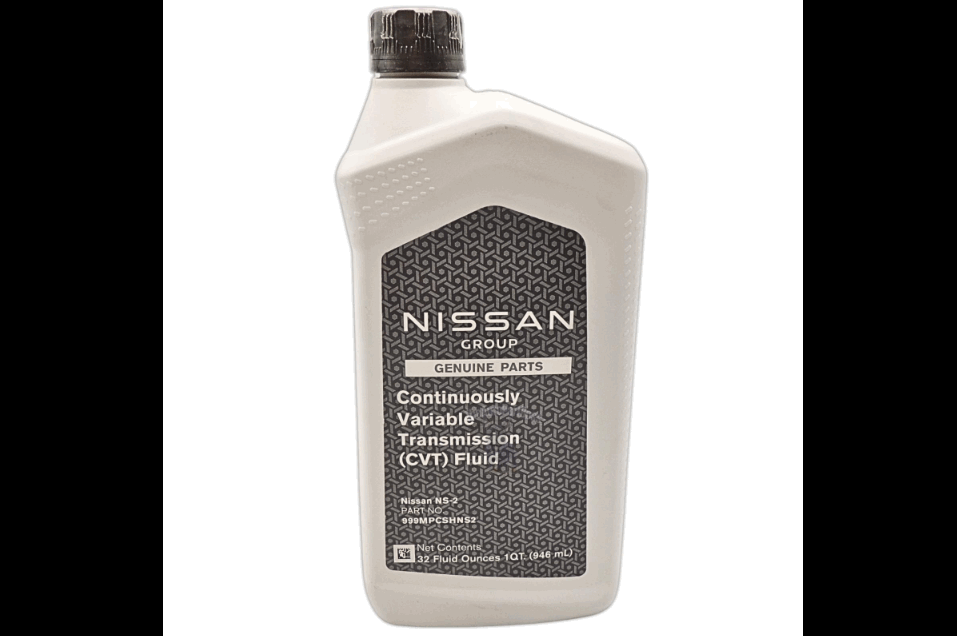
What Is Equivalent to Nissan CVT Fluid NS-2?
A Nissan CVT Fluid NS-2 equivalent is a CVT fluid that supports Nissan NS-2 applications and meets the transmission’s required performance characteristics. The safest replacement comes from a manufacturer that explicitly lists Nissan NS-2 in its application guide or technical documentation. A general CVT label alone does not confirm compatibility.
Several fluid manufacturers produce multi vehicle CVT fluids for Nissan NS-2 applications. However, compatibility matters more than brand name or product color. The fluid must provide the friction control, hydraulic performance, lubrication, and heat protection that the CVT requires. These properties affect how the transmission transfers power and controls its internal components.
Drivers should also distinguish an equivalent fluid from an identical fluid. An aftermarket product may support NS-2 applications without using the same formulation as genuine Nissan fluid. Manufacturers often design one CVT fluid for several transmission specifications. They then list the applications that their product supports.
Check the product data sheet before choosing any alternative. Look for Nissan NS-2 in the specification or application information. Then confirm that your vehicle and transmission require NS-2. This process provides stronger evidence of compatibility than retailer descriptions or generic claims such as “universal CVT fluid.”
What Is Nissan CVT Fluid NS-2?
Nissan CVT Fluid NS-2 is a transmission fluid specification used for specific Nissan continuously variable transmissions. Nissan developed the fluid requirements around the operating needs of compatible CVTs. These transmissions rely on fluid for more than basic lubrication. The fluid also supports hydraulic control, friction management, cooling, and component protection.
A CVT operates differently from a conventional automatic transmission. Its internal components require controlled friction to transfer power smoothly. The fluid must protect moving surfaces while maintaining the friction behavior required by the transmission. Heat control also matters because transmission operation creates thermal stress. A suitable fluid carries heat away from critical components and helps maintain stable operation.
NS-2 also has a direct relationship with specific Nissan and JATCO CVT applications. This relationship makes the transmission application important when selecting replacement fluid. Vehicle name alone does not always provide enough information. Model year, engine, drivetrain, market, and transmission type can affect the required fluid specification.
For this reason, drivers should identify the required specification before buying CVT fluid. They should then select genuine NS-2 or a product that explicitly supports the application. This approach reduces uncertainty and prevents assumptions based only on viscosity, fluid color, or the words “CVT fluid” on the bottle.
Which CVT Fluids Are Compatible With Nissan NS-2?
Several aftermarket CVT fluids support Nissan NS-2 applications when their manufacturers explicitly list NS-2 compatibility. These products give drivers alternatives to genuine Nissan CVT Fluid NS-2. However, drivers should verify each product before using it in a specific transmission.
Multi vehicle CVT fluids represent one common replacement category. Manufacturers formulate these products for several CVT applications instead of one vehicle brand. A suitable product should list Nissan NS-2 in its application guide or technical data. This statement provides stronger evidence than a generic claim that the product works with Nissan vehicles.
Compatibility also depends on the transmission application. Two Nissan vehicles can require different CVT fluids even when they share a similar model name. Model year, transmission design, engine, drivetrain, and market can affect the required specification. For this reason, drivers should not select fluid from the vehicle brand alone.
The best replacement is a fluid that matches both requirements. First, the vehicle or transmission must specify Nissan NS-2. Second, the replacement fluid manufacturer must support that NS-2 application. Genuine Nissan NS-2 remains the direct OEM option. Aftermarket fluids provide alternatives when their technical documentation confirms the required application. This method helps drivers choose a compatible fluid without assuming that every CVT product can replace NS-2.
How Can You Verify a Nissan NS-2 Equivalent Fluid?
You can verify a Nissan NS-2 equivalent by checking the vehicle specification and the fluid manufacturer’s application information. Start with the owner’s manual or Nissan service information. Confirm that the exact vehicle and transmission require NS-2 before comparing replacement products.
Next, check the fluid manufacturer’s product data sheet or application guide. Search for Nissan NS-2 among the listed applications. Do not rely only on the front label of the bottle. Terms such as “CVT fluid” or “multi vehicle” describe a broad product category. They do not confirm support for every CVT design.
Pay attention to how the manufacturer describes compatibility. A company may state that its fluid is suitable for applications that require NS-2. Another manufacturer may provide a vehicle specific application list. Use the manufacturer’s exact statement rather than assuming that every compatibility claim represents an OEM approval.
Finally, match the fluid information with the exact vehicle application. Check the model year, engine, drivetrain, and transmission when these details affect fluid selection. This verification process connects the vehicle requirement with the replacement product. It also reduces the risk of choosing fluid based on viscosity, color, price, or retailer descriptions instead of documented compatibility.
What Is the Difference Between Nissan NS-2 and NS-3 CVT Fluid?
Nissan NS-2 and NS-3 are different CVT fluid specifications for different transmission applications. Nissan introduced each specification around the requirements of compatible CVTs. Therefore, drivers should not treat NS-3 as an automatic replacement for NS-2 simply because NS-3 is newer.
The correct fluid depends on the transmission that Nissan installed in the vehicle. Different CVT designs can require specific friction, lubrication, and hydraulic performance. These requirements influence how the fluid supports pressure control and power transfer. They also affect component protection during normal transmission operation.
Drivers should follow the fluid specification assigned to their exact transmission. Use NS-3 instead of NS-2 only when Nissan documentation supports that substitution for the application. The same rule applies when replacing NS-3 with NS-2. A newer specification does not automatically establish backward compatibility.
Mixing NS-2 and NS-3 also requires caution. Adding one specification to a transmission that contains another can change the fluid mixture. The final properties depend on both products and their proportions. For a routine service, identify the required specification before adding fluid. If the transmission already contains an unknown product, confirm the appropriate service procedure before changing or topping up the fluid. This approach protects the CVT from an unsupported fluid combination.
Which Nissan Vehicles Use NS-2 CVT Fluid?
Specific Nissan vehicles equipped with compatible CVTs use Nissan NS-2 fluid, but the requirement depends on the exact transmission and application. Drivers should not assume that every model within one Nissan nameplate uses the same CVT fluid. Nissan can change transmissions and fluid requirements between model years.
Model year provides an important starting point. Engine choice and drivetrain can also affect the installed transmission. Regional versions of the same vehicle may use different equipment. These variations make a broad model list less reliable than vehicle specific documentation.
Check the owner’s manual first to determine the required CVT fluid. Nissan service information can provide additional transmission specific details. Drivers can also identify the transmission and compare it with a reputable fluid manufacturer’s application guide. These sources provide a stronger basis for fluid selection than a retailer’s general vehicle lookup.
The verification process should connect three pieces of information. Identify the exact Nissan vehicle first. Confirm its transmission and required fluid specification next. Then select genuine NS-2 or an aftermarket fluid that explicitly supports that application. This method prevents a common mistake: choosing NS-2 because another model year or version of the same Nissan model uses it.
Can You Use Universal CVT Fluid Instead of Nissan NS-2?
You can use a multi vehicle CVT fluid instead of Nissan NS-2 when the fluid manufacturer explicitly supports the required NS-2 application. The word “universal” alone does not prove compatibility. Drivers should verify the product specifications before adding the fluid to a Nissan CVT.
Multi vehicle CVT fluids serve several transmission applications with one formulation. Manufacturers test and recommend these products for specific vehicle or fluid requirements. A product may support Nissan NS-2 alongside other CVT fluid applications. This broad coverage makes aftermarket fluid convenient, but it does not make every CVT fluid suitable for every transmission.
Check the manufacturer’s application guide or technical data before choosing a universal product. Look for a clear reference to Nissan NS-2. Then compare that information with the fluid requirement for your exact vehicle and transmission. This two step check provides a stronger basis for selecting a replacement.
A compatible multi vehicle fluid also does not become identical to genuine Nissan NS-2. The products can use different formulations while serving the same application. Focus on documented compatibility rather than bottle color, price, brand popularity, or marketing terms. Choose another product when the manufacturer does not support NS-2 for your application.
What Happens If You Use the Wrong CVT Fluid Instead of NS-2?
Using an incompatible fluid can change CVT operation because the transmission depends on specific friction, lubrication, and hydraulic characteristics. The wrong product may alter how internal components transfer power or respond to hydraulic control. Continued operation with unsuitable fluid can also reduce component protection.
Incorrect friction behavior can affect smooth power transfer inside the CVT. A driver may notice changes in transmission response or abnormal operation. Poor lubrication can also increase contact stress between moving components. In addition, unsuitable fluid performance can reduce the transmission’s ability to manage heat under demanding conditions.
However, one symptom does not prove that the wrong CVT fluid caused the problem. Shuddering, unusual noise, delayed response, or abnormal operation can have several causes. Mechanical wear, fluid level problems, and other transmission faults can produce similar symptoms. Diagnosis should consider the vehicle’s service history and transmission condition.
Check the fluid specification promptly when symptoms begin after a CVT service. Confirm which product entered the transmission and compare it with the required specification. Correcting a fluid problem early reduces the time that the CVT operates with an unsupported product. A technician should inspect the transmission when abnormal operation continues after the fluid issue has been addressed.
How Do You Replace Nissan NS-2 CVT Fluid Correctly?
To replace Nissan NS-2 CVT fluid correctly, first confirm the required fluid specification and the service procedure for your transmission. Nissan CVTs do not all use the same fluid quantity or service method. The exact transmission therefore determines how you should perform the fluid change.
Start by confirming that the vehicle requires NS-2. Check the owner’s manual or appropriate Nissan service information. Next, choose genuine Nissan NS-2 or a compatible fluid that explicitly supports the NS-2 application. Do not select a replacement based only on viscosity, color, price, or a general CVT label.
The required fluid quantity also depends on the service method. A routine drain and refill removes only part of the fluid inside many transmissions. The total transmission capacity can include fluid that remains in internal components. For this reason, total capacity does not always equal the amount needed during routine service.
Follow the correct filling and fluid level procedure for the specific CVT. Some transmission procedures also require technicians to check fluid under defined operating conditions. After completing the service, inspect for leaks and evaluate transmission operation. Recheck the service details when the CVT behaves differently after a fluid change.
How Often Should Nissan NS-2 CVT Fluid Be Changed?
The correct Nissan NS-2 CVT fluid change interval depends on the vehicle, transmission, maintenance schedule, and operating conditions. A single mileage figure does not apply to every Nissan that uses NS-2. Drivers should follow the maintenance information for their exact vehicle.
Operating conditions can affect transmission fluid service requirements. Frequent heavy use places different demands on a CVT than moderate highway driving. Vehicle age, mileage, service history, and previous transmission maintenance also provide useful context when planning fluid service.
Check the Nissan maintenance schedule that applies to the vehicle’s model year and market. Pay attention to any separate requirements for demanding operating conditions. Use transmission specific service information when the maintenance schedule calls for inspection or replacement.
Do not choose a change interval only because another Nissan owner follows it. Two vehicles can have different CVTs, maintenance requirements, and operating histories. Instead, connect the service interval to the exact vehicle and transmission. Regular verification also helps drivers avoid extending fluid use based on an unsupported universal interval. When the vehicle’s service history remains unknown, identify the required NS-2 specification and review the appropriate maintenance information before deciding on the next service.
Which Nissan NS-2 Equivalent Should You Choose?
Choose a Nissan NS-2 equivalent that explicitly supports the NS-2 application required by your vehicle and transmission. Genuine Nissan CVT Fluid NS-2 provides the direct OEM option. An aftermarket CVT fluid can provide an alternative when its manufacturer clearly lists Nissan NS-2 in its application or technical information.
Confirm the vehicle requirement before comparing products. Check the model year, transmission, and specified CVT fluid in the appropriate Nissan documentation. Then compare that requirement with the fluid manufacturer’s application guide. This process helps you avoid choosing a product based only on price, viscosity, fluid color, or a universal CVT label.
Do not assume that NS-3 automatically replaces NS-2 because it carries a newer designation. Apply the same caution to multi vehicle CVT fluids. A broad application range only matters when the manufacturer includes the required NS-2 application.
The best choice connects two verified facts. Your Nissan CVT requires NS-2, and the selected fluid supports that requirement. Once you confirm both points, follow the correct fluid change procedure and service information for your transmission. This approach provides a clear basis for choosing replacement fluid while reducing the risk of an incompatible CVT fluid.