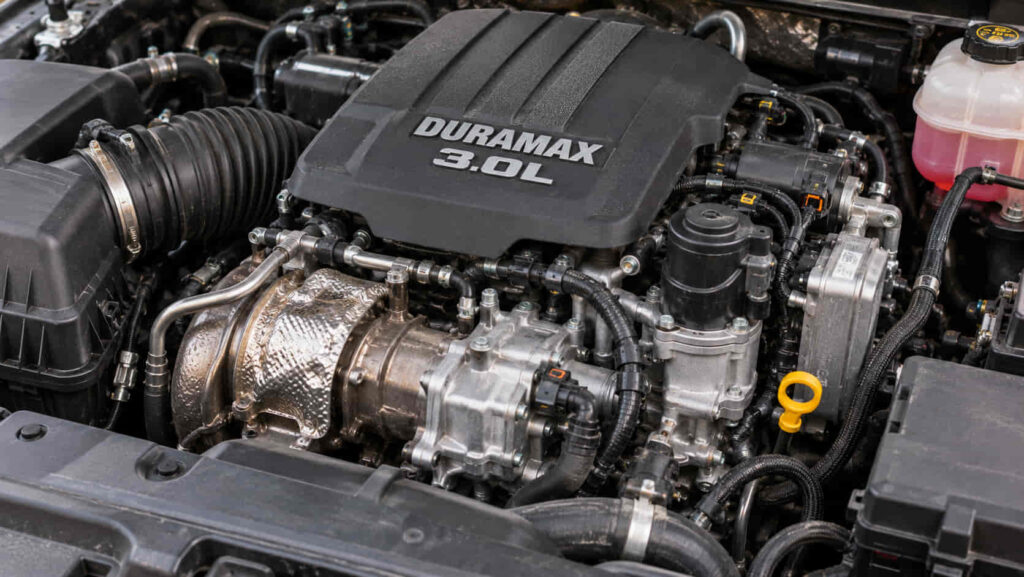
The most important 3.0 Duramax problems include coolant control valve failures, rear engine oil leaks, extended cranking, costly oil pump belt maintenance, diesel emissions system faults, and crankshaft thrust bearing concerns in certain newer LZ0 engines. However, these issues do not affect every model year or engine configuration equally.
The 3.0L Duramax is a turbocharged inline-six diesel engine developed by General Motors for light-duty pickup trucks and full-size SUVs. Unlike the larger 6.6L Duramax V8, this engine emphasizes fuel efficiency, smooth power delivery, and substantial low-RPM torque.
The first-generation LM2 Duramax was introduced in the Chevrolet Silverado 1500 and GMC Sierra 1500 for the 2020 model year. It produces 277 horsepower and 460 lb-ft of torque.
The second-generation LZ0 arrived in the Silverado and Sierra for the 2023 model year. GM increased output to 305 horsepower and 495 lb-ft of torque while updating the pistons, fuel injectors, and turbocharger.
Although both engines share a 3.0-liter inline-six layout, their maintenance requirements and reliability concerns are not identical.
One of the most important updates for owners is GM’s coolant control valve special coverage, introduced in September 2025. Eligible LM2 and certain 2023 LZ0 vehicles receive extended coverage for the specified coolant control valve condition for 15 years or 150,000 miles, whichever occurs first.
A newer issue involves the LZ0 crankshaft thrust bearing.
GM Service Bulletin 25-NA-307 addresses certain 2025–2026 vehicles experiencing unusual noise around the transmission bellhousing, sometimes accompanied by diagnostic trouble code P06DD.
An October 13, 2026 revision identified a specific vehicle manufacturing window from May 1 through September 1, 2025, for that bulletin.
However, a technical service bulletin does not establish that every engine within its scope will experience a failure.
The 3.0 Duramax also has an unusual maintenance feature: a rear-mounted oil pump drive belt. Its scheduled replacement interval is 150,000 miles for the LM2 and 200,000 miles for the LZ0.
This guide examines seven major 3.0 Duramax problems and maintenance concerns, explains their symptoms and causes, compares LM2 and LZ0 reliability, and provides practical guidance on engine lifespan, repair costs, recalls, and used-truck inspections.
What Are the Most Common 3.0 Duramax Problems?
The most significant 3.0 Duramax concerns involve the cooling system, engine oil sealing, starting and camshaft-position detection, emissions aftertreatment, and certain generation-specific internal components.
However, the distinction between documented failures and normal maintenance is important.
A coolant control valve that stops functioning is a mechanical or electrical fault.
A rear main seal that moves out of position is another documented failure condition.
A damaged camshaft position sensor trigger wheel can cause extended cranking or a no-start condition.
By contrast, replacing the rear-mounted oil pump belt at its scheduled interval is routine maintenance rather than evidence that the engine is defective.
The LZ0 crankshaft thrust bearing concern is different again.
It involves a potentially serious internal engine condition identified in a specific GM service bulletin.
Emissions-related problems may also cause warning messages or reduced performance.
However, a diesel particulate filter regeneration event is a normal operating function, not automatically a failure.
The correct diagnosis depends on the engine code, vehicle production date, stored trouble codes, and actual symptoms.
1. 3.0 Duramax Coolant Control Valve Failure
Coolant control valve failure is one of the best-documented 3.0 Duramax problems, affecting certain LM2 and LZ0 applications and prompting GM to introduce extended warranty coverage.
The engine uses an electronically controlled coolant flow system to manage temperature.
Unlike a simple fixed cooling arrangement, the valve directs coolant through different passages according to operating requirements.
This helps the engine achieve suitable temperatures during warm-up and normal driving.
However, the valve assembly can malfunction.
Symptoms may include a check engine light, cooling-related diagnostic trouble codes, unusual engine warm-up behavior, or cooling fans operating after the ignition is switched off.
Some owners report poor cabin heating or longer-than-normal warm-up periods.
However, these symptoms can also have other causes.
GM Service Bulletin 25-NA-185 provides diagnostic and replacement guidance for the coolant control valve.
The bulletin has been revised to address relevant LM2 and LZ0 applications.
The repair procedure includes checking whether the engine control module has the appropriate calibration.
However, replacing the valve is not automatically required whenever a cooling system warning appears.
The technician must confirm the actual fault.
For eligible vehicles, GM’s special coverage programs may substantially reduce the owner’s repair expense.
3.0 Duramax Coolant Control Valve Warranty Extension
GM introduced special coverage for the 3.0 Duramax coolant control valve in September 2025, extending protection to 15 years or 150,000 miles for certain eligible vehicles.
The LM2 program is identified as N252508341.
It includes eligible 2021–2022 Chevrolet Silverado 1500 and GMC Sierra 1500 trucks.
It also covers specified 2021–2023 Chevrolet Tahoe, Suburban, GMC Yukon, and Cadillac Escalade applications.
A separate LZ0 program, N252508340, addresses eligible 2023 Silverado 1500 and Sierra 1500 vehicles.
However, the existence of a model in the bulletin does not mean that every VIN automatically qualifies.
GM requires dealers to verify eligibility through the vehicle’s warranty information.
The specified condition must also be confirmed.
For qualifying vehicles, the relevant coolant control valve repair can be completed without charge.
Owners who previously paid for certain eligible repairs may qualify for reimbursement under the program’s requirements.
This is an important financial consideration when buying a used 3.0 Duramax.
A vehicle with a documented coolant valve replacement may be more attractive than one with unresolved cooling system warnings.
However, buyers should check the current warranty status rather than assuming coverage applies.
2. 3.0 Duramax Rear Main Oil Seal Leaks
Certain early LM2 Duramax engines can experience oil leaks from the rear of the engine, including a condition involving the rear crankshaft oil seal and lower timing chain cover.
GM addressed this issue in Service Bulletin 22-NA-022.
The bulletin covers specified 2020–2022 vehicles equipped with the LM2 engine.
It identifies a condition in which the rear main oil seal can move out of position within the lower timing cover.
The result may be visible engine oil leakage.
Some affected engines also store diagnostic trouble code P06DD.
However, P06DD is not exclusive to this condition.
It can appear in other oil-pressure-control-related situations.
The correct diagnostic process must therefore establish the actual source of the problem.
For the specific condition addressed in the bulletin, GM instructs technicians to replace the lower timing chain cover assembly with a correctly installed seal.
The installation procedure requires particular care to prevent damaging or rolling the seal lip.
A poorly installed replacement seal can cause another leak.
Because the problem occurs at the rear of the engine, repair access may require substantial labor.
A used LM2 truck should be checked for oil accumulation around the engine-to-transmission interface.
However, oil visible in that area does not automatically prove that the rear main seal is defective.
The leak source must be confirmed.
Read more: C15 Cat Engine Specs
Other Common 3.0 Duramax Oil Leak Locations
Oil leaks on the LM2 and LZ0 can originate from several engine sealing locations, making accurate leak tracing important before replacing expensive components.
GM issued Bulletin 23-NA-011 to help technicians identify potential oil leak paths on the 3.0L Duramax.
The bulletin covers LM2 and LZ0 applications within its specified model-year range.
It includes illustrations identifying areas where oil may escape.
However, an engine can develop leakage for different reasons.
A sealing surface may become damaged.
A gasket may deteriorate.
An incorrectly installed component can also leak.
The location where oil drips onto the ground may not be the point where the leak originates.
Airflow and gravity can move oil across engine surfaces.
Therefore, the engine should be cleaned and inspected before a repair is authorized.
A small external leak also differs from a genuine low-oil-pressure condition.
Oil pressure must be checked separately when necessary.
An owner should monitor the dipstick and investigate unexplained oil loss.
A persistent leak should not be ignored simply because the engine continues running normally.
3. 3.0 Duramax Long Crank and No-Start Problems
Certain 2020–2021 LM2 Duramax engines can experience intermittent extended cranking or a crank/no-start condition associated with damage to the camshaft position sensor exciter wheel.
GM documented this condition in its May 2021 TechLink publication.
The issue can affect specified Silverado and Sierra trucks as well as relevant 2021 full-size SUVs.
The engine computer may store diagnostic trouble code P0341.
The camshaft position sensor provides information needed to determine camshaft position and support proper engine operation.
The exciter wheel, also called a trigger wheel, is part of that position-detection arrangement.
If the wheel becomes bent or damaged, the sensor may receive an abnormal signal.
This can interfere with starting.
GM’s technical guidance directs technicians to inspect the exciter wheel when the relevant symptoms are present.
However, not every long-cranking LM2 has a damaged wheel.
Other possible causes include fuel supply problems, electrical faults, insufficient cranking speed, or sensor-related issues.
A mechanic should therefore examine the stored codes and perform the appropriate diagnostic tests.
Replacing the camshaft position sensor without confirming the condition of the exciter wheel may not correct the underlying problem.
Does P0341 Mean the 3.0 Duramax Needs a New Engine?
No. Diagnostic trouble code P0341 does not automatically mean that the 3.0 Duramax engine requires replacement.
P0341 relates to camshaft position sensor performance.
The problem may involve the sensor, wiring, signal quality, or the component used to generate the camshaft-position signal.
GM’s LM2 guidance specifically identifies a possible damaged exciter wheel.
However, that is only one potential cause.
The technician must first identify the correct diagnostic condition.
If the wheel is damaged, the repair should address the affected component.
A complete engine replacement is not the automatic remedy for every P0341 complaint.
The engine’s mechanical condition should also be evaluated when necessary.
A truck that occasionally cranks longer than normal may have a relatively limited electrical or fuel system problem.
Another truck may have more substantial mechanical damage.
Therefore, the code must be interpreted alongside physical symptoms and diagnostic test results.
4. 3.0 Duramax Oil Pump Belt Maintenance Costs
The rear-mounted oil pump drive belt is one of the most important long-term maintenance considerations on the 3.0 Duramax, even though its scheduled replacement is not inherently an engine failure.
Both LM2 and LZ0 engines use a belt-driven oil pump arrangement.
The belt is positioned at the rear of the engine.
This differs from conventional front-mounted accessory belts.
It also creates additional labor requirements when the belt needs to be serviced.
GM originally specified a 150,000-mile replacement interval for the LM2.
For the revised LZ0 engine, the manufacturer extended the interval to 200,000 miles.
GM’s official LZ0 product information confirms that the oil pump belt was validated for the longer service interval.
The manufacturer’s 2025 diesel supplement specifies replacement at 200,000 miles or 15 years, whichever occurs first.
This is an important improvement for long-term ownership.
However, the belt is still a scheduled maintenance item.
Its replacement can require removing the transmission to access the rear engine assembly.
Therefore, the labor cost is greater than a conventional accessory belt change.
Owners should budget for this service rather than viewing the interval as a guarantee that the belt will never fail.
The correct replacement schedule should always match the engine code and vehicle manual.
Is the 3.0 Duramax Oil Pump Belt a Wet Belt?
Yes. The 3.0 Duramax oil pump drive belt operates inside the engine’s oil environment rather than functioning as an ordinary external accessory belt.
This design is often described as a wet belt.
A wet belt must be compatible with the lubricant and operating conditions inside the engine.
The belt drives the oil pump.
The oil pump supplies lubricant to critical components, including engine bearings and the turbocharger.
Therefore, the oil pump system is essential for normal engine operation.
However, the wet belt should not be confused with the engine’s main camshaft timing system.
The 3.0 Duramax uses timing chains for camshaft timing.
The rear oil pump belt has a different function.
If the oil pump drive system fails, the engine may lose lubrication.
This can cause serious mechanical damage.
However, scheduled replacement is intended to reduce the risk of service-related deterioration.
GM’s longer LZ0 service interval reflects additional durability validation.
It does not mean that belt service can be ignored indefinitely.
The correct oil specification and maintenance schedule are also important.
5. 3.0 Duramax DPF, DEF and EGR Problems
DPF regeneration complaints, DEF warnings, nitrogen oxide sensor faults, and EGR-related issues can increase 3.0 Duramax ownership costs, but they should be distinguished from mechanical engine failure.
The LM2 and LZ0 use modern diesel emissions systems.
These include exhaust gas recirculation and exhaust aftertreatment components.
The DPF captures particulate matter produced during diesel combustion.
Regeneration is used to reduce accumulated soot.
The SCR system uses diesel exhaust fluid to reduce nitrogen oxide emissions.
Sensors monitor exhaust conditions and system performance.
However, these components can experience faults.
A sensor may provide inaccurate information.
A fluid delivery problem may affect SCR operation.
An EGR valve may become restricted or fail to operate correctly.
However, a warning message does not identify the exact component that needs replacement.
The owner should have the relevant trouble codes diagnosed.
A malfunctioning emissions system may cause reduced power or vehicle-speed limitations.
However, removing or disabling the equipment is not an appropriate road-use repair.
The correct approach is to restore the system’s intended function.
Why Does the 3.0 Duramax Regenerate So Often?
Frequent DPF regeneration on a 3.0 Duramax may be related to operating conditions, excessive soot generation, interrupted cleaning cycles, or a fault in the exhaust aftertreatment system.
GM’s diesel supplement explains that DPF regeneration occurs automatically under appropriate conditions.
The engine control system monitors factors relevant to soot accumulation.
However, repeated short trips and extended idling can interfere with the process.
The exhaust system may not reach the temperatures needed to complete cleaning efficiently.
Consequently, the vehicle may request additional regeneration.
However, frequent regeneration can also indicate a mechanical or sensor problem.
A fuel injection fault may increase soot production.
An intake or boost-system problem can affect combustion efficiency.
A pressure sensor fault may also create inaccurate loading information.
The correct diagnosis should review operating conditions and scan-tool data.
A short drive does not automatically correct a heavily restricted DPF.
Likewise, an engine that regularly completes regeneration does not necessarily have a defective aftertreatment system.
The owner should follow the vehicle’s exact messages and manufacturer’s operating instructions.
What Does P2463 Mean on a 3.0 Duramax?
P2463 indicates a diesel particulate filter soot accumulation condition, but the code alone does not prove that the DPF must be replaced.
The engine management system monitors exhaust aftertreatment performance.
When soot loading exceeds an applicable threshold, the system may store P2463.
However, the cause must be investigated.
The filter may contain excessive soot after repeated interrupted regeneration events.
The engine may also be producing more soot than expected.
A sensor problem can affect the calculated loading.
In December 2025, GM issued Engineering Information PIE0883 regarding P2463 concerns in certain 2026 LZ0 applications.
The purpose of that document was to gather engineering information.
It should not be confused with a blanket recall or a repair instruction requiring every vehicle to receive a new DPF.
A qualified diesel technician should diagnose the fault using the applicable GM service procedures.
Replacing expensive aftertreatment parts without identifying the underlying cause can result in repeated problems.
6. LZ0 Crankshaft Thrust Bearing Problems in 2025–2026
A particularly important newer 3.0 Duramax concern involves excessive crankshaft end play in certain 2025–2026 LZ0 vehicles, which GM addressed through Service Bulletin 25-NA-307.
The crankshaft thrust bearing controls the crankshaft’s movement along its axis.
A small amount of movement is normal.
However, excessive movement can indicate bearing damage or another internal problem.
GM’s bulletin addresses symptoms that may include abnormal mechanical noise from the transmission bellhousing area.
An affected vehicle may also have a check engine light.
Relevant diagnostic codes can include P06DD and P06DA-92.
However, neither code independently proves that the thrust bearing has failed.
The technician must measure actual crankshaft end play.
The published LZ0 reference range is approximately 0.0033–0.0124 inch, equivalent to 0.084–0.316 mm.
A measurement outside the approved range requires further evaluation.
In the revised October 2026 bulletin, GM identified a vehicle production window from May 1 through September 1, 2025.
This applies to the bulletin’s specified vehicles and circumstances.
However, the manufacturing window does not mean every engine built during those dates will fail.
It also does not establish a statistically verified failure rate.
A buyer considering a 2025 or 2026 LZ0 should ask whether the vehicle falls within the relevant service bulletin scope.
Latest 2026 Update: GM Bulletin 25-NA-307
The October 13, 2026 revision of GM Bulletin 25-NA-307 provides more specific guidance for evaluating certain LZ0 crankshaft thrust bearing concerns.
The revised bulletin identifies the May 1 through September 1, 2025 vehicle build-date range.
It also states that the specified bulletin procedure applies to vehicles with no more than 20,000 miles.
However, the mileage condition is a limitation of the bulletin’s diagnostic scope.
It does not prove that mechanical failures cannot occur beyond that mileage.
The diagnostic process involves measuring crankshaft end play.
If excessive movement is confirmed within the bulletin’s applicable conditions, the published repair guidance calls for replacement of the complete engine assembly.
The procedure also identifies replacement of the turbocharger and associated oil feed pipe.
This makes the condition more serious than an ordinary external oil leak or sensor fault.
However, the available technical information does not establish how common the failure is across the entire LZ0 population.
A technician should not conclude that the crankshaft is defective merely because a truck was manufactured during the identified period.
The actual symptoms, stored codes, and measured end play determine whether the condition exists.
7. 3.0 Duramax Turbocharger, Boost and Misfire Problems
Loss of power, abnormal boost response, hesitation, and misfires can occur on LM2 or LZ0 engines, but the root cause may involve fuel delivery, electronic control, air leaks, or other components rather than the turbocharger itself.
The 3.0 Duramax uses turbocharging to produce substantial torque from a relatively small displacement.
The turbocharger increases intake airflow.
The fuel injection system then supplies diesel according to engine demand.
However, the systems must operate together correctly.
A charge-air leak can reduce boost pressure.
A sensor fault may affect engine management.
Restricted fuel delivery can also create weak acceleration.
The turbocharger itself may develop a mechanical or actuator-related problem.
However, replacing the turbocharger without confirming the fault can be expensive.
GM has also investigated certain LZ0 misfire or shudder complaints.
Preliminary information bulletin PIP6091 addresses a passing-maneuver concern in specified 2024–2026 LZ0 applications.
However, that bulletin is an engineering investigation rather than proof of one universal mechanical defect.
The symptoms must be diagnosed using the relevant service information.
A driver should record when the problem occurs and whether it is associated with a downshift, acceleration, or warning message.
3.0 Duramax Transmission Recall 24V-797
Certain GM diesel trucks and SUVs were included in NHTSA safety recall 24V-797 because a transmission control valve failure could result in rear-wheel lockup.
This is a vehicle drivetrain concern rather than a mechanical defect inside the 3.0 Duramax engine.
The recall includes specified 2020–2022 Chevrolet Silverado and GMC Sierra models.
Certain 2021 Tahoe, Suburban, Yukon, and Cadillac Escalade vehicles are also listed.
However, the recall population includes some heavy-duty diesel vehicles with different engines.
It should not be presented as a recall affecting only the 3.0-liter Duramax.
The documented concern involves the transmission control valve.
If the component fails under the specified conditions, the rear wheels may lock.
This can increase the risk of a crash.
The prescribed initial remedy involves updated transmission control module software.
GM also provided special coverage for certain transmissions identified by the remedy software as having the relevant defective valve condition.
Owners should verify the recall status using the vehicle VIN.
A recall may already have been completed.
However, a seller’s statement is not a substitute for official verification.
The transmission should also be evaluated during a pre-purchase road test.
LM2 vs LZ0: Which 3.0 Duramax Is More Reliable?
The LZ0 includes several engineering improvements over the LM2, but its longer oil pump belt service interval and higher power output do not automatically establish that every LZ0 is more reliable.
The LM2 is the original 3.0-liter inline-six Duramax.
It produces 277 horsepower and 460 lb-ft of torque.
The LZ0 is the revised engine.
It produces 305 horsepower and 495 lb-ft.
GM changed the piston design and material.
The LZ0 uses steel pistons intended to support its revised combustion requirements.
The fuel injectors were also updated.
A revised turbocharger helps increase torque.
Another important change involves the oil pump belt service interval.
GM increased it from 150,000 miles to 200,000 miles.
These are meaningful technical improvements.
However, both engines have documented service concerns.
The LM2 is associated with certain rear oil seal and camshaft exciter wheel problems.
Both generations have coolant control valve service information.
The newer LZ0 also has the specific 2025–2026 crankshaft thrust bearing bulletin.
Therefore, model-year selection should not be based only on the newer engine designation.
The best engine is the one with verified mechanical condition and a strong maintenance history.
What Years Have the Most 3.0 Duramax Problems?
There is no sufficiently comprehensive public failure-rate dataset establishing one universally worst 3.0 Duramax model year, but several production periods require specific inspections.
The 2020–2021 LM2 deserves attention for the camshaft exciter wheel condition documented by GM.
Early LM2 applications also have service information covering rear crankshaft oil seal leakage.
The 2021–2023 period is especially relevant to coolant control valve service programs.
However, eligibility depends on model and VIN.
The 2023 LZ0 introduced the revised engine architecture.
It also has a dedicated coolant valve special coverage program for certain pickups.
The 2025–2026 LZ0 deserves additional consideration because of the thrust bearing concerns described in Bulletin 25-NA-307.
The latest relevant production window is May 1 through September 1, 2025.
However, a service bulletin does not mean every engine within its scope is defective.
Likewise, the absence of a particular bulletin does not guarantee a failure-free engine.
The appropriate decision should be based on the actual condition, manufacturing information, and repair history.
Is the 2020 3.0 Duramax Reliable?
The 2020 LM2 Duramax can be a dependable engine, but buyers should investigate its service history and early-production issues before purchasing a used truck.
The 2020 Silverado and Sierra introduced the LM2 into the light-duty pickup market.
Its 277-horsepower output provided substantial performance for the engine’s displacement.
The engine was paired with a 10-speed automatic transmission.
However, early production introduced technical concerns that later appeared in service bulletins.
These include certain oil leaks and camshaft position sensor exciter wheel problems.
A buyer should request documentation of previous repairs.
A cold-start test is also useful.
The engine should crank and start normally.
Oil leakage should be checked.
The coolant control system and emissions equipment should also be evaluated.
However, a properly maintained 2020 engine should not automatically be rejected because it belongs to the first model year.
Its actual mechanical condition is more important.
Is the 2023 3.0 Duramax Better Than the 2022?
The 2023 Silverado and Sierra 3.0 Duramax generally offer improved factory engine specifications because they introduced the LZ0 in place of the earlier LM2.
The LZ0 produces more horsepower and torque.
GM also revised the pistons, injectors, and turbocharger.
The oil pump belt interval increased to 200,000 miles.
These changes improve the engine’s published performance and long-term maintenance schedule.
However, the 2023 engine still requires modern diesel emissions equipment.
It also retains an electronically controlled cooling system.
Certain 2023 LZ0 pickups qualify for GM’s coolant control valve special coverage.
Therefore, the newer engine does not eliminate every potential maintenance concern.
When comparing a 2022 LM2 with a 2023 LZ0, the vehicle’s maintenance history should receive substantial weight.
A well-serviced 2022 truck may be preferable to a neglected 2023 model.
The appropriate comparison also includes mileage, warranty status, transmission condition, and overall vehicle value.
Is the 2025–2026 LZ0 Duramax Reliable?
The 2025–2026 LZ0 Duramax offers strong factory performance, but the revised crankshaft thrust bearing bulletin makes production-date verification particularly important.
The engine delivers 305 horsepower and 495 lb-ft of torque.
It also benefits from the LZ0’s updated internal components.
However, GM issued Bulletin 25-NA-307 after receiving complaints involving abnormal bellhousing-area noise and oil-pressure-related codes.
The October 2026 revision identifies a more specific production window.
This makes the bulletin an important part of a pre-purchase inspection.
However, a vehicle that falls within the date range is not automatically defective.
The bulletin requires specific symptoms and diagnostic findings.
The buyer should ask whether the dealer has evaluated the vehicle under the latest service information.
An engine with abnormal mechanical knocking should not simply be driven until the sound becomes worse.
Prompt inspection is essential.
For a newer vehicle still under applicable warranty, an authorized GM dealer is the appropriate starting point.
How Long Does the 3.0 Duramax Last?
A properly maintained 3.0 Duramax may provide 200,000 miles or more of service, but there is no manufacturer-guaranteed mileage lifespan applicable to every LM2 and LZ0.
GM has validated specific components for defined service intervals.
For example, the LZ0 oil pump belt has a published 200,000-mile replacement interval.
However, that does not mean every other engine component is guaranteed to last 200,000 miles.
A fuel injector can require repair earlier.
A coolant control valve may fail independently of normal internal engine wear.
An emissions sensor may also require replacement.
A vehicle can therefore accumulate substantial mileage while still needing repairs.
The engine’s actual lifespan depends on lubrication, cooling, operating loads, fuel quality, and maintenance.
A truck used for frequent heavy towing may experience different mechanical stress from one used primarily for highway driving.
Long-term reliability should be assessed using oil pressure, engine noise, coolant condition, starting performance, and maintenance records.
The commonly discussed 200,000–300,000-mile range should be treated as a possible ownership target rather than a verified average or guarantee.
What Oil Does the 3.0 Duramax Use?
GM specifies SAE 0W-20 engine oil meeting the dexosD specification for the 2025 3.0L Duramax diesel engine.
The official owner supplement identifies both the viscosity and the required lubricant approval.
An oil container displaying 0W-20 is not automatically suitable.
The product must also meet the manufacturer’s diesel oil specification.
This is important because the engine uses modern emissions equipment and precision lubrication components.
The turbocharger depends on a reliable oil supply.
The crankshaft bearings and valvetrain also require correct lubrication.
The rear oil pump belt is another reason to follow the specified lubricant requirements.
However, owners should not assume that a thicker oil provides additional protection.
Using an unapproved viscosity may affect engine operation and warranty coverage.
The correct oil filter must also be used.
GM advises against unnecessary oil additives and engine flushing treatments in the documented service instructions.
The exact manual for the vehicle’s model year should determine the final lubricant selection.
How Much Oil Does the 3.0 Duramax Take?
The 2025 GM 3.0 Duramax diesel has an engine oil capacity of approximately 7.0 US quarts, equivalent to 6.6 liters, including the filter.
This figure comes directly from GM’s 2025 diesel owner supplement.
However, the capacity should always be checked against the relevant model-year manual.
The engine must be filled to the correct operating level.
Overfilling can create problems.
Underfilling can compromise lubrication.
The oil should be checked using the manufacturer’s specified procedure.
GM recommends checking the oil level regularly, particularly before long trips.
The engine should be parked on level ground.
Sufficient time must be allowed for oil to drain back into the sump.
An accurate level reading helps identify leaks or abnormal oil consumption.
For an engine with a suspected rear main seal problem, monitoring oil level is particularly important.
However, a low dipstick reading does not identify the source of the oil loss.
The actual cause must be diagnosed.
How Often Should You Change 3.0 Duramax Oil?
GM recommends following the Engine Oil Life System and replacing engine oil and filter at least once annually for the relevant 3.0 Duramax applications.
The system estimates oil life according to operating conditions.
When the vehicle displays a change-oil message, service should be completed within the manufacturer’s specified period.
However, the Oil Life System does not directly measure every form of oil contamination.
The engine’s operating environment still matters.
Frequent towing, dusty conditions, and extended idling may influence maintenance needs.
The owner should also monitor oil level between changes.
A vehicle with an external leak can develop insufficient oil before its next scheduled service.
The fuel filter has a separate maintenance requirement.
GM’s 2025 diesel supplement specifies replacement every 30,000 miles or two years, or when the vehicle indicates the need for service, whichever occurs first.
Severe operating conditions can require earlier replacement.
The correct service schedule should be obtained from the actual vehicle’s manual.
Are 3.0 Duramax Repairs Expensive?
Some 3.0 Duramax repairs can be expensive because the engine uses modern diesel emissions systems, precision fuel injection, electronic cooling controls, and rear-mounted components that require additional labor to access.
Routine oil and filter service is relatively straightforward.
However, major mechanical repairs can involve substantial labor.
The rear-mounted oil pump belt is an important example.
Replacement requires access to components at the back of the engine.
This can involve transmission removal.
The belt itself is not necessarily the most expensive part of the repair.
Labor often represents a substantial share of the total cost.
A coolant control valve repair is a different situation.
Eligible vehicles may qualify for extended GM special coverage.
A rear main seal problem can also require significant disassembly.
Crankshaft thrust bearing damage may be more serious.
The 2026 revision of GM’s relevant bulletin describes complete engine replacement when the specified excessive end play condition is confirmed.
However, repair costs vary by region, labor rate, vehicle model, warranty status, and actual damage.
An itemized diagnosis is more useful than one generic repair-cost estimate for every 3.0 Duramax.
What Should You Check Before Buying a Used 3.0 Duramax?
A used 3.0 Duramax should be inspected for coolant control valve history, rear oil leaks, abnormal starting behavior, emissions warnings, engine noise, and outstanding VIN-specific recalls.
The first step is identifying whether the truck has an LM2 or LZ0 engine.
The model year and engine RPO code should be confirmed.
Maintenance records should then be reviewed.
A genuine cold-start inspection is valuable.
Extended cranking may indicate a fuel, electrical, or camshaft position signal problem.
The engine should start and idle normally.
The oil level should be checked.
The rear engine area should be inspected for leakage.
The cooling system should also be evaluated.
A check engine light or cooling fan operating unexpectedly after shutdown may justify additional coolant valve diagnosis.
For newer LZ0 vehicles, the manufacturing date should be checked against the latest thrust bearing bulletin.
Transmission recall status is another important consideration.
The buyer should request an authorized dealer VIN check.
A professional diesel inspection can help identify problems before purchase.
How to Prevent Common 3.0 Duramax Problems
The best way to reduce avoidable 3.0 Duramax problems is to maintain the correct engine oil, replace fuel filters on schedule, monitor coolant and oil levels, and respond promptly to warning messages.
The lubrication system deserves particular attention.
Use the manufacturer-approved oil.
Maintain the proper oil level.
Replace the filter at the appropriate interval.
The rear-mounted oil pump belt should also be replaced according to the correct LM2 or LZ0 maintenance schedule.
However, routine maintenance cannot prevent every possible component defect.
A coolant control valve may still fail.
A manufacturing-related mechanical problem may also occur even when the engine has been maintained correctly.
The owner should therefore distinguish preventive maintenance from warranty-related repairs.
Cooling system problems should be diagnosed promptly.
Repeated overheating can damage engine components.
The emissions system must also be maintained.
An unresolved DPF or DEF warning should not be ignored.
Fuel quality is another important factor.
Use the diesel fuel specified by GM.
A complete maintenance history can help identify developing problems and support warranty discussions when appropriate.
Is the 3.0 Duramax Better Than the 6.6 Duramax?
The 3.0 Duramax and 6.6 Duramax serve different vehicle classes and workloads, so the better engine depends on towing requirements, operating costs, and intended use.
The 3.0-liter LM2 and LZ0 are inline-six engines designed for light-duty trucks and certain full-size SUVs.
They emphasize fuel efficiency and useful low-speed torque.
The larger 6.6L L5P Duramax is a V8 designed for heavy-duty Silverado and Sierra applications.
It produces substantially more torque.
However, the engine and transmission are installed in heavier truck platforms.
For an owner who regularly tows large trailers, the heavy-duty configuration may provide greater capability.
For daily commuting, highway driving, and moderate towing, the 3.0 Duramax may be more appropriate.
Reliability cannot be compared solely by engine displacement.
Both engine families have their own maintenance requirements and service histories.
The vehicle’s actual towing rating, payload, transmission, and chassis must also be considered.
Is the 3.0 Duramax Worth Buying in 2026?
The 3.0 Duramax remains worth considering in 2026, especially for drivers who want strong diesel torque and good highway efficiency without purchasing a heavy-duty pickup.
The LM2 and LZ0 provide different ownership considerations.
The LM2 has a longer operating history.
Its known service concerns include specific oil leaks, camshaft exciter wheel problems, and coolant control valve faults.
The LZ0 offers higher factory performance and a longer oil pump belt service interval.
However, its reliability record includes coolant valve concerns and the more recent crankshaft thrust bearing bulletin.
Therefore, a newer engine is not automatically a safer purchase.
The correct choice depends on production date, warranty status, mileage, maintenance records, and mechanical condition.
A 2023 LZ0 with documented maintenance and completed repairs may be attractive.
A 2020 LM2 with a healthy fuel system and no unresolved oil leaks can also be a sensible option.
For certain 2025–2026 LZ0 vehicles, the latest GM bulletin deserves particular attention.
The vehicle should be inspected before purchase if it exhibits the relevant warning signs.
Final Verdict: Are 3.0 Duramax Problems Serious?
The 3.0 Duramax is a capable and potentially durable diesel engine, but several documented issues can lead to expensive repairs if they are not diagnosed correctly.
The most important early LM2 problems include certain rear main oil seal leaks and camshaft position sensor exciter wheel damage.
Coolant control valve failure is another major concern.
GM introduced special coverage programs for eligible LM2 and 2023 LZ0 applications in September 2025.
These programs provide up to 15 years or 150,000 miles of coverage for the specified condition.
The rear-mounted oil pump belt is also an important maintenance consideration.
Its service interval is 150,000 miles for the LM2 and 200,000 miles for the LZ0.
However, scheduled belt replacement is not the same as a documented premature engine failure.
Diesel emissions components can also require attention.
DPF, EGR, DEF, and related sensor problems may affect drivability and increase ownership costs.
For newer LZ0 engines, the crankshaft thrust bearing bulletin is especially important.
The October 2026 revision of GM Bulletin 25-NA-307 identified a manufacturing window from May 1 through September 1, 2025, for certain vehicles experiencing the specified symptoms.
However, the bulletin does not prove that every engine manufactured during that period will fail.
The 2020–2022 transmission recall is another important item to check, although it concerns drivetrain components rather than the diesel engine itself.
For buyers researching 3.0 Duramax problems, the strongest recommendation is to identify the engine code, verify the vehicle’s production date and VIN-specific coverage, review maintenance records, and investigate any coolant warning, oil leak, unusual knocking, or extended cranking before purchase.
A mechanically healthy 3.0 Duramax can provide excellent everyday performance and substantial service life, but its long-term reliability depends on correct maintenance, timely repairs, and careful evaluation of the engine’s known service concerns.