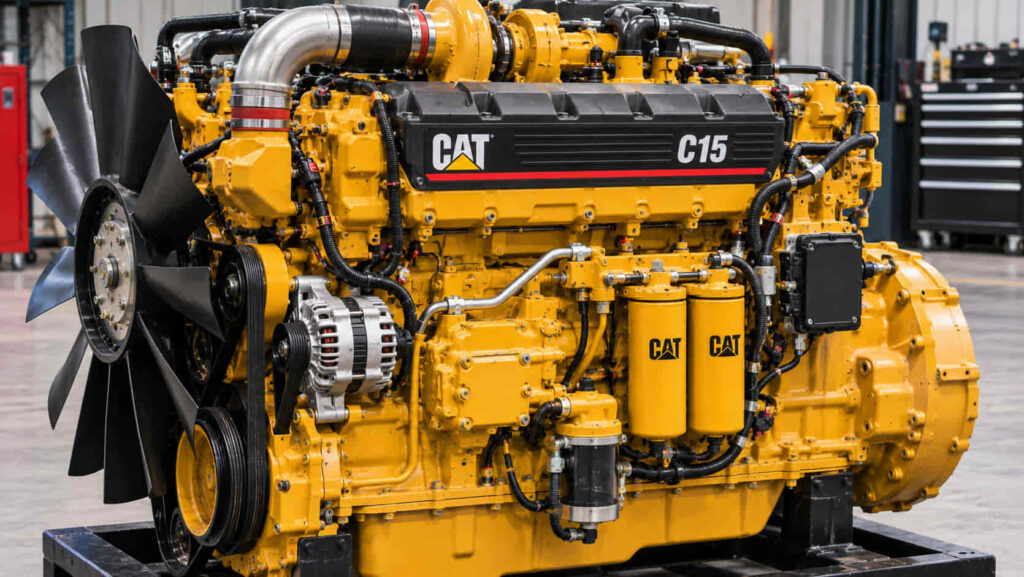
The Caterpillar C15 is a 15.2-liter (927.6-cubic-inch), inline-six diesel engine with a 5.4-inch bore, approximately 6.75-inch stroke, and firing order of 1-5-3-6-2-4. It is designed for heavy-duty trucks, construction equipment, industrial machinery, generator sets, and specialized oilfield applications.
The C15 engine family is known for its high torque output, durable construction, and extensive service support. Depending on the application, factory configurations offer substantially different horsepower and torque ratings.
Caterpillar’s historical on-highway engine documentation identifies C-15 and C15 ACERT truck engines rated from approximately 435 to 625 horsepower. Modern industrial versions provide additional choices, including a Tier 4 Final C15 rated at 475–580 horsepower and up to 1,958 lb-ft of torque at 1,400 RPM.
However, C15 Cat engine specs are not identical across the entire engine family.
Early C-15 truck engines, including the well-known 6NZ configuration, use different turbocharging and emissions equipment from later C15 ACERT engines.
The 2003-era BXS and later MXS and NXS configurations introduced additional ACERT technology. The SDP generation incorporated more advanced exhaust emissions-control equipment for the relevant on-highway applications.
Modern industrial engines have their own specifications, including different compression ratios, aftertreatment systems, and installed weights.
For example, Caterpillar identifies a 17.0:1 compression ratio for its current Tier 4 Final industrial C15 and 18.0:1 for a different industrial configuration.
The same distinction applies to engine weight. Depending on configuration, Caterpillar publishes dry weights ranging from approximately 2,743 pounds for selected oilfield engines to 3,673 pounds for a modern Tier 4 Final industrial engine.
Oil capacity is another important specification.
Caterpillar’s 2005 on-highway operation and maintenance manual identifies approximately 38 liters, or 40 US quarts, for the documented C15 with its standard oil filtration arrangement.
However, auxiliary oil filtration equipment can increase the refill requirement.
This guide explains Caterpillar C15 horsepower, torque, displacement, bore and stroke, compression ratio, fuel injection, firing order, valve lash, oil capacity, engine weight, maintenance intervals, common problems, and reliability.
What Is the Caterpillar C15 Engine?
The Caterpillar C15 is a four-stroke, turbocharged inline-six diesel engine developed for demanding applications requiring substantial torque, dependable operation, and long service life.
The engine belongs to Caterpillar’s heavy-duty diesel family.
It evolved from the company’s established 3406 engine architecture.
However, the C15 should not be described as identical to the earlier 3406E.
The C15 has a larger nominal displacement because of its longer piston stroke.
Its approximately 15.2-liter displacement provides a foundation for high torque output.
The engine uses a cast-iron cylinder block and a heavy-duty crankshaft arrangement.
It also incorporates electronically controlled fuel injection.
Unlike many other electronically controlled diesel engines, traditional C15 configurations use mechanically actuated electronic unit injectors rather than a conventional high-pressure common-rail fuel system.
The C15 was widely used in North American heavy trucks.
It also remains relevant in industrial power applications.
However, the correct engine specifications depend on the actual production generation and Caterpillar arrangement number.
Caterpillar C15 Engine Displacement
The Caterpillar C15 has a displacement of 15.2 liters, equivalent to approximately 927.6 cubic inches.
This displacement is one of the defining specifications of the engine family.
It is produced by the combined swept volume of six cylinders.
The engine uses an inline-six layout.
All six cylinders are arranged in a single bank.
This differs from a V8 engine, where the cylinders are divided into two banks.
The inline-six configuration provides a naturally balanced mechanical arrangement.
However, displacement alone does not determine horsepower.
A 15.2-liter C15 industrial engine may have a different rated output from a C15 ACERT used in a highway truck.
Turbocharging, fuel calibration, operating speed, and emissions equipment all influence performance.
The engine’s displacement also should not be confused with its lubrication capacity.
Although the engine displaces 15.2 liters, many truck configurations require approximately 38 liters of engine oil.
The correct specifications must be considered independently.
CAT C15 Bore and Stroke Specifications
The Caterpillar C15 has a cylinder bore of approximately 5.4 inches (137.2 mm) and a piston stroke of approximately 6.75 inches (171.5 mm).
Caterpillar’s current industrial documentation commonly rounds these measurements to 137 mm and 171 mm.
The bore represents the nominal diameter of each cylinder.
The stroke measures the distance the piston travels between top dead center and bottom dead center.
Because the stroke is longer than the bore, the C15 is an undersquare engine.
This design supports substantial displacement and torque at relatively modest operating speeds.
However, stroke length alone does not determine torque.
Fuel injection, turbocharger performance, combustion pressure, and engine calibration are also important.
The bore specification matters during rebuilding.
Cylinder liners must be measured and inspected.
Pistons and rings must match the applicable dimensions.
The exact wear tolerances depend on the engine serial number and Caterpillar service specifications.
Rounded catalog measurements should not be used as machining tolerances.
CAT C15 Horsepower Specifications
Caterpillar C15 horsepower varies considerably, with historical truck engines commonly rated between 435 and 625 horsepower and current industrial configurations available at approximately 440–595 horsepower.
The exact range depends on the engine generation.
Caterpillar’s 2024 remanufactured-engine catalog identifies the early 6NZ C-15 with factory ratings of 435–550 horsepower.
The MBN generation is identified with ratings of approximately 435–525 horsepower.
The early BXS C15 ACERT also appears with ratings of 435–550 horsepower.
Later MXS and NXS ACERT configurations include higher-output versions rated at 600–625 horsepower.
However, these figures are associated with specific truck applications.
They should not be used as universal ratings for all C15 engines.
Current industrial configurations have different power ranges.
For example, Caterpillar’s Tier 4 Final C15 is offered at 475–580 horsepower.
Another industrial configuration is available at 440–595 horsepower.
The engine’s operating duty and rated speed must also be considered.
An engine intended for continuous industrial operation may use a different rating from an over-the-road truck engine.
CAT C15 Engine Torque Specs
The Caterpillar C15 is known for high torque output, but peak torque depends on engine calibration and application rather than displacement alone.
Historical on-highway configurations were offered with substantial torque ratings suitable for heavy commercial trucks.
Depending on the exact truck-engine rating, published specifications can fall in the approximate range of 1,550–2,050 lb-ft.
However, this is a broad historical reference rather than the factory rating of every C15.
Caterpillar’s modern Tier 4 Final industrial C15 provides a more specific example.
The manufacturer identifies a maximum torque of 1,958 lb-ft, equivalent to approximately 2,655 Nm, at 1,400 RPM.
A different industrial C15 configuration produces up to 2,004 lb-ft at 1,400 RPM.
The distinction matters.
These figures represent different factory configurations.
They should not be combined into one universal engine specification.
Torque is particularly important for equipment operating under heavy load.
An engine’s complete torque curve is also more useful than its peak number alone.
The correct performance sheet should be used when selecting a transmission or determining an industrial equipment’s power requirements.
Caterpillar C15 Rated RPM
Caterpillar C15 rated engine speed depends on application, with many modern industrial versions rated between 1,800 and 2,100 RPM.
The rated speed is the engine speed associated with its published factory power rating.
However, it is not necessarily the same as the engine’s absolute maximum permitted speed.
An engine can produce maximum torque at a lower RPM than its horsepower rating.
For example, Caterpillar identifies maximum torque at 1,400 RPM for certain industrial C15 configurations.
However, their rated power occurs at higher operating speeds.
This difference is important when evaluating equipment performance.
A generator may operate at a relatively constant governed speed.
A highway truck requires a broader range of operating conditions.
A construction machine may experience frequent changes in load.
The correct governor calibration helps maintain the intended engine behavior.
The maximum permitted engine speed should be confirmed using the actual engine arrangement and service information.
Operating outside the specified limits can increase mechanical stress and reduce durability.
Caterpillar C15 Compression Ratio
The C15 compression ratio varies by configuration, with Caterpillar identifying 17.0:1 for its Tier 4 Final industrial engine and 18.0:1 for another industrial version.
Compression ratio describes the relationship between cylinder volume at bottom dead center and top dead center.
A diesel engine relies on compression to increase air temperature before fuel injection.
However, compression ratio does not independently determine power.
The combustion chamber design, fuel system, turbocharger, and engine calibration also matter.
Caterpillar’s published industrial specifications demonstrate that different C15 versions can use different ratios.
The Tier 4 Final industrial C15 has a documented 17.0:1 ratio.
The Tier 3-equivalent industrial configuration is listed at 18.0:1.
A Caterpillar C15 ACERT generator specification provides another example, identifying a 16.1:1 ratio for the documented generating-set arrangement.
These figures should not be applied interchangeably.
Piston and combustion chamber components can differ.
During rebuilding, the correct piston configuration must match the engine’s original arrangement or an approved replacement specification.
CAT C15 Engine Block and Cylinder Head
The Caterpillar C15 uses a heavy-duty cast-iron engine block and a six-cylinder inline arrangement designed to withstand substantial combustion loads.
The block supports the crankshaft, cylinder liners, and other internal components.
A single cylinder head serves the inline-six layout.
The engine also uses a heavy-duty lubrication system.
Its internal design allows the engine to operate under demanding load conditions when maintained correctly.
However, the C15’s durability depends on more than block construction.
Correct liner installation and cylinder head sealing are essential.
Cooling system condition is equally important.
An overheating engine can damage its cylinder head gasket or other internal components.
Improper lubrication may affect crankshaft bearings and camshaft components.
The C15’s large displacement and heavy-duty structure provide a strong mechanical foundation, but operating conditions ultimately determine component wear.
During an overhaul, the block must be inspected for cracks, liner seating problems, and bearing-related damage.
The exact procedures depend on the engine serial number.
Caterpillar C15 Firing Order
The Caterpillar C15 firing order is 1-5-3-6-2-4.
This firing order is used in the relevant Caterpillar C15 service information.
It identifies the sequence in which combustion occurs across the six cylinders.
Cylinder number one is located at the front of the engine.
The remaining cylinders are numbered toward the rear.
However, firing order should not be confused with valve adjustment order.
Valve lash procedures require the engine to be positioned at specific crankshaft locations.
The correct cylinder groups can then be inspected.
The C15 uses electronically controlled diesel injection.
It does not have a gasoline ignition distributor or spark plugs.
Instead, the injectors deliver diesel fuel according to the engine’s electronic control strategy.
The mechanical timing system must remain synchronized.
An incorrect camshaft or injector adjustment can cause serious operating problems.
For service work, the firing order should always be used together with the relevant Caterpillar adjustment procedure.
Caterpillar C15 Valve Lash Specifications
A commonly documented C15 valve lash specification is 0.015 inch (0.38 mm) for the intake valves and 0.032 inch (0.81 mm) for the exhaust valves.
These values appear in Caterpillar C15 and C18 service procedures.
However, some earlier C-15 and related service information identifies 0.030 inch for the exhaust valves.
Therefore, the correct clearance must be verified by engine generation and serial number.
Valve lash is the clearance between the rocker arm and valve bridge when the valve is closed.
The engine must be stopped during inspection.
The valves must also be positioned correctly.
Excessive clearance may cause abnormal valvetrain noise.
Insufficient clearance can interfere with proper valve seating.
The C15’s valve adjustment procedure commonly involves placing cylinder number one at top center on its compression stroke.
Selected intake and exhaust valves can then be adjusted.
The crankshaft is subsequently rotated to position the remaining cylinders.
However, the exact procedure should follow the applicable Caterpillar service manual.
Injector and engine-brake adjustments may also be required during overhead service.
Caterpillar C15 Fuel Injection System
The Caterpillar C15 uses mechanically actuated, electronically controlled unit injection, commonly known as MEUI.
This system combines mechanical injector actuation with electronic control.
The engine’s camshaft provides the mechanical force needed for the injection process.
The electronic control module determines fuel delivery according to operating conditions.
This differs from a conventional common-rail diesel engine.
A common-rail system uses a separate high-pressure fuel reservoir.
The C15 MEUI system develops injection pressure through the mechanically actuated unit injectors.
Caterpillar also developed advanced MEUI-C components for later engine generations.
The manufacturer identifies MEUI-C technology in its Tier 4 fuel system information for engines including the C15 ACERT.
The system supports precise fuel delivery.
However, correct operation depends on the injectors, electrical controls, fuel supply, and engine sensors.
Fuel contamination can damage precision injection components.
The correct diagnostic procedure should evaluate the actual fault before replacing injectors.
Read more: CAT 3306 Engine Specs
Caterpillar C15 Electronic Control Module
The Caterpillar C15 uses an electronic control module to manage fuel injection, engine protection, diagnostic functions, and other operating parameters.
Caterpillar developed several generations of electronic engine management.
Certain C15 ACERT industrial engines use the ADEM A3 system.
Later configurations use ADEM A4 or other application-specific control strategies.
The ECM receives information from sensors.
These may include engine speed, temperature, and pressure measurements.
The controller uses this information to adjust engine operation.
It can also record diagnostic fault codes.
However, an ECM problem should not be assumed whenever the engine runs poorly.
A damaged sensor or electrical connection may produce similar symptoms.
The wiring harness should be inspected.
Fuel system faults can also affect engine behavior.
For a used engine, diagnostic information can be valuable.
The ECM may provide engine operating hours and other historical data, depending on the configuration.
The correct diagnostic software and communication equipment are needed for accurate interpretation.
CAT C15 vs. C15 ACERT: What’s the Difference?
The main difference between the earlier C-15 and the C15 ACERT is the later engine’s combination of revised combustion control, air-management equipment, and emissions-related technologies.
The pre-ACERT C-15 is frequently associated with the 6NZ and MBN serial-number prefixes.
These engines use the original C15 architecture and application-specific turbocharging.
The early ACERT generation introduced additional engine-management technology.
ACERT stands for Advanced Combustion Emissions Reduction Technology.
The system involves coordinated changes to combustion and air management.
Certain on-highway ACERT engines use a compound turbocharging arrangement.
They may also incorporate intake valve actuation systems.
However, not every ACERT engine uses identical hardware.
For example, Caterpillar’s industrial C15 ACERT dry-manifold configuration identifies a single turbocharger.
Therefore, the ACERT designation alone does not establish turbocharger count.
The engine’s application and serial prefix must be checked.
Later emissions generations introduced additional exhaust aftertreatment equipment.
For repairs, an early 6NZ engine should not be treated as mechanically identical to a later SDP C15 ACERT.
Caterpillar C15 6NZ Engine Specs
The Caterpillar C-15 6NZ is an early on-highway engine configuration with a 15.2-liter displacement and factory horsepower ratings of approximately 435–550 horsepower.
The 6NZ is one of the most recognized Caterpillar engine serial-number prefixes.
It is commonly associated with the pre-ACERT C-15 generation.
Caterpillar’s remanufactured-engine catalog identifies 6NZ applications in the 2000–2002 model-year range.
However, engine manufacturing dates and equipment model years do not always align perfectly.
The 6NZ uses electronically controlled unit injection.
It is also commonly associated with a single-turbocharger arrangement.
The engine has a strong reputation among some truck owners and diesel specialists.
However, this reputation is based largely on field experience rather than a controlled failure-rate comparison with every later engine.
A 6NZ with neglected maintenance may be less dependable than a properly maintained later C15.
The engine serial number should be verified before purchasing parts.
A truck may have received an engine replacement during its service life.
Caterpillar C15 MBN Engine Specs
The Caterpillar C-15 MBN is a transitional engine configuration commonly called the bridge engine because it was produced between the earlier C-15 and the ACERT generation.
Caterpillar’s remanufactured-engine catalog identifies MBN truck applications with approximately 435–525 horsepower.
The MBN uses the same general 15.2-liter engine architecture.
However, its factory calibration differs from the earlier 6NZ configuration.
The differences influence engine operation and emissions performance.
Some truck owners report different fuel economy or engine response compared with earlier models.
However, these experiences vary.
They do not establish that every MBN is mechanically inferior.
The correct performance assessment should consider the engine’s condition and original rating.
Fuel injection components must also match the MBN arrangement.
A replacement injector intended for an earlier 6NZ is not automatically correct for an MBN.
The engine serial-number prefix is especially important when ordering parts.
The MBN remains a serviceable member of the C15 engine family when correctly maintained.
Caterpillar C15 ACERT BXS, MXS and NXS Specs
The BXS, MXS, and NXS prefixes identify important C15 ACERT on-highway engine configurations, but they should not automatically be considered identical in every component.
Caterpillar’s remanufactured-engine literature identifies the BXS as an early C15 ACERT configuration.
The MXS and NXS prefixes are associated with later ACERT engines.
These engines retain the familiar 15.2-liter displacement.
However, their valve actuation systems, turbocharging components, and other hardware may differ from earlier C-15 engines.
Some MXS and NXS configurations were offered with high factory horsepower ratings.
Caterpillar’s remanufactured-engine information includes 600–625-horsepower versions in the relevant engine group.
However, not every MXS or NXS engine produces 625 horsepower.
The original calibration must be confirmed.
The exact serial number also determines injector compatibility and service parts.
A used engine advertised simply as a C15 ACERT should therefore be identified more precisely.
This helps prevent expensive component mismatches.
Caterpillar C15 SDP Engine Specs
The Caterpillar C15 SDP is associated with the later on-highway ACERT generation equipped with additional exhaust aftertreatment equipment to meet changing emissions requirements.
The engine retains the 15.2-liter inline-six architecture.
However, the emissions equipment differs from earlier C-15 configurations.
The later engine includes a diesel particulate filter and regeneration-related components.
These systems reduce particulate emissions.
However, they also require additional monitoring and maintenance.
Caterpillar’s documentation submitted to the National Highway Traffic Safety Administration identifies certain SDP engines produced from April 24, 2006, through March 27, 2009.
The document covers a specific regeneration-system safety recall.
However, that manufacturing range should not be interpreted as the complete production history of every SDP engine.
Nor does the existence of a recall mean that every engine experienced the same failure.
For a used SDP engine, the emissions-control history and recall status should be reviewed.
The DPF, sensors, regeneration components, and engine controls must be inspected according to the relevant service procedures.
Caterpillar C15 ACERT Turbocharger Specs
C15 ACERT turbocharger specifications depend on the engine generation and application, with some highway engines using two-stage turbocharging and certain industrial models using a single turbocharger.
Turbocharging increases the amount of air entering the engine.
This helps support greater fuel delivery and horsepower.
A turbocharger uses exhaust energy to drive an intake compressor.
The system must also manage intake temperatures.
Aftercooling reduces the temperature of compressed intake air.
However, turbocharger arrangements vary.
Early C-15 engines commonly use a single turbocharger.
Several on-highway ACERT engines use a two-stage system.
Some Caterpillar industrial ACERT engines retain a single-turbocharger design.
Therefore, an engine’s ACERT designation alone is insufficient for identifying its turbocharger arrangement.
Turbocharger replacement parts must match the actual configuration.
Oil supply and return passages are also important.
A turbocharger with inadequate lubrication can fail prematurely.
However, a boost problem may also originate from an intake leak, fuel delivery issue, or control fault.
The complete system should be diagnosed before replacing the turbocharger.
CAT C15 Oil Capacity
The Caterpillar C15 on-highway engine has a documented oil refill capacity of 38 liters, equivalent to approximately 40 US quarts or 10 US gallons, for the standard sump and factory oil filter configuration described in Caterpillar manual SEBU7695-06.
This is one of the most frequently requested C15 engine specifications.
However, the value belongs to a particular lubrication system configuration.
The manual identifies a standard oil pan and filter arrangement.
Engines with auxiliary filtration require additional oil.
Caterpillar specifies that certain optional bypass oil filters add approximately 2.5 liters, equivalent to 2.6 US quarts.
Other auxiliary systems can have different capacities.
The manufacturer’s truck-engine programming information also identifies a special front-sump BrakeSaver configuration that may require a different programmed lubrication capacity.
Therefore, the correct oil quantity cannot always be determined from the C15 model name alone.
A replacement oil pan may change the required amount.
For servicing, the engine serial number and installed sump must be identified.
The final oil level should always be confirmed using the appropriate dipstick and service procedure.
What Oil Does a CAT C15 Take?
The Caterpillar C15 requires heavy-duty diesel engine oil meeting the appropriate Caterpillar performance specifications, with SAE 15W-40 and SAE 10W-30 commonly considered according to climate and application.
The correct viscosity depends on operating temperature.
Caterpillar’s 2005 C11, C13, and C15 operation manual includes a temperature-based viscosity chart.
The chart identifies SAE 15W-40 for conditions beginning at approximately 15°F (-9.5°C) and extending to 122°F (50°C).
It also lists SAE 10W-30 for a different temperature range.
However, viscosity is only one requirement.
The lubricant must also meet the correct performance classification.
Older Caterpillar manuals refer to historical categories such as API CI-4 and Caterpillar ECF-1.
These standards reflect the lubricant requirements available when the manuals were written.
For a C15 being serviced today, owners should confirm the compatibility of current heavy-duty diesel oils with the specific engine.
The correct oil filter is also important.
Using synthetic oil does not automatically authorize longer service intervals.
The engine’s operating conditions and maintenance instructions remain the determining factors.
CAT C15 Oil Change Interval
Caterpillar C15 oil change intervals depend on engine generation, application, operating conditions, oil capacity, and the manufacturer’s maintenance program.
A modern industrial C15 may have an approved maintenance interval of up to 500 operating hours under specified conditions.
Caterpillar identifies this possibility in its current industrial engine information.
However, the manufacturer qualifies the interval according to rating, application, operating conditions, and maintenance practices.
Older oilfield configurations may use different schedules.
For example, Caterpillar dealer specifications identify a 250-hour oil change interval for certain C15 ACERT well-service engines.
On-highway engines may use mileage-based service requirements.
Oil analysis can also help determine lubricant condition.
Caterpillar’s S·O·S program evaluates wear metals, contamination, and changes in lubricant properties.
However, oil analysis must be interpreted correctly.
It does not justify indefinitely extending service intervals without an approved maintenance strategy.
The correct interval should come from the actual engine’s operation and maintenance manual.
CAT C15 Normal Oil Pressure
Normal Caterpillar C15 oil pressure depends on engine speed, oil temperature, lubricant viscosity, and the engine’s specific lubrication system.
Oil pressure is essential for protecting the crankshaft bearings, camshaft components, turbocharger, and other internal surfaces.
The oil pump draws lubricant from the sump.
The oil then circulates through the filtration and cooling systems.
However, pressure changes during operation.
Cold oil can produce a higher pressure reading.
As the engine warms, pressure may decrease.
Oil pressure also generally increases with engine speed.
Therefore, an idle reading should not automatically be compared with a rated-speed specification.
A sudden loss of pressure is a serious warning.
Possible causes include insufficient oil, pump problems, internal leakage, or excessive bearing clearance.
An inaccurate sensor can also produce a misleading reading.
The correct diagnosis involves verifying actual pressure and comparing it with the applicable Caterpillar specification.
A genuine lubrication failure should be corrected before the engine returns to service.
CAT C15 Cooling System Capacity
Caterpillar C15 cooling system capacity varies by application, and published engine-only values should not be confused with the total cooling system capacity of an installed truck or industrial machine.
Caterpillar identifies approximately 20.8 liters, or 5.5 US gallons, for the engine-only cooling system of certain C15 ACERT oilfield configurations.
However, that does not include every possible radiator, expansion tank, or auxiliary cooling component.
An installed truck may contain substantially more coolant.
A construction machine can have a different cooling package.
The appropriate coolant type also matters.
Caterpillar recommends coolant meeting its relevant heavy-duty diesel specifications.
Its operation manuals identify Caterpillar Extended Life Coolant and approved alternatives.
Other conventional heavy-duty coolants may require supplemental coolant additives.
However, the correct maintenance strategy depends on the coolant formulation.
Cooling system neglect can contribute to cylinder liner damage, corrosion, and overheating.
The complete installation should be inspected for leaks, restricted cooling passages, and abnormal operating temperature.
CAT C15 Engine Weight
Caterpillar C15 engine weight varies significantly by configuration, with published dry weights of approximately 2,743–3,673 pounds for selected industrial and oilfield engines.
Caterpillar’s C15 ACERT dry-manifold well-service specification identifies a weight of approximately 2,743 pounds, equivalent to 1,245 kg.
A different industrial C15 configuration is listed at approximately 3,239 pounds, or 1,469 kg.
The current Tier 4 Final industrial C15 has a published net dry weight of approximately 3,673 pounds, equivalent to 1,666 kg.
However, these are different engine packages.
They should not be interpreted as inconsistent measurements of an identical configuration.
The equipment installed on the engine affects the weight.
Turbocharging components, aftercooling equipment, flywheel housings, and other accessories can change the total.
Emissions aftertreatment equipment can also add substantial mass.
Caterpillar lists a separate aftertreatment assembly weight of approximately 600 pounds for one Tier 4 Final configuration.
Therefore, the complete installed power system may weigh significantly more than the basic engine.
The correct weight should be established before transport, lifting, or engine replacement.
Caterpillar C15 Engine Dimensions
The dimensions of a Caterpillar C15 vary according to engine configuration and installed equipment.
Caterpillar identifies approximately 54 inches in length, 37 inches in width, and 48 inches in height for one C15 ACERT oilfield configuration.
The current Tier 4 Final industrial C15 has different dimensions.
It measures approximately 56.6 inches long, 38.1 inches wide, and 49.1 inches high.
However, these figures describe the corresponding published engine arrangements.
They do not necessarily include every external component.
A complete industrial power unit may include a cooling package, mounting frame, air intake equipment, and aftertreatment system.
This can substantially increase the installation footprint.
Engine dimensions matter during replacement.
A C15 from one application may not be a direct fit for another.
The flywheel housing, engine mounts, exhaust routing, and cooling system must also be compatible.
The correct arrangement drawing should be used when planning a repower or equipment modification.
Caterpillar C15 Cylinder Liners and Rebuild Design
The Caterpillar C15 uses replaceable cylinder liners, making liner replacement an important part of major engine overhaul procedures.
The liners provide the surfaces against which the pistons and rings operate.
Over time, cylinder wear can affect compression and oil consumption.
The liners must be inspected for wear and damage.
During a major overhaul, replacement liners and associated components may be installed.
Caterpillar’s official remanufactured-engine documentation identifies new cylinder liners as part of its remanufacturing process.
However, rebuilding requires more than replacing liners.
The block’s liner seating surfaces must also remain suitable.
The crankshaft bearings, connecting rods, pistons, cylinder head, and other components require inspection.
The fuel injection system and turbocharger may also need service.
The correct replacement components depend on the engine serial number.
A 6NZ engine may use different parts from a later ACERT configuration.
The appropriate Caterpillar service procedures and machining tolerances must be followed.
Can You Rebuild a Caterpillar C15 Engine?
Yes. The Caterpillar C15 is designed to be serviceable, and major overhauls can restore its operation when the engine block and other critical components remain suitable.
A rebuild typically begins with evaluating the engine’s condition.
Oil pressure, crankcase blow-by, coolant condition, and operating performance provide useful information.
The engine may then require disassembly.
Cylinder liners and pistons are inspected.
The crankshaft journals and bearings must be measured.
The cylinder head should be evaluated for cracks, wear, and sealing problems.
The turbocharger and injection system also require attention.
However, the correct scope depends on actual damage.
A complete overhaul may not be necessary for every injector or turbocharger problem.
Caterpillar also offers remanufactured engine assemblies.
Its 2024 remanufactured-engine brochure identifies options for several older C-15 and C15 ACERT serial-number groups.
This can provide an alternative to rebuilding the original engine.
The best decision depends on component condition, labor costs, equipment value, and parts availability.
Is the CAT C15 a Reliable Engine?
The Caterpillar C15 has a strong reputation for heavy-duty reliability, particularly when properly maintained and operated within its rated power and load requirements.
The engine’s large displacement and heavy-duty construction make it suitable for demanding applications.
Its electronic fuel injection system provides precise control over fuel delivery.
The basic engine architecture also supports major repairs.
However, reliability varies across engine generations.
Early pre-ACERT engines have a strong reputation among many long-haul truck owners.
Later ACERT engines introduced additional technology.
This includes more complex air-management and valve-actuation systems in certain applications.
Newer emissions-equipped versions also require maintenance of exhaust aftertreatment components.
However, added technology does not automatically establish a shorter lifespan.
The actual condition of the engine is more important.
Oil pressure, cooling performance, injector condition, turbocharger operation, and maintenance history all influence durability.
A well-maintained C15 can provide extensive service.
However, no engine is immune to wear, neglect, or overheating.
Common Caterpillar C15 Engine Problems
Common Caterpillar C15 problems include injector faults, turbocharger wear, oil leaks, cooling system problems, valve-actuation faults on certain ACERT engines, and emissions-system problems on later configurations.
Fuel injection problems can cause rough running, reduced power, or abnormal exhaust smoke.
However, these symptoms can also involve fuel supply restrictions or electrical faults.
Turbocharger problems may result in reduced boost pressure.
Oil leakage or abnormal turbocharger noise may also occur.
However, an intake restriction can produce similar performance symptoms.
Certain ACERT engines use additional valve-actuation components.
A fault in those systems may affect engine performance.
Later emissions-equipped engines also require attention to the DPF and regeneration equipment.
For some engines, aftertreatment faults can cause warning messages or operating limitations.
Cooling system problems are another serious concern.
Repeated overheating can damage cylinder head sealing and internal components.
The correct repair should identify the underlying fault rather than replacing parts based only on symptoms.
How Long Does a Caterpillar C15 Last?
A properly maintained Caterpillar C15 can accumulate substantial mileage or operating hours, but there is no universal lifespan figure applicable to every truck, generator, and industrial engine configuration.
Some on-highway C15 owners report engines approaching or exceeding one million miles.
However, these examples may include major component repairs or previous overhauls.
They should not be treated as a manufacturer-guaranteed lifespan.
Industrial engines are commonly evaluated using operating hours rather than mileage.
Caterpillar’s Tier 4 Final C15 documentation identifies a design B10 life of up to 10,000 hours for specified applications.
B10 life is a statistical durability measure.
It does not mean that every engine will run for exactly 10,000 hours without repair.
Actual service life depends on operating conditions and maintenance.
A truck carrying heavy loads through mountainous terrain may experience different stress from a generator operating at a controlled load.
High idle time also affects the relationship between mileage and operating hours.
The best assessment includes oil analysis, blow-by measurements, oil pressure, and maintenance records.
CAT C15 vs. Caterpillar 3406E
The Caterpillar C15 and 3406E share a related heavy-duty inline-six architecture, but the C15 has greater displacement and a longer stroke.
The familiar Caterpillar 3406E has a nominal displacement of approximately 14.6 liters.
It uses a 5.4-inch bore and approximately 6.5-inch stroke.
The C15 retains a similar nominal bore but increases stroke to approximately 6.75 inches.
This produces approximately 15.2 liters.
Both engine families are known for heavy-duty truck applications.
They also use electronically controlled diesel injection.
However, their components are not universally interchangeable.
The crankshaft, piston and liner arrangements, injectors, and electronics must be matched to the correct engine.
The C15 also underwent additional ACERT and emissions-system changes.
A 3406E from the 1990s should not automatically be treated as identical to a later C15 ACERT.
The better choice depends on engine condition, power requirements, available parts, and intended use.
CAT C15 vs. Caterpillar C13
The Caterpillar C15 is larger than the Caterpillar C13 and is generally better suited to applications requiring greater displacement and high torque potential.
The C15 has 15.2 liters of displacement.
The C13 family has approximately 12.5 liters.
Both engines use inline-six configurations.
However, the C15 has larger cylinders and greater displacement.
The C13 can provide a smaller and lighter engine package in appropriate applications.
This may be useful when installation space and equipment weight are important.
The C15 is attractive for heavier workloads.
However, displacement alone should not determine the engine choice.
Factory horsepower and torque curves matter.
The operating duty must also be considered.
A correctly rated C13 may be more appropriate for some machines than an oversized C15.
Likewise, a C15 may provide greater torque reserves for demanding applications.
The correct selection depends on the equipment’s engineering requirements and the condition of the available engines.
Caterpillar C15 Generator Set Specs
The Caterpillar C15 is used in diesel generator sets, where engine ratings are defined according to electrical output, operating frequency, duty cycle, and emissions requirements.
Caterpillar’s published C15 generator specifications include diesel generator sets in the approximate 350–500 ekW range.
However, electrical kilowatts should not be confused directly with engine brake horsepower.
A generator set includes an engine and an electrical alternator.
The alternator converts mechanical power into electrical energy.
Losses occur during conversion.
Therefore, engine output and generator electrical output are related but different specifications.
A generator may be rated for standby, prime, or another defined duty.
These ratings have different operating requirements.
A C15 generator specification identifies a 15.2-liter inline-six engine with a 16.1:1 compression ratio in the relevant arrangement.
However, other industrial C15 engines use different compression ratios.
The generator’s correct specifications should be obtained from its complete Caterpillar generator set model and rating document.
Caterpillar C15 Oilfield and Industrial Applications
Caterpillar continues to offer C15 engines for industrial and oilfield applications requiring reliable power and substantial torque.
The engine has been used in equipment such as pump drives, drilling support machinery, hydraulic power units, and other specialized systems.
Different applications require different factory ratings.
A well-service engine may be designed for demanding intermittent or continuous work.
A construction machine may operate under rapidly changing load conditions.
A generator set may maintain a controlled operating speed.
Therefore, the same engine family can use different calibrations and supporting equipment.
Caterpillar currently offers industrial C15 configurations meeting multiple regional emissions standards.
Some use aftertreatment equipment incorporating a diesel oxidation catalyst, diesel particulate filter, and selective catalytic reduction system.
Other C15 configurations are certified to different standards and use different aftertreatment arrangements.
The correct engine should be selected according to local emissions regulations, power requirements, and equipment compatibility.
How to Identify a Caterpillar C15 by Serial Number
The most reliable method of identifying Caterpillar C15 engine specifications is to check the engine serial number and arrangement number.
The serial-number prefix identifies an important part of the engine family.
For example, 6NZ commonly identifies a pre-ACERT C-15 truck engine.
MBN identifies a transitional C-15 configuration.
BXS, MXS, and NXS are associated with C15 ACERT generations.
SDP identifies a later emissions-equipped engine group.
However, the prefix alone does not establish every installed component or operating specification.
The complete serial number and arrangement information are needed.
The engine may also have received replacement components or an overhaul.
An engine installed in a used truck may not be the original assembly.
The identification plate and engine block markings should therefore be checked.
Caterpillar’s parts and service systems use this information to identify compatible components.
Correct identification is especially important for fuel injectors, turbochargers, pistons, cylinder liners, and ECM calibration.
Is a Used Caterpillar C15 Worth Buying?
A used Caterpillar C15 can be a good purchase when its condition, maintenance records, and engine configuration justify the price.
The first step is confirming the engine serial number.
The buyer should identify whether the engine is a pre-ACERT, early ACERT, or later emissions-equipped configuration.
The factory horsepower rating should also be verified.
A cold-start inspection is useful.
Unusual smoke, hard starting, and abnormal engine noise may require investigation.
However, these symptoms have multiple possible causes.
Oil pressure should be checked.
The cooling system should also be inspected.
Turbocharger condition and fuel injection operation are important.
For ACERT engines, the relevant valve-actuation and electronic systems should be evaluated.
For emissions-equipped engines, service records and aftertreatment condition matter.
A diagnostic scan can provide useful information.
However, the complete truck or machine must also be inspected.
Transmission condition, cooling equipment, frame condition, and other systems can substantially affect ownership cost.
A well-maintained high-mileage C15 may be preferable to a lower-mileage engine with poor service history.
Final Verdict: What Are the Caterpillar C15 Engine Specs?
The Caterpillar C15 is a 15.2-liter, 927.6-cubic-inch inline-six diesel engine with a 5.4-inch bore, approximately 6.75-inch stroke, and firing order of 1-5-3-6-2-4.
The engine uses mechanically actuated electronic unit injection and turbocharging.
Factory horsepower varies substantially.
Historical on-highway C-15 and C15 ACERT engines include ratings from approximately 435 to 625 horsepower.
Modern industrial versions are available with ratings of approximately 440–595 horsepower, depending on the configuration.
The current Tier 4 Final industrial C15 produces up to 1,958 lb-ft of torque at 1,400 RPM.
Another industrial configuration reaches 2,004 lb-ft.
Compression ratio also varies.
Caterpillar identifies 17.0:1 for the Tier 4 Final industrial engine and 18.0:1 for another industrial configuration.
Certain generator-set arrangements use different ratios.
The C15’s firing order is 1-5-3-6-2-4.
Valve lash is commonly specified at 0.015 inch for intake valves and 0.032 inch for exhaust valves in applicable C15 service procedures, although earlier documentation may differ.
The documented on-highway oil refill capacity is approximately 38 liters, equivalent to 40 US quarts, for the standard configuration.
Auxiliary filtration or special oil pan arrangements can change this requirement.
Engine weight also varies considerably.
Published industrial and oilfield specifications identify dry weights from approximately 2,743 to 3,673 pounds.
The engine’s reliability depends on its generation, operating conditions, fuel system health, lubrication, cooling, and maintenance history.
For anyone researching C15 Cat engine specs, the most important step is to verify the exact engine serial number, arrangement number, and application before using horsepower, torque, oil capacity, valve adjustment, or replacement-parts information.
This ensures that the engine is serviced correctly and helps preserve the C15’s long-term durability in demanding commercial and industrial applications.