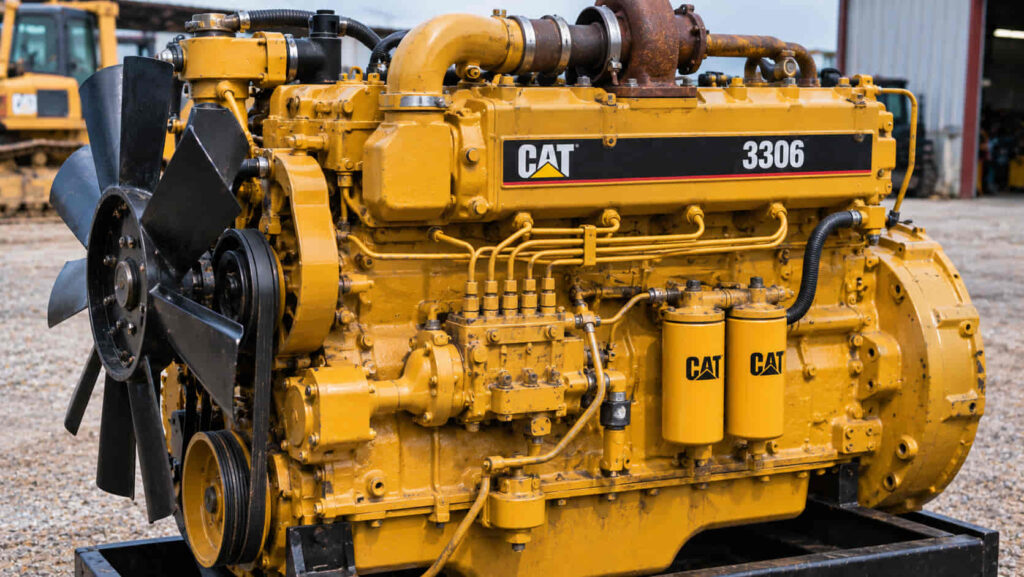
The Caterpillar 3306 is a 10.5-liter (638-cubic-inch), inline-six diesel engine with a 4.75-inch bore, 6.00-inch stroke, and firing order of 1-5-3-6-2-4. It was developed for heavy-duty industrial equipment, construction machinery, trucks, generators, agricultural applications, and marine propulsion.
According to Caterpillar’s industrial engine specifications, the 3306 was available with factory power ratings from 125 to 325 brake horsepower at approximately 2,000–2,200 RPM. Some individual turbocharged-aftercooled performance charts list ratings up to 335 horsepower.
The engine was produced in naturally aspirated, turbocharged, and turbocharged-aftercooled configurations. Later variants include the Caterpillar 3306B and 3306C, which share the same basic engine architecture but differ in application-specific components and service requirements.
The 3306 uses a cast-iron engine block, an inline-six crankshaft arrangement, mechanical fuel injection, and a gear-driven timing system. Many versions also use replaceable cylinder liners, making major overhauls more practical than on engines with nonreplaceable parent-bore cylinders.
However, CAT 3306 engine specs vary according to the engine serial number, arrangement number, fuel system, horsepower rating, and intended application.
For example, Caterpillar’s industrial brochure identifies a lubrication system refill capacity of approximately 27.4 liters, equivalent to 7.3 US gallons or 29 US quarts.
Certain 3306B marine auxiliary engines have a larger published oil capacity of 38.8 liters.
Engine weight also varies. Caterpillar identifies approximately 2,050 pounds for a naturally aspirated industrial version, 2,160 pounds for a turbocharged version, and 2,220 pounds for a turbocharged-aftercooled configuration.
These differences are important when selecting replacement parts, evaluating used engines, planning rebuilds, or comparing industrial and marine power ratings.
This guide explains Caterpillar 3306 displacement, horsepower, torque, compression ratio, fuel injection, oil capacity, valve lash, engine weight, operating speed, maintenance requirements, reliability, and the differences between the 3306, 3306B, and 3306C.
What Is the Caterpillar 3306 Engine?
The Caterpillar 3306 is a six-cylinder, four-stroke diesel engine designed for sustained operation in demanding commercial and industrial environments.
It belongs to Caterpillar’s established 3300 engine family.
The engine shares fundamental design characteristics with the smaller Caterpillar 3304, which uses four cylinders rather than six.
The 3306 has a relatively long stroke compared with its cylinder bore.
This supports a torque-oriented operating character appropriate for heavy equipment.
The engine uses mechanical valve actuation with a camshaft, lifters, pushrods, and rocker arms.
Its timing gears synchronize the crankshaft, camshaft, and fuel injection system.
Unlike many modern diesel engines, traditional 3306 configurations do not depend on electronic common-rail injection.
However, the fuel injection design changed across production generations.
Some early Caterpillar 3306 engines used a precombustion-chamber injection arrangement.
Later industrial versions used direct injection.
This distinction matters when identifying replacement cylinder heads, pistons, and fuel system components.
The engine was offered for several types of equipment.
Its mechanical simplicity and robust design contributed to its widespread industrial use.
However, the correct specifications must be matched to the actual engine configuration.
Caterpillar 3306 Engine Displacement
The Caterpillar 3306 has a nominal displacement of 10.5 liters, commonly listed as 638 cubic inches in Caterpillar’s industrial documentation.
Displacement is calculated from the combined swept volume of the engine’s six cylinders.
Each cylinder has a nominal bore of 4.75 inches and a stroke of 6.00 inches.
Together, these measurements produce approximately 10.5 liters of total displacement.
Some Caterpillar 3306B marine literature lists 641 cubic inches.
This difference reflects the nominal dimensions and reporting conventions used in particular published specifications.
Both figures refer to the same general 10.5-liter engine family.
However, an owner should use the actual arrangement-specific documentation when exact dimensions are needed for machining or component replacement.
Displacement should not be confused with oil capacity.
A 10.5-liter engine does not necessarily use 10.5 liters of lubricant.
Most industrial 3306 configurations require considerably more oil than that.
Displacement also does not establish factory horsepower.
The same engine family includes substantially different naturally aspirated and turbocharged power ratings.
Caterpillar 3306 Bore and Stroke
The CAT 3306 has a bore of 4.75 inches, approximately 121 mm, and a stroke of 6.00 inches, approximately 152 mm.
The bore is the diameter of each cylinder.
The stroke is the distance the piston travels between top dead center and bottom dead center.
Because the stroke exceeds the bore, the Caterpillar 3306 is an undersquare engine.
This configuration is consistent with a diesel engine designed to deliver substantial torque at relatively modest engine speeds.
However, bore and stroke alone do not determine performance.
Combustion chamber design, compression ratio, turbocharging, injection timing, and fuel delivery also influence output.
The bore specification is particularly important during rebuilding.
Cylinder liners must be inspected for wear, taper, and out-of-round conditions.
The pistons and rings must match the applicable liner dimensions.
Incorrect clearances can increase oil consumption and blow-by.
For engine machining, rounded catalog figures are not sufficiently precise.
The exact tolerances must come from the Caterpillar service specifications associated with the engine serial number.
CAT 3306 Engine Horsepower
Caterpillar’s published industrial 3306 engine ratings range from 125 to 325 horsepower, with certain individual performance schedules identifying turbocharged-aftercooled configurations rated as high as 335 horsepower.
The horsepower depends on aspiration, fuel calibration, rated speed, and application.
Naturally aspirated engines generally have lower power ratings.
Turbocharged engines deliver greater output because additional air can be supplied to the cylinders.
Turbocharged-aftercooled versions support higher power in many industrial configurations.
Caterpillar’s industrial performance literature identifies naturally aspirated ratings of 125, 135, 150, 160, and 170 horsepower.
Turbocharged configurations include ratings such as 190, 225, 249, 268, and 275 horsepower.
Turbocharged-aftercooled versions include several ratings between approximately 260 and 335 horsepower.
However, these are published configurations rather than a universal list of every engine arrangement.
The rating also influences the appropriate operating duty.
An engine intended for continuous industrial use should not automatically be recalibrated to the highest available horsepower.
Supporting components, cooling capacity, and fuel settings may differ.
The correct factory horsepower is determined by the engine’s identification and Caterpillar performance data.
CAT 3306 Engine Torque Specs
The Caterpillar 3306 produces substantial low-speed torque, but the exact torque output depends on the engine’s horsepower rating and operating speed.
There is no single factory torque figure applicable to every 3306.
A naturally aspirated 125-horsepower engine develops a different torque curve from a 335-horsepower turbocharged-aftercooled engine.
Caterpillar’s industrial performance charts provide horsepower at multiple engine speeds.
These values can be used to understand the torque characteristics of a particular rating.
For example, one 335-horsepower industrial arrangement is listed at approximately 317 horsepower at 1,500 RPM.
Using the standard relationship between horsepower, torque, and engine speed, this corresponds to approximately 1,110 lb-ft of calculated torque at that operating point.
However, this is a calculated value for one published performance configuration, not a universal 3306 peak torque specification.
The marine engine specifications provide another example.
A particular 3306B marine propulsion version rated at 290 horsepower develops approximately 781 lb-ft across part of its published torque curve.
These differences demonstrate why torque figures must be matched to the exact engine rating.
For transmission selection or equipment engineering, the official performance curve should be used instead of a generic internet torque number.
Caterpillar 3306 Naturally Aspirated Engine Specs
Naturally aspirated Caterpillar 3306 engines operate without a turbocharger and were offered in several lower-output industrial configurations.
Caterpillar’s published industrial performance data includes ratings from approximately 125 to 170 horsepower.
These versions use atmospheric pressure to supply combustion air.
Their intake systems are mechanically simpler than those of turbocharged engines.
However, naturally aspirated engines generally produce less power from the same displacement.
This can be acceptable for equipment designed around moderate power requirements.
The lower output does not automatically establish greater engine life.
Actual durability depends on operating load, engine speed, cooling, and maintenance.
A naturally aspirated engine that is continuously overloaded may wear faster than a properly maintained turbocharged engine operating within its rating.
The naturally aspirated configuration also uses different intake and exhaust components.
Engine weight is lower because turbocharging equipment is absent.
Caterpillar’s industrial brochure identifies a net dry weight of approximately 2,050 pounds for the relevant naturally aspirated arrangement.
For a replacement engine, the correct fuel calibration and installation requirements must be verified.
Caterpillar 3306 Turbocharged Engine Specs
The turbocharged Caterpillar 3306 uses exhaust energy to increase intake airflow and support higher horsepower than naturally aspirated configurations.
A turbocharger contains a turbine driven by exhaust gases.
The turbine drives a compressor that increases intake pressure.
Additional air allows the engine to burn more fuel efficiently under appropriate conditions.
Caterpillar’s industrial literature identifies turbocharged 3306 ratings extending into the 200-horsepower range.
Some specific configurations approach approximately 275 horsepower.
However, the turbocharger must be matched to the engine’s fuel system and duty rating.
Increasing fuel delivery without adequate airflow can produce excessive smoke and high exhaust temperatures.
The lubrication system is another important consideration.
The turbocharger depends on a clean oil supply.
Restrictions or leakage in its oil lines can cause damage.
A turbocharged engine must also maintain adequate cooling.
Caterpillar’s industrial brochure lists an approximate net dry weight of 2,160 pounds for the documented turbocharged version.
However, actual installation weight changes with accessories.
For a used engine, the turbocharger should be inspected for abnormal noise, oil leakage, and evidence of excessive wear.
Caterpillar 3306 Turbocharged-Aftercooled Specs
The Caterpillar 3306 turbocharged-aftercooled configuration combines increased intake pressure with charge-air cooling to support higher power output.
Aftercooling reduces the temperature of compressed intake air.
This helps increase air density.
The engine can then support greater fuel delivery under suitable operating conditions.
Caterpillar’s industrial ratings include turbocharged-aftercooled configurations producing approximately 260–335 horsepower.
The exact available rating depends on the intended duty.
Aftercooling also introduces additional cooling components.
These require regular maintenance.
A restricted aftercooler can reduce performance and contribute to excessive operating temperatures.
The turbocharger and fuel system must also operate correctly.
Caterpillar identifies a net dry weight of approximately 2,220 pounds for the documented industrial turbocharged-aftercooled version.
This is heavier than the equivalent naturally aspirated or turbocharged configuration.
However, it should not be assumed that every 3306TA has identical external dimensions or weight.
A replacement engine must match the equipment’s cooling and mounting requirements.
Read more: LS Cam Gear Torque Specs
Caterpillar 3306B Engine Specs
The Caterpillar 3306B retains the basic 10.5-liter inline-six architecture while incorporating application-specific fuel, cooling, and performance configurations.
The documented 3306B specifications identify a bore of 121 mm and a stroke of 152 mm.
The firing order remains 1-5-3-6-2-4.
The engine rotates counterclockwise when viewed from the flywheel end.
The 3306B operation and maintenance documentation identifies a 15:1 compression ratio for its specified configuration.
However, the value should not automatically be assigned to every earlier or later 3306 arrangement.
The 3306B was used in industrial and marine applications.
Its configurations include naturally aspirated, turbocharged, and turbocharged-aftercooled versions.
The engine’s mechanical fuel injection system uses precision components that must match the application.
Marine engines can also have different cooling systems and oil capacities.
Therefore, the 3306B name alone does not establish all service specifications.
The exact engine serial number should be used for parts selection, valve adjustment, and overhaul procedures.
Caterpillar 3306C Engine Specs
The Caterpillar 3306C is a later version of the 3306 diesel engine family, retaining the familiar 10.5-liter inline-six architecture while using application-specific components and service procedures.
The 3306C was offered in truck and Caterpillar equipment applications.
Its engine family continued the basic displacement and mechanical design associated with earlier 3306 versions.
However, the 3306C should not automatically be treated as mechanically identical to the 3306B.
The fuel injection components, governor settings, engine arrangement, and associated equipment may differ.
Caterpillar maintains separate technical documentation for the 3306C.
For example, the 3306C truck engine has its own specifications and service publications.
The engine is also represented in Caterpillar’s official parts lookup system.
This distinction is important for repairs.
A component that fits an earlier 3306 may not necessarily be the correct replacement for a 3306C.
The exact part number should be confirmed using the engine identification information.
The 3306C’s factory horsepower and maintenance specifications should likewise be taken from the appropriate arrangement rather than copied from a general 3306B document.
CAT 3306 Compression Ratio
The compression ratio of a Caterpillar 3306 depends on the engine configuration, with Caterpillar 3306B documentation identifying 15:1 for the specified engine arrangement.
Compression ratio is the relationship between cylinder volume at bottom dead center and the remaining volume at top dead center.
Diesel engines use high compression to heat the air sufficiently for fuel ignition.
The fuel is injected near the appropriate point in the combustion cycle.
However, compression ratio depends on combustion chamber and piston geometry.
Different engine arrangements may use different pistons.
Earlier precombustion-chamber versions also differ from later direct-injection configurations.
Therefore, one compression ratio should not automatically be applied to the entire 3306 production history.
This is particularly important when rebuilding.
The wrong piston or cylinder head components can alter compression.
A changed compression ratio may affect starting, combustion characteristics, and mechanical stress.
Replacement components must match the original engine design unless a manufacturer-approved conversion is being performed.
CAT 3306 Firing Order
The Caterpillar 3306 firing order is 1-5-3-6-2-4.
This firing order is documented in Caterpillar’s engine service literature.
The sequence defines the order in which the six cylinders produce power.
The 3306 is an inline-six diesel engine.
Its crankshaft and camshaft must remain synchronized.
The fuel injection system must also deliver fuel at the correct point in each cylinder’s cycle.
An incorrect injection sequence can create severe operating problems.
However, the firing order should be used with the proper cylinder numbering diagram.
Cylinder number one is located at the front of the engine in the conventional Caterpillar inline-six identification arrangement.
The remaining cylinders are numbered toward the rear.
This is important during valve adjustment and injection timing procedures.
The engine does not use a gasoline-style ignition distributor or spark plugs.
Its firing order refers to diesel combustion and the injection sequence.
Caterpillar 3306 Valve Lash Specs
The documented Caterpillar 3306B valve lash specifications are 0.015 inch (0.38 mm) for the intake valves and 0.025 inch (0.64 mm) for the exhaust valves.
These figures appear in the relevant 3306B operation and maintenance literature.
Valve lash is the mechanical clearance in the valvetrain when the valve is closed.
Correct clearance allows for thermal expansion.
If the clearance is excessive, the engine may develop abnormal mechanical noise and altered valve operation.
If the clearance is too tight, a valve may fail to seat correctly.
This can affect compression and valve temperature.
The 3306 uses a mechanical pushrod valvetrain.
Valve clearance must therefore be inspected and adjusted according to the applicable service schedule.
However, Caterpillar manuals for different engines and configurations can contain different values.
The exact engine arrangement and adjustment condition must be verified.
A technician should also follow the prescribed crankshaft positioning sequence.
The firing order alone does not replace the manufacturer’s valve adjustment procedure.
CAT 3306 Fuel Injection System
The Caterpillar 3306 uses mechanically controlled diesel fuel injection, although early and later versions differ in combustion chamber and injection design.
Some earlier 3306 engines used injection into a precombustion chamber.
Caterpillar’s older 3304 and 3306 vehicle service manual describes this arrangement.
The manual identifies individual injection pumping elements and injection valves.
Fuel is delivered into a precombustion chamber rather than directly into the main cylinder chamber.
Later industrial 3306 literature identifies direct injection.
This design delivers fuel directly into the combustion chamber.
The mechanical fuel system includes pumps, a governor, and timing components.
These determine fuel quantity and injection timing.
However, the components must be correctly calibrated.
A worn injector or injection pump can cause poor starting, abnormal exhaust smoke, and reduced power.
Fuel contamination can also damage precision parts.
Therefore, the fuel system should be maintained using the correct filters and clean diesel.
An engine with poor performance should be diagnosed before injection timing or fuel delivery settings are changed.
Is the CAT 3306 Direct Injection?
Many later Caterpillar 3306 industrial engines use direct injection, but not every engine built under the original 3306 designation has the same combustion system.
Caterpillar’s industrial brochure explicitly identifies direct injection for its documented 3306 configuration.
However, earlier Caterpillar service literature describes precombustion-chamber fuel injection.
The distinction matters because the engine’s internal components are different.
A precombustion-chamber engine uses an additional chamber arrangement in the cylinder head.
A direct-injection engine delivers fuel into the main combustion chamber.
The designs require different injector and combustion hardware.
Therefore, an owner should not assume that a replacement cylinder head, piston, or injector from one version will fit another.
The engine serial number should determine the correct configuration.
This is particularly important when rebuilding engines removed from older construction machinery.
The term mechanical injection describes how fuel delivery is controlled.
It does not necessarily identify whether combustion uses direct injection or a precombustion chamber.
Both systems can be mechanically controlled.
CAT 3306 Oil Capacity
The Caterpillar industrial 3306 has a published oil system refill capacity of approximately 27.4 liters, equal to 7.3 US gallons or about 29 US quarts, for the configuration identified in Caterpillar’s brochure.
However, this value should not be applied to every 3306 engine.
The oil pan arrangement can differ.
Industrial, truck, generator, and marine installations may use different sumps.
External filtration equipment can also change the total refill requirement.
For example, certain 3306B marine auxiliary engines have a published oil capacity of 38.8 liters.
That is approximately 10.25 US gallons.
The difference is substantial.
An owner who assumes that every 3306 requires 27.4 liters could underfill an arrangement with a larger oil system.
Likewise, filling a smaller sump with 38.8 liters could create an overfill problem.
The correct capacity must be confirmed using the engine serial number and installed oil pan.
After the initial refill, the oil level should be verified using the appropriate dipstick procedure.
The manufacturer’s specifications should always take priority over a generic internet capacity.
CAT 3306B Oil Capacity
A Caterpillar 3306B oil capacity may be approximately 27.4 liters or 38.8 liters depending on the specific marine or industrial arrangement.
Caterpillar’s 3306B marine propulsion literature includes configurations with a 27.4-liter refill quantity.
The company’s 3306B marine auxiliary engine documentation also identifies arrangements with a 38.8-liter lubrication system.
These are legitimate published specifications for different configurations.
The difference does not indicate that one document is necessarily incorrect.
It reflects the equipment and lubrication arrangement being described.
A propulsion engine and an auxiliary engine may have different oil system requirements.
The sump design and installation orientation may also differ.
Therefore, the term 3306B is insufficient for determining an exact oil capacity.
The correct approach is to identify the engine arrangement and consult its service manual.
The installed dipstick must also be compatible with the oil pan.
A replacement engine or modified installation may require additional verification.
Correct oil quantity is essential for reliable bearing and turbocharger lubrication.
What Oil Does a CAT 3306 Use?
Caterpillar specifies heavy-duty diesel engine oil for the 3306, with SAE 10W-30 and SAE 15W-40 identified in its documented 3306B marine service specifications.
The appropriate viscosity depends on operating temperature and engine application.
SAE 15W-40 is commonly used in heavy-duty diesel engines operating in moderate to warm conditions.
SAE 10W-30 can provide different cold-start characteristics.
However, oil viscosity alone does not determine suitability.
The lubricant must meet the applicable Caterpillar or industry performance requirements.
Older manuals may refer to oil classifications that have since been superseded.
For modern maintenance, owners should confirm that a currently available lubricant is compatible with the older engine’s requirements.
The oil filter should also be replaced according to the appropriate schedule.
A turbocharged engine depends on clean oil for turbocharger lubrication.
The crankshaft bearings, camshaft, and other internal components require proper oil pressure.
Using a more expensive oil does not automatically permit longer drain intervals.
The manufacturer’s maintenance recommendations should determine service timing.
Caterpillar 3306 Oil Change Interval
The Caterpillar 3306 oil change interval varies by application, with published 3306B marine documentation specifying a 250-hour interval for the relevant arrangements.
However, this figure should not automatically be applied to every industrial or truck engine.
A marine propulsion engine may operate under sustained load for extended periods.
An industrial engine may operate at constant speed.
A truck engine experiences changing engine speed and road load.
These applications have different maintenance requirements.
Fuel quality and lubricant condition also matter.
Contaminated oil can increase wear.
Excessive soot loading can affect the lubricant’s performance.
Caterpillar has long used oil analysis as part of its maintenance programs.
Oil analysis can help identify changes in wear metals, contamination, and lubricant condition.
However, oil analysis does not eliminate the need for approved service intervals.
The correct schedule should be obtained from the engine-specific operation and maintenance manual.
The owner should also inspect the oil level between services.
A low oil level can cause engine damage regardless of how recently the oil was changed.
CAT 3306 Normal Oil Pressure
Normal Caterpillar 3306 oil pressure depends on engine speed, oil temperature, lubricant viscosity, and the specific engine arrangement.
The engine uses a pressure-lubrication system to protect its bearings and other internal components.
Oil is drawn from the sump by the engine-driven pump.
The lubricant then passes through the oil filtration and cooling systems.
It is distributed to the components requiring lubrication.
Oil pressure generally changes with engine speed.
It also changes as the lubricant warms.
Cold oil can produce a higher pressure reading.
Warm oil may produce a lower reading at idle.
However, a specific normal pressure range should not be assigned to every 3306 without the appropriate service specifications.
A sudden loss of pressure is a serious concern.
The engine should not continue operating when actual lubrication pressure is insufficient.
Possible causes include low oil level, pump wear, restrictions, or excessive internal bearing clearance.
An inaccurate pressure gauge can also produce misleading readings.
The correct diagnosis should verify the pressure and compare it with Caterpillar’s specifications for the actual arrangement.
CAT 3306 Cooling System Capacity
Caterpillar’s industrial 3306 brochure identifies an engine-only cooling system capacity of approximately 15.9 liters for naturally aspirated and turbocharged configurations, and 18.2 liters for the specified turbocharged-aftercooled version.
These values do not necessarily describe the entire installed cooling system.
A radiator, hoses, expansion tank, and other equipment can increase the total capacity.
Marine installations can use different cooling arrangements.
These may include heat exchangers and auxiliary cooling equipment.
The coolant quantity must therefore be verified for the complete installation.
Cooling system condition is essential for engine durability.
The 3306 can operate under sustained heavy loads.
An obstructed radiator or defective thermostat can cause overheating.
Marine engines require additional attention to heat exchangers and seawater-related equipment.
The coolant must also provide suitable corrosion and liner protection.
Caterpillar engines with replaceable wet liners may require specific coolant chemistry and maintenance procedures.
Incorrect coolant or neglected corrosion protection can contribute to long-term engine damage.
The correct coolant formulation should be selected according to the engine’s service information.
CAT 3306 Engine Weight
The Caterpillar 3306 industrial engine has a published net dry weight of approximately 2,050–2,220 pounds depending on aspiration configuration.
Caterpillar identifies approximately 2,050 pounds, or 930 kg, for the naturally aspirated industrial version.
The turbocharged arrangement weighs approximately 2,160 pounds, or 980 kg.
The turbocharged-aftercooled version weighs approximately 2,220 pounds, or 1,007 kg.
However, these figures describe specific industrial configurations.
Other engines may weigh more or less.
For example, Caterpillar’s older vehicle service manual identifies approximately 1,940 pounds for the documented basic 3306 engine without oil or coolant.
Marine engines can be heavier because of additional cooling and exhaust equipment.
Some 3306B marine propulsion arrangements have published dry weights approaching 2,470 pounds.
The actual installed weight also includes accessories, fluids, and mounting hardware.
This matters during engine replacement.
Lifting equipment should be selected for the complete engine assembly.
The rated lifting capacity must provide an appropriate safety margin.
Caterpillar 3306 Engine Dimensions
The Caterpillar 3306 engine dimensions depend on the installed accessories, but one industrial brochure identifies approximate dimensions of 59.2 inches long, 30.8 inches wide, and 46.1 inches high.
These values correspond to approximately 1,505 mm in length, 783 mm in width, and 1,171 mm in height.
However, the measurements belong to the documented industrial configuration.
A turbocharged engine may have different external clearances from a naturally aspirated engine.
Aftercooling components can also change the overall installation dimensions.
Marine engines may include additional manifolds and cooling hardware.
A generator installation can use different accessories and mounting arrangements.
Therefore, a 3306 from one application may not fit directly into another.
An engine swap requires more than matching displacement and horsepower.
The installer must consider crankshaft centerline height, flywheel housing, mounts, exhaust routing, and cooling equipment.
Maintenance access is another important requirement.
The engine should have enough clearance for filter changes, valve adjustment, and fuel system service.
The correct arrangement drawing should be used before planning a replacement installation.
Caterpillar 3306 Cylinder Liners
The Caterpillar 3306 uses replaceable cylinder liners in the documented vehicle and industrial service configurations, making liner condition an important part of engine maintenance and rebuilding.
The liners provide the running surfaces for the pistons and rings.
They must maintain appropriate dimensions and sealing.
During an overhaul, worn liners can be removed and replaced according to the manufacturer’s procedures.
However, replacement is not simply a matter of inserting new parts.
Liner projection and sealing surfaces must be inspected.
The cylinder block must also be evaluated for corrosion or damage.
Incorrect liner installation can create cooling system or combustion sealing problems.
Wet-liner systems are also sensitive to coolant maintenance.
Cavitation and corrosion can damage liner surfaces.
The correct coolant additives and maintenance schedule are important.
Caterpillar’s older 3306 service specifications provide detailed liner inspection and installation procedures.
These should be followed when rebuilding the engine.
A qualified diesel machine shop should measure the components and confirm that the block remains serviceable.
Can You Rebuild a Caterpillar 3306 Engine?
The Caterpillar 3306 can be rebuilt, and its replaceable cylinder liners make it suitable for major engine overhauls when the block and other critical components remain in good condition.
A proper rebuild begins with disassembly and inspection.
The cylinder liners and pistons must be evaluated.
The crankshaft journals should be measured for wear.
Connecting rods, bearings, and cylinder heads also require inspection.
The fuel injection equipment may need separate service.
However, the correct rebuild parts depend on the engine’s arrangement.
A precombustion-chamber engine may require different internal components from a direct-injection version.
The 3306B and 3306C can also have application-specific differences.
Therefore, the engine identification information must be established before ordering a rebuild kit.
The cooling system should be inspected at the same time.
A badly corroded liner seating area can increase overhaul complexity.
The lubrication system and oil cooler should also be evaluated.
For turbocharged engines, the turbocharger must be inspected for wear.
The best rebuild restores the engine’s complete mechanical condition rather than replacing only worn pistons and liners.
Is the CAT 3306 a Reliable Engine?
The Caterpillar 3306 is widely regarded as a durable older industrial diesel engine, particularly when maintained correctly and operated within its specified power and duty ratings.
Its basic design emphasizes heavy-duty construction.
The engine uses a cast-iron block and an inline-six configuration.
Mechanical fuel injection reduces dependence on complex electronic controls in many original applications.
The timing system uses gears rather than a conventional timing belt.
Replaceable cylinder liners also support overhaul work.
However, reliability does not mean that the engine is maintenance-free.
Fuel injection components can wear.
Turbochargers require clean lubrication.
Cooling problems can cause serious mechanical damage.
The engine’s age is another important consideration.
Many surviving 3306 engines have accumulated decades of use.
Even engines with relatively low recorded hours may have deteriorated seals, hoses, or fuel system components.
The best reliability assessment considers oil pressure, coolant condition, blow-by, starting performance, exhaust smoke, and maintenance records.
A lower-rated industrial engine operating within its intended duty may offer a more predictable ownership experience than a high-output engine that has been repeatedly overloaded.
Common Caterpillar 3306 Engine Problems
Common Caterpillar 3306 problems include fuel injection faults, overheating, oil leaks, turbocharger wear, cylinder liner damage, and age-related internal engine wear.
Fuel system problems can cause hard starting and poor performance.
A restricted fuel filter may reduce fuel delivery.
Water or other contamination can damage injection components.
Incorrect injection timing can also affect combustion and exhaust smoke.
However, these symptoms require proper diagnosis.
Turbocharged engines may experience boost-related problems.
A worn turbocharger can cause oil leakage or reduced performance.
Intake restrictions can produce similar symptoms.
Cooling system problems are another concern.
A blocked radiator or defective thermostat can cause overheating.
For engines with wet liners, poor coolant maintenance can contribute to cavitation-related damage.
Oil leaks may develop as gaskets and seals age.
Excessive crankcase blow-by can indicate internal cylinder or piston ring wear.
However, blow-by should be measured and interpreted according to the manufacturer’s procedures.
A reliable repair identifies the actual cause instead of replacing components based only on engine age.
How Long Does a Caterpillar 3306 Last?
The Caterpillar 3306 can provide many thousands of service hours, but there is no single manufacturer-supported operating-hour figure that guarantees its lifespan across all applications.
An industrial generator operates differently from a bulldozer or marine propulsion engine.
The amount of load carried during each operating hour matters.
A generator may run at a relatively constant speed.
Construction equipment may experience repeated load changes.
Marine propulsion engines can operate under sustained heavy load.
Therefore, operating hours alone do not fully describe engine wear.
Maintenance is equally important.
Clean oil and fuel protect the internal components.
The cooling system must remain in good condition.
Valve lash and fuel injection timing should also be maintained correctly.
Some older Caterpillar engines are capable of substantial service life before requiring a major overhaul.
However, the actual overhaul point should be determined using condition monitoring.
Oil analysis, blow-by measurements, oil pressure, compression-related symptoms, and fuel consumption are useful indicators.
A high-hour engine with a documented overhaul may be a better purchase than a lower-hour engine with neglected cooling and lubrication systems.
Caterpillar 3306 vs. 3208 Engine
The Caterpillar 3306 and 3208 have similar nominal displacement, but they use very different engine architectures and rebuilding strategies.
The 3306 is a 10.5-liter inline-six diesel.
The 3208 is a 10.4-liter V8 diesel.
The 3306 uses six cylinders arranged in one bank.
The 3208 uses eight cylinders divided into two banks.
The difference affects overall engine dimensions and packaging.
The 3306 uses replaceable cylinder liners in the relevant industrial and vehicle configurations.
The 3208 uses a parent-bore cylinder block without conventional replaceable wet liners.
This can make their overhaul procedures substantially different.
Power ratings also vary by application.
Neither engine should be judged solely by displacement.
The 3208 may be suitable for installations where its V8 configuration fits the available space.
The 3306 may be attractive for equipment designed around its heavy-duty inline-six architecture.
The correct choice depends on duty cycle, installation dimensions, maintenance support, and actual engine condition.
Caterpillar 3306 vs. 3406 Engine
The Caterpillar 3306 is smaller than the Caterpillar 3406, with 10.5 liters of displacement compared with approximately 14.6 liters for the familiar 3406 diesel engine family.
Both engines use inline-six configurations.
However, the 3406 is designed for higher-output heavy-duty applications.
The larger engine has greater displacement and substantial torque potential.
It has been used extensively in heavy trucks and demanding industrial equipment.
The 3306 offers a smaller installation package.
This can make it suitable for medium-duty equipment and certain industrial applications.
However, the two engines should not be assumed interchangeable.
The block dimensions, mounts, flywheel housings, cooling systems, and fuel settings may differ.
A 3406 replacement can also create additional weight and space requirements.
For equipment originally designed around a 3306, rebuilding the existing engine may be more practical than installing a larger engine.
However, the best choice depends on power requirements and the condition of the available components.
Caterpillar 3306 Marine Engine Specs
Caterpillar 3306B marine engines were offered in different propulsion and auxiliary configurations, with power ratings and lubrication capacities determined by the specific marine duty.
Caterpillar’s 3306B marine propulsion literature includes a 215-bhp configuration rated at 2,000 RPM.
Other documented propulsion configurations include 235, 290, and 350 bhp arrangements.
However, the permitted operating duty differs.
A commercial vessel operating continuously under heavy load requires an appropriate engine rating.
A higher-output recreational or intermittent-duty rating may not be suitable for the same service.
Marine engine cooling is another major distinction.
Heat exchanger and seawater cooling systems have different maintenance requirements.
The exhaust manifold may also be water-cooled.
Caterpillar’s marine auxiliary documentation identifies 3306B configurations rated at approximately 216, 233, 247, and 275 bhp, depending on speed and arrangement.
Some of these auxiliary engines have a published oil capacity of 38.8 liters.
Therefore, a marine 3306 should not automatically be serviced using industrial engine figures.
The official marine performance and maintenance documents must match the installed engine.
What Equipment Uses the CAT 3306?
The Caterpillar 3306 has been used in construction equipment, industrial machinery, agricultural applications, generator sets, trucks, and marine vessels.
Its displacement and torque characteristics made it suitable for a wide range of work.
Caterpillar’s industrial brochure identifies applications such as agricultural tractors, harvesters, off-highway trucks, drilling equipment, rock crushers, wood chippers, and oilfield machinery.
Older Caterpillar equipment also used the engine in specific tractor and grader arrangements.
However, not every machine carrying a similar model name uses the same engine.
Equipment manufacturers sometimes changed engine configurations during production.
The correct engine model should be identified from the installed unit.
Generator installations may have different governor settings and rated speeds.
Marine engines use different cooling and exhaust arrangements.
Off-highway machinery may incorporate specialized mounting systems and power takeoffs.
Therefore, a replacement engine should be selected according to the complete application rather than displacement alone.
How to Identify a Caterpillar 3306 Engine
The most reliable method for identifying a Caterpillar 3306 is to use the engine serial number, arrangement number, and associated Caterpillar service documentation.
These identifiers determine the original factory configuration.
They help establish the correct engine components.
They are also important for verifying horsepower and operating speed.
An older 3306 may have a different fuel injection system from a later direct-injection version.
The 3306B and 3306C may also use different application-specific parts.
An engine advertised simply as a CAT 3306 can therefore be difficult to identify accurately.
The serial number should be inspected before purchasing repair parts.
A rebuilt engine may also contain replacement components that differ from its original production specification.
This history should be documented.
Caterpillar’s parts system provides model-specific component information.
An authorized Caterpillar dealer can use the engine identification data to confirm the correct service information.
This is especially valuable for cylinder liners, pistons, injection components, oil pans, and turbochargers.
Is a Used Caterpillar 3306 Worth Buying?
A used Caterpillar 3306 can be worth purchasing when its mechanical condition, service history, and compatibility with the intended equipment justify the cost.
The first step is verifying the engine identification.
The serial number and arrangement number should be documented.
The buyer should determine whether the engine is naturally aspirated, turbocharged, or turbocharged-aftercooled.
Its factory horsepower rating should also be confirmed.
A cold-start inspection can provide useful information.
Excessive smoke or difficult starting may indicate problems.
However, these symptoms require diagnosis.
Oil pressure should be checked according to the correct operating conditions.
The cooling system should also be inspected.
A history of overheating may increase the risk of cylinder head or liner damage.
For turbocharged engines, the turbocharger and intake system deserve attention.
Fuel injection equipment should be evaluated for leakage and abnormal operation.
The buyer should also consider rebuild history.
An engine with a properly documented overhaul may provide good value.
However, an undocumented rebuild can make component identification more difficult.
The complete equipment installation must also be considered before purchase.
Final Verdict: What Are the CAT 3306 Engine Specs?
The Caterpillar 3306 is a 10.5-liter, 638-cubic-inch inline-six diesel engine with a 4.75-inch bore, 6.00-inch stroke, mechanical fuel injection, and firing order of 1-5-3-6-2-4.
Caterpillar’s industrial specifications identify a broad range of factory horsepower ratings.
Naturally aspirated versions commonly produce approximately 125–170 horsepower in the published industrial arrangements.
Turbocharged versions reach higher ratings.
Turbocharged-aftercooled configurations include ratings up to approximately 325–335 horsepower in the relevant Caterpillar performance data.
Torque output also changes according to engine rating and RPM.
There is no single universal peak torque value for every 3306.
The engine’s published industrial oil capacity is approximately 27.4 liters, equal to 7.3 US gallons or roughly 29 US quarts.
However, certain 3306B marine auxiliary engines use approximately 38.8 liters.
The dry weight of the documented industrial configurations ranges from approximately 2,050 to 2,220 pounds.
Cooling capacity and overall dimensions also depend on installation.
The 3306B service documentation identifies a 15:1 compression ratio for its specified configuration, with intake valve lash of 0.015 inch and exhaust valve lash of 0.025 inch.
However, these figures should be checked against the actual engine arrangement.
The Caterpillar 3306 is known for its durable construction and mechanical simplicity.
Replaceable cylinder liners are another important advantage for overhaul work.
However, long-term reliability depends on correct fuel system maintenance, lubrication, cooling, and operating load.
For anyone researching CAT 3306 engine specs, the most important step is to match the specifications to the actual engine serial number, arrangement number, and application.
This prevents incorrect parts selection, oil overfilling, unsuitable maintenance procedures, and unnecessary engine damage while helping preserve the engine’s remaining service life.