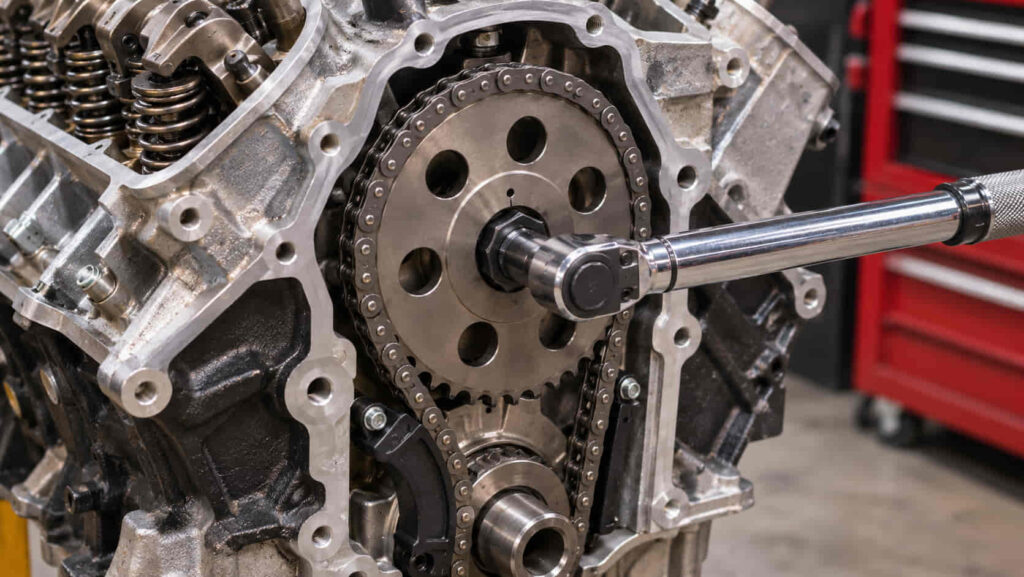
LS cam gear torque specifications depend on the engine, camshaft mounting design, and fastener type. Many Chevrolet LS engines with a conventional three-bolt camshaft sprocket use 26 lb-ft (35 Nm), while certain applications require different values. For example, the 2006 Corvette LS2 specifies 18 lb-ft (25 Nm), and the 2010 Corvette LS7 specifies 22 lb-ft (30 Nm).
Single-bolt camshaft sprockets require a different tightening procedure.
For the 2010 Chevrolet Camaro LS3, General Motors specifies an initial torque of 55 lb-ft (75 Nm), followed by an additional 50 degrees of bolt rotation. However, certain 2008 GM truck-engine service procedures specify 66 lb-ft (90 Nm), followed by 40 degrees.
These figures cannot be used interchangeably.
The camshaft retainer plate also has separate tightening specifications. Many LS applications use 18 lb-ft for hex-head retainer bolts or 11 lb-ft for the countersunk Torx-head design.
The correct LS cam gear torque must match the actual camshaft, sprocket, engine RPO code, production year, and fastener instructions.
Using the wrong tightening procedure can cause insufficient clamping force, damaged threads, a loose timing sprocket, or potentially serious valvetrain damage.
This is particularly important during an LS camshaft replacement.
Some factory LS3 camshafts use a single-bolt sprocket, while certain Chevrolet Performance LS376/480 and LS376/525 engines use three-bolt camshafts.
Aftermarket camshaft conversions can also change the original sprocket arrangement.
Therefore, the engine’s original specification may no longer apply after a camshaft modification.
This LS cam gear torque specs guide explains the seven most important torque values and procedures, the differences between LS1, LS2, LS3, LS6, LS7, and common truck engines, and the steps needed to install the camshaft sprocket correctly.
What Are the Correct LS Cam Gear Torque Specs?
The most commonly referenced LS camshaft sprocket torque is 26 lb-ft for a conventional three-bolt arrangement, but factory applications may specify 18 lb-ft, 22 lb-ft, or a torque-plus-angle procedure instead.
The LS engine family includes many different configurations.
Although these engines share a general small-block architecture, their camshaft sprocket hardware is not identical.
Early LS1 and LS6 engines commonly use three-bolt camshaft sprockets.
For these applications, 26 lb-ft is a widely published reference specification.
However, the LS2 used in the 2006 Chevrolet Corvette has a documented camshaft sprocket torque of 18 lb-ft.
The LS7 provides another example.
The 2010 Corvette LS7 service specifications list 22 lb-ft.
For the 2010 LS3 Camaro, the single-bolt camshaft sprocket requires 55 lb-ft followed by an additional 50 degrees.
Certain 2008 GM truck engines use a different procedure of 66 lb-ft followed by another 40 degrees.
The camshaft retainer plate has its own fasteners.
Hex-head retainer bolts commonly require 18 lb-ft.
Countersunk Torx retainer bolts require 11 lb-ft in the relevant factory applications.
These specifications should be treated as application-specific references.
The correct vehicle service manual or aftermarket component instructions must determine the final tightening procedure.
1. LS1 Cam Gear Torque Specs — 26 lb-ft
The conventional Chevrolet LS1 three-bolt camshaft sprocket is commonly tightened to 26 lb-ft, approximately 35 Nm.
The LS1 is a 5.7-liter Gen III small-block V8.
It appeared in the Chevrolet Corvette and other GM performance vehicles.
The engine uses a timing chain to connect the crankshaft and camshaft.
The camshaft sprocket is secured using three mounting bolts.
These bolts must hold the sprocket firmly against the camshaft mounting surface.
Correct clamping prevents unwanted movement between the components.
During installation, the sprocket must also engage the camshaft’s locating feature correctly.
The sprocket should not be forced into position using excessive bolt torque.
If the components do not seat correctly, the cause must be identified before tightening.
For the conventional LS1 three-bolt arrangement, 26 lb-ft is the established reference.
However, aftermarket fasteners may require another value.
An aftermarket timing gear or adjustable sprocket can also introduce different hardware.
Therefore, the correct bolt specification and manufacturer instructions should be checked before assembly.
The camshaft retainer plate must be installed correctly before the timing sprocket is secured.
2. LS2 Cam Gear Torque Specs — 18 lb-ft
The 2006 Chevrolet Corvette LS2 service manual specifies 18 lb-ft (25 Nm) for its three camshaft sprocket bolts.
This is a particularly important exception to the frequently repeated 26-lb-ft specification.
The LS2 is a 6.0-liter Gen IV engine.
It shares many architectural features with earlier LS engines.
However, sharing an engine family does not mean that every fastener uses the same torque.
GM’s 2006 Corvette LS2 service document identifies the camshaft sprocket bolt torque as 25 Nm.
That converts to approximately 18 lb-ft.
The same document lists different values for the camshaft retainer bolts.
This distinction helps prevent confusion between the timing gear fasteners and the retainer plate.
A technician installing an LS2 camshaft should confirm the exact service procedure.
The original camshaft may have been replaced during an earlier engine modification.
If the engine now uses an aftermarket three-bolt conversion or a different sprocket, the supplied hardware instructions may take precedence.
However, the factory 18-lb-ft value should not be replaced with 26 lb-ft solely because the engine belongs to the LS family.
Matching the specification to the actual components is more important than relying on a generic torque chart.
3. LS3 Cam Gear Torque Specs — 55 lb-ft Plus 50 Degrees
The 2010 Chevrolet Camaro LS3 service manual specifies 55 lb-ft (75 Nm) for the initial camshaft sprocket bolt tightening stage, followed by an additional 50 degrees.
This procedure applies to the documented single-bolt arrangement.
The LS3 is a 6.2-liter Gen IV small-block V8.
Its factory camshaft sprocket configuration differs from the traditional three-bolt mounting arrangement used in many earlier LS applications.
The single central bolt provides the clamping force required to secure the sprocket.
GM specifies a torque-plus-angle tightening procedure.
The technician first tightens the bolt to the required initial torque.
The bolt is then rotated through the additional specified angle.
A torque-angle gauge is useful for completing this procedure accurately.
However, the final angle is not another torque value.
An additional 50 degrees refers to bolt rotation.
It does not mean adding 50 lb-ft to the original torque.
The appropriate factory procedure also requires a new camshaft sprocket bolt where specified.
Reusing a torque-to-yield fastener can compromise the intended clamping force.
The camshaft and timing sprocket must also be correctly aligned.
For a stock LS3 single-bolt configuration, the documented procedure is 55 lb-ft followed by 50 degrees.
4. LS6 Cam Gear Torque Specs — 26 lb-ft
The Chevrolet LS6 commonly uses the same conventional three-bolt camshaft sprocket tightening reference of 26 lb-ft (35 Nm) associated with the early LS1 arrangement.
The LS6 is a performance-oriented 5.7-liter V8 developed from the LS1 architecture.
It was used in vehicles such as the Chevrolet Corvette Z06.
The engine uses a timing chain and a camshaft sprocket mounted to the front of the camshaft.
The original three-bolt configuration requires the correct tightening procedure to maintain sprocket alignment.
The installation process involves checking the sprocket’s seating surface and timing marks.
The camshaft locating feature must engage correctly.
The bolts should be tightened evenly.
However, LS6 engines are frequently modified.
An aftermarket camshaft, timing set, or fastening kit can change the relevant installation requirements.
A replacement component may use a different fastener grade or thread treatment.
Therefore, the original torque value is only appropriate when the installed hardware matches the documented arrangement.
The correct assembly procedure should be confirmed before the timing cover is installed.
5. LS7 Cam Gear Torque Specs — 22 lb-ft in the 2010 Corvette
The 2010 Chevrolet Corvette LS7 service specifications identify 22 lb-ft (30 Nm) for the camshaft sprocket bolts.
The LS7 is a 7.0-liter Gen IV small-block V8.
Its camshaft and timing system are designed for a high-performance engine configuration.
However, the LS7 has also undergone service and component revisions over its production history.
Earlier documentation for the 2006 Corvette LS7 identifies 18 lb-ft for the three camshaft sprocket bolts.
The 2010 GM service specifications identify 22 lb-ft.
This is another example of why the exact production year matters.
It would be inaccurate to assign one torque value to every LS7 without checking the associated service information.
The engine may also contain aftermarket components.
Performance LS7 engines frequently receive camshaft and timing upgrades.
These changes can include different sprockets or fasteners.
The correct procedure must match the actual installed hardware.
A technician should identify the engine year and relevant service document before tightening.
If a performance camshaft is installed, the camshaft supplier’s instructions should also be consulted.
6. LS Camshaft Retainer Plate Torque — 18 lb-ft for Hex Bolts
Many GM LS engines specify 18 lb-ft (25 Nm) for conventional hex-head camshaft retainer plate bolts.
The camshaft retainer plate sits behind the camshaft sprocket.
It helps control the camshaft’s axial movement.
Proper installation is essential for maintaining the camshaft’s intended position.
However, the retainer plate bolts must not be confused with the sprocket bolts.
They secure different components.
The camshaft sprocket bolts attach the timing gear to the camshaft.
The retainer plate bolts secure the camshaft retaining assembly to the engine block.
GM’s 2006 LS2 and 2010 LS3 service documentation identifies 18 lb-ft for the applicable hex-head fasteners.
The correct plate design must be used.
Its sealing surface and mounting area should be clean.
The plate must also be oriented correctly.
Excessive tightening can damage threads or distort the assembly.
Insufficient tightening can allow the retainer plate to loosen.
A properly installed retainer plate is an important foundation for accurate camshaft timing.
7. LS Camshaft Retainer Plate Torque — 11 lb-ft for Torx Bolts
The countersunk Torx-head camshaft retainer plate bolts used in several GM LS applications require 11 lb-ft (15 Nm).
This value is different from the 18-lb-ft specification associated with the hex-head design.
The difference exists because the fasteners and retaining arrangements are not identical.
The correct identification is therefore essential.
The technician should inspect the actual fastener head and plate design.
A Torx-head bolt should not automatically receive the torque intended for a hex-head retainer bolt.
The correct tool must also engage the fastener securely.
An incorrectly sized Torx bit can damage the drive recess.
This may make future removal difficult.
The retainer plate should be installed with the proper orientation and seating.
A damaged or warped plate may need replacement.
For certain LS camshaft installations, the retainer plate can also be supplied with an integrated sealing feature.
The correct component should match the engine design.
The 11-lb-ft value applies to the documented Torx fasteners.
Aftermarket retainer plates or hardware may have different requirements.
Why Do LS Cam Gear Torque Specs Vary?
LS cam gear torque specifications vary because GM used different camshaft sprocket designs, fastener dimensions, bolt materials, and assembly procedures across engine generations.
The LS engine family covers more than one displacement.
Common versions include 4.8L, 5.3L, 5.7L, 6.0L, 6.2L, and 7.0L engines.
However, displacement alone does not determine the correct cam gear torque.
Some engines use a three-bolt camshaft sprocket.
Others use a single central bolt.
Certain configurations also have variable valve timing.
These components can have different mechanical requirements.
The LS2 demonstrates that even a conventional three-bolt sprocket can use a different torque from the LS1.
The LS7 demonstrates that year-specific service information can matter within one engine family.
Single-bolt engines use torque-plus-angle procedures in many factory applications.
Therefore, a generic LS torque chart is not always sufficient.
The exact engine RPO code should be identified.
The camshaft and timing sprocket should also be inspected.
If aftermarket components are installed, their instructions may supersede the original factory values.
LS Cam Gear Torque Specs for 4.8L, 5.3L, and 6.0L Truck Engines
GM LS-based truck engines do not all use one camshaft sprocket torque specification, even when they have similar displacement or belong to the same general engine family.
Early Gen III truck engines commonly use a conventional three-bolt camshaft arrangement.
These include certain LR4 4.8L, LM7 5.3L, and LQ4 6.0L applications.
However, later Gen IV engines can have different camshaft sprocket hardware.
Some use a single-bolt configuration.
Others include variable cam timing components.
A 2008 Silverado 5.3L service procedure provides an important example.
For specified engine RPO codes, GM identifies an initial camshaft sprocket bolt torque of 66 lb-ft, followed by another 40 degrees.
However, another GM timing-chain installation procedure for certain configurations identifies 55 lb-ft followed by 50 degrees.
The difference illustrates why the relevant repair operation and engine configuration must be checked.
Owners should not assume that all 5.3L engines use 26 lb-ft.
Likewise, an LQ4 or LY6 engine should not automatically receive the same procedure.
The correct specification depends on the installed camshaft and sprocket assembly.
What Is the Difference Between a 3-Bolt and Single-Bolt LS Cam Gear?
A three-bolt LS cam gear uses three separate fasteners to secure the sprocket to the camshaft, while a single-bolt arrangement uses one central retaining bolt.
The distinction is visible at the front of the camshaft.
A traditional three-bolt sprocket has three mounting locations.
The fasteners are distributed around the sprocket’s center.
A single-bolt sprocket has one central retaining bolt.
However, the appearance of the timing gear alone is not enough to establish every installation detail.
The camshaft must have the appropriate mounting design.
The sprocket must also be compatible with the timing chain and surrounding engine components.
Chevrolet Performance’s LS3 long-block installation guide identifies the production LS3 camshaft as a single-bolt design.
The same guide identifies the LS376/480 and LS376/525 performance camshafts as three-bolt designs.
Therefore, two engines based on the LS3 platform can use different sprocket mounting configurations.
The correct torque depends on which arrangement is actually installed.
The bolt count should be confirmed before beginning the tightening process.
Can You Convert an LS3 From Single-Bolt to 3-Bolt?
An LS3 can be configured with a compatible three-bolt camshaft and sprocket, but the conversion must use components designed to work together.
Chevrolet Performance provides a clear example of this arrangement.
Its LS3 long-block uses a production single-bolt camshaft.
However, the LS376/480 and LS376/525 long-block packages use performance camshafts with three-bolt mounting.
The manufacturer identifies camshaft sprocket part number 12623754 and three bolts identified as part number 11588723 for the relevant three-bolt arrangement.
However, the correct components must match the installed camshaft.
A single-bolt sprocket cannot simply be attached to a three-bolt camshaft without the intended hardware.
Likewise, a three-bolt camshaft requires a compatible sprocket.
Timing chain alignment and clearance are also important.
The installer should evaluate the timing cover, tensioner, and any related components.
If the camshaft has been modified or replaced, the original LS3 single-bolt torque procedure may no longer apply.
The three-bolt sprocket should be tightened according to the instructions for the installed components.
LS Cam Gear Torque Specs With Variable Valve Timing
LS engines equipped with variable valve timing can use different camshaft phaser hardware and tightening procedures from conventional fixed-timing LS sprockets.
Variable valve timing allows the engine to change camshaft position relative to the crankshaft during operation.
This can improve performance, fuel economy, and emissions under different conditions.
However, the timing system includes additional components.
The camshaft phaser, actuator, and oil-control hardware must function correctly.
A VVT sprocket should not be treated as interchangeable with an ordinary non-VVT timing gear.
The tightening specification can also differ.
Certain GM service manuals list separate torque-plus-angle procedures for the camshaft position actuator solenoid valve.
These values are not necessarily the same as the camshaft sprocket bolt torque.
Using the wrong specification can damage the actuator or its retaining hardware.
The correct engine RPO code must be identified.
This is especially important for Gen IV truck engines and performance applications that use VVT.
An aftermarket VVT-delete conversion also changes the original hardware arrangement.
The correct instructions must come from the parts installed after the conversion.
Can You Reuse an LS Single-Bolt Cam Gear Bolt?
An LS single-bolt camshaft sprocket fastener should be replaced whenever the applicable GM service procedure identifies it as a one-time-use torque-to-yield bolt.
Torque-to-yield fasteners are designed to achieve a specified preload through controlled tightening and elongation.
The installation procedure commonly uses an initial torque followed by an additional rotation angle.
After the bolt has been used, its original mechanical condition may no longer be suitable for another installation.
For relevant LS single-bolt timing assemblies, GM service information specifically requires a new camshaft sprocket bolt.
Reusing the original fastener can result in incorrect clamping force.
This is especially important because the camshaft sprocket must remain securely attached while controlling engine timing.
However, bolt reuse requirements should not be generalized without checking the specific hardware.
Conventional three-bolt fasteners may have different service requirements.
Aftermarket performance bolts may also use different procedures.
The technician should inspect the correct service information and replacement hardware instructions.
A new bolt must be compatible with the camshaft and sprocket.
The appropriate tightening procedure must then be followed.
Do LS Cam Gear Bolts Need Threadlocker?
LS cam gear bolts should receive threadlocker only when required by the manufacturer of the specific fasteners or timing assembly.
Threadlocker is intended to help resist loosening under appropriate conditions.
However, not every fastener requires the same product.
Some replacement bolts may have a factory-applied locking compound.
Others require a particular threadlocker or lubricant.
The specified tightening procedure is developed around the intended fastener condition.
Adding an unapproved compound can change friction during tightening.
This may affect the relationship between indicated torque and actual clamping force.
Therefore, a threadlocker recommendation should not be separated from the applicable fastener instructions.
For an OEM assembly, follow the GM service procedure.
For an aftermarket timing set or bolt kit, use the supplier’s instructions.
The threaded holes should be clean and undamaged.
Old compound may need to be removed according to the applicable service procedure.
However, cleaners and lubricants should not be applied indiscriminately.
The goal is to establish the correct fastener preload using the specified preparation method.
How to Install and Torque an LS 3-Bolt Cam Gear
Installing a three-bolt LS cam gear requires correct sprocket alignment, proper hardware preparation, and an application-specific final torque rather than automatically tightening every bolt to 26 lb-ft.
The first step is confirming the engine and camshaft configuration.
The timing sprocket must be compatible with the camshaft.
The mounting surfaces should be clean.
The locating feature must engage correctly.
The timing chain should be placed on the sprockets in the correct orientation.
Before tightening, the camshaft and crankshaft timing marks must be aligned according to the applicable procedure.
The three camshaft bolts should be installed using the specified thread preparation.
The sprocket must seat evenly.
A suitable holding tool should be used to prevent unwanted rotation while tightening.
When the documented torque is 26 lb-ft, each bolt should be tightened evenly to that value.
However, an LS2 application requiring 18 lb-ft must use its own specification.
The same principle applies to the LS7.
The bolts should not be overtightened in an attempt to make the sprocket more secure.
After tightening, the technician should confirm that the sprocket is seated and the timing marks remain correctly aligned.
The timing assembly should be inspected before the front cover is installed.
How to Torque an LS Single-Bolt Cam Gear
The correct single-bolt LS cam gear procedure uses the manufacturer’s specified initial torque and final tightening angle, with a new bolt installed where required.
For the documented 2010 Camaro LS3, the first stage is 55 lb-ft.
The second stage adds 50 degrees of rotation.
The camshaft sprocket must be properly positioned before tightening.
The timing chain must mesh with both sprockets.
The camshaft locating feature must also be correctly engaged.
The crankshaft should be held using the specified tool or approved method.
The technician should avoid using the timing chain itself to absorb excessive tightening force.
A calibrated torque wrench is used for the initial stage.
An angle gauge or suitable torque-angle equipment is used for the final rotation.
The additional angle must be measured accurately.
The procedure should not be completed by estimating bolt rotation visually.
However, the LS3 specification should not be copied to every single-bolt truck engine.
Some GM service procedures identify 66 lb-ft followed by 40 degrees.
The correct procedure must match the engine and service document.
How to Align LS Cam Gear Timing Marks
Correct LS camshaft timing requires aligning the timing marks on the camshaft and crankshaft sprockets according to the specified engine assembly procedure.
For many conventional non-VVT LS engines, the installation procedure places the camshaft sprocket timing mark at the six-o’clock position.
The crankshaft sprocket timing mark is positioned at twelve o’clock.
The two marks therefore face each other.
This arrangement is commonly called dot-to-dot alignment.
However, the installer should confirm that the selected timing set uses the expected markings.
Aftermarket adjustable timing sets may provide multiple marks or keyway positions.
These can be used to change camshaft timing when allowed by the component manufacturer.
A performance camshaft may also need to be degreed using the supplied camshaft specification.
Simply aligning the visible marks does not necessarily verify that every aftermarket camshaft is installed at its intended centerline.
The timing chain must engage the sprockets correctly.
The tensioner or guide should also be installed where applicable.
After tightening, the assembly should be checked again.
A properly torqued sprocket cannot compensate for incorrect camshaft timing.
Read more: L5P Delete Kit Guide
LS Cam Retainer Plate vs. Cam Gear: Why the Torque Values Differ
The LS camshaft retainer plate and cam gear are separate components, so their fasteners have different functions and potentially different torque values.
The retainer plate helps control camshaft endplay.
It is mounted against the front of the engine block.
The cam gear is attached to the camshaft.
It transmits rotational motion from the crankshaft through the timing chain.
The cam gear bolts must secure the sprocket.
The retainer plate bolts must secure the retaining assembly without distorting it.
Because the components perform different functions, their fastening requirements are not identical.
For example, the camshaft retainer plate may require 18 lb-ft for hex-head bolts.
However, the same engine can use 11 lb-ft for the relevant Torx-head retainer fasteners.
The camshaft sprocket may use 26 lb-ft or a completely different procedure.
Confusing these specifications can lead to damaged hardware.
During engine assembly, the mechanic should identify each component before tightening.
A labeled factory service diagram is useful.
The correct retainer plate should also be installed with the proper orientation and sealing arrangement.
Are LS Cam Gear Torque Specs Different With Aftermarket Camshafts?
Aftermarket LS camshafts can require different sprockets, bolts, and tightening procedures from the original factory components.
Camshaft upgrades are common in LS performance builds.
An aftermarket camshaft may be designed for a single-bolt or three-bolt sprocket.
Some performance packages include a compatible timing gear and new bolts.
Others require the installer to purchase separate components.
A camshaft from a different engine family may also change the timing configuration.
Therefore, the factory engine’s original bolt count cannot always be trusted after a modification.
For example, an LS3 crate engine can use a single-bolt production camshaft.
However, Chevrolet Performance’s LS376/480 and LS376/525 configurations use three-bolt performance camshafts.
Brian Tooley Racing also publishes a 26-lb-ft three-bolt camshaft sprocket specification for the relevant LS3 Stage 5 V2 installation instructions.
However, this does not establish one universal value for every aftermarket fastener kit.
A specialized bolt may require different lubrication or torque.
The correct installation instructions should be obtained before assembly.
The final setup should also be checked for timing accuracy and mechanical clearance.
Does an LS Cam Gear Need to Be Degreed?
An LS camshaft does not always require separate degreeing when a standard factory timing set is installed according to the correct service procedure, but degreeing is valuable for many performance camshaft installations.
Degreeing measures the camshaft’s actual position relative to the crankshaft.
The process commonly uses a degree wheel and a dial indicator.
It helps determine whether the installed camshaft matches its intended timing specification.
However, camshaft degreeing is different from bolt tightening.
The cam gear must be secured correctly regardless of whether the camshaft is degreed.
A sprocket tightened to the correct torque can still be installed with incorrect timing.
Likewise, a correctly degreed camshaft can develop problems if its sprocket bolts are improperly tightened.
Aftermarket timing sets may include adjustment features.
These allow the camshaft position to be changed relative to the crankshaft.
However, the appropriate setting must come from the camshaft manufacturer’s specifications.
An engine builder should confirm that the valve train has sufficient clearance throughout its operating range.
This is especially important with performance camshafts and modified cylinder heads.
What Happens if LS Cam Gear Bolts Are Too Loose?
Loose LS cam gear bolts can allow the sprocket to move relative to the camshaft, potentially affecting timing accuracy and causing serious engine damage.
The timing chain transfers rotation from the crankshaft to the camshaft.
The camshaft must maintain its intended relationship with the crankshaft.
If the sprocket is not securely attached, that relationship can become unstable.
The engine may develop abnormal mechanical noise or timing-related symptoms.
However, the exact consequences depend on how much movement occurs.
A slight loss of clamping force may initially produce limited symptoms.
A more severe failure can allow substantial timing movement.
This can interfere with valve operation.
In an interference engine, incorrect timing can create a risk of contact between valves and pistons.
Therefore, a loose camshaft sprocket is not a condition that should be ignored.
If a technician discovers loose bolts during an engine repair, the components should be inspected for damage.
The camshaft mounting surface, locating feature, sprocket, and bolt holes may require evaluation.
Simply tightening damaged fasteners again may not provide a reliable repair.
The correct replacement components and tightening procedure must be used.
What Happens if LS Cam Gear Bolts Are Overtightened?
Overtightening LS cam gear bolts can damage the fasteners, internal threads, or mounting surfaces and may compromise the intended clamping arrangement.
A torque specification is designed to establish the appropriate fastener preload.
Applying substantially more torque does not automatically improve joint strength.
Instead, excessive force can stretch a bolt beyond its intended range.
A smaller fastener may break.
Threads in the camshaft may also become damaged.
A bolt can also produce misleading resistance if the threaded hole contains debris or the sprocket is incorrectly seated.
This is why clean components and correct assembly matter.
The risk is particularly important when torque specifications are confused.
For example, applying 55 lb-ft plus 50 degrees to a three-bolt LS2 sprocket intended for 18 lb-ft would be a major error.
Likewise, applying a three-bolt torque value to a single-bolt torque-to-yield assembly would not provide the specified clamping procedure.
If a fastener has been overtightened, it should be inspected and replaced when appropriate.
Damaged threads may require specialized repair.
The correct service manual should guide the repair decision.
Common LS Cam Gear Installation Mistakes
The most common LS cam gear installation mistakes involve confusing single-bolt and three-bolt specifications, reusing one-time-use hardware, installing the wrong timing sprocket, and failing to verify timing alignment.
One major error is assuming that all three-bolt LS sprockets use 26 lb-ft.
The factory LS2 specification demonstrates otherwise.
The LS7 also has documented year-specific differences.
Another mistake is treating the initial torque value of a single-bolt installation as the complete procedure.
An LS3 requiring 55 lb-ft followed by 50 degrees is not correctly installed after only the initial torque stage.
The bolt must also be replaced where required.
Threadlocker is another concern.
Applying additional locking compound without checking the fastener instructions can change the tightening conditions.
Timing alignment is equally important.
A sprocket may be securely mounted while the timing chain is positioned incorrectly.
The camshaft retainer plate should not be overlooked.
Its bolts have separate specifications.
Finally, performance camshafts may require different hardware.
An LS3 converted to a three-bolt camshaft should not automatically use the original single-bolt procedure.
The correct installation begins with verifying the actual components.
How to Convert LS Cam Gear Torque From lb-ft to Nm
LS cam gear torque specifications can be converted from pound-feet to newton-meters using the factor 1 lb-ft = approximately 1.356 Nm.
For example, 26 lb-ft equals approximately 35 Nm.
The LS2 reference of 18 lb-ft equals approximately 24.4 Nm, rounded to 25 Nm in GM’s service information.
The documented LS7 value of 22 lb-ft equals approximately 30 Nm.
The LS3 single-bolt initial torque of 55 lb-ft equals approximately 75 Nm.
The alternative 66-lb-ft initial torque identified in certain GM truck procedures equals approximately 90 Nm.
The camshaft retainer plate specifications convert to approximately 25 Nm for 18 lb-ft and 15 Nm for 11 lb-ft.
However, torque-angle specifications should not be converted into another torque number.
An additional 50 degrees is an angular measurement.
It remains 50 degrees regardless of whether the torque wrench displays pound-feet or newton-meters.
The same principle applies to a 40-degree final rotation.
A torque-angle gauge must be used when the procedure requires angle tightening.
The original manufacturer’s published figures should remain the primary reference.
Should You Use a Torque Wrench for LS Cam Gear Bolts?
Yes. LS cam gear bolts should be tightened using an appropriately calibrated torque wrench, and torque-angle procedures also require accurate measurement of bolt rotation.
A torque wrench helps establish the intended clamping force.
However, the tool must be suitable for the specified torque range.
A small fastener requiring 11 lb-ft may be difficult to measure accurately with a large torque wrench designed primarily for high-torque applications.
Likewise, a single-bolt camshaft sprocket may require a higher-capacity wrench.
The tool’s accuracy should be verified.
The correct socket must also engage the bolt securely.
The camshaft or crankshaft should be held using an appropriate method.
A torque wrench should not be used to force a misaligned sprocket into position.
For torque-plus-angle installations, the initial stage is completed using torque.
The final stage is completed by measuring the required rotation.
The mechanic should not estimate the angle by feel.
Correct tools and procedures help prevent stripped threads, broken bolts, and incomplete tightening.
How to Verify an LS Cam Gear After Installation
After installing an LS cam gear, the technician should verify sprocket seating, timing mark alignment, timing chain engagement, and the correct fastener tightening procedure before completing engine assembly.
The first check is visual.
The sprocket should sit properly against the camshaft mounting surface.
The locating feature must be engaged.
The timing chain should be positioned correctly.
The camshaft and crankshaft timing marks must match the engine’s installation procedure.
The camshaft retainer plate should also be properly secured.
If an aftermarket camshaft has been installed, the manufacturer may require additional timing verification.
The engine should then be rotated carefully by hand according to the appropriate service procedure.
Unexpected mechanical resistance requires investigation.
However, this check does not replace measuring valve-to-piston clearance when a performance build requires it.
A high-lift camshaft can introduce mechanical clearance concerns even when the timing sprocket has been installed correctly.
Before startup, the technician should confirm that all related components have been reassembled correctly.
The lubrication system must also be suitable for initial operation.
A properly torqued cam gear is an essential part of a reliable LS engine build, but it is only one element of correct engine assembly.
Final Verdict: What Are the Correct LS Cam Gear Torque Specs?
The correct LS cam gear torque depends on the specific engine and camshaft sprocket arrangement, with 26 lb-ft commonly used for traditional three-bolt LS1 and LS6 applications and 55 lb-ft plus 50 degrees specified for the documented LS3 single-bolt design.
However, important exceptions exist.
The 2006 Corvette LS2 specifies 18 lb-ft for its three camshaft sprocket bolts.
The 2010 Corvette LS7 specifies 22 lb-ft.
Earlier LS7 service documentation identifies a different value, reinforcing the importance of checking the production year.
Certain 2008 GM 5.3L truck-engine service procedures identify 66 lb-ft followed by 40 degrees for the applicable single-bolt arrangement.
The camshaft retainer plate also uses separate specifications.
Hex-head bolts commonly require 18 lb-ft.
The relevant Torx-head retainer bolts require 11 lb-ft.
However, these values should never be applied to unrelated fasteners simply because they are located near the timing system.
Aftermarket camshaft installations require additional attention.
An LS3 originally equipped with a single-bolt sprocket may be converted to a three-bolt configuration.
That changes the hardware and potentially the tightening procedure.
Single-bolt torque-to-yield fasteners should be replaced whenever required by GM service information.
Thread preparation and locking compounds must also follow the relevant instructions.
Correct timing chain alignment is just as important as the tightening torque.
The safest approach to LS cam gear torque specs is to identify the engine RPO code, inspect the actual camshaft and sprocket, confirm the fastener design, and follow the exact manufacturer-approved tightening procedure.
This prevents common assembly mistakes and helps protect the LS timing system from avoidable mechanical damage.