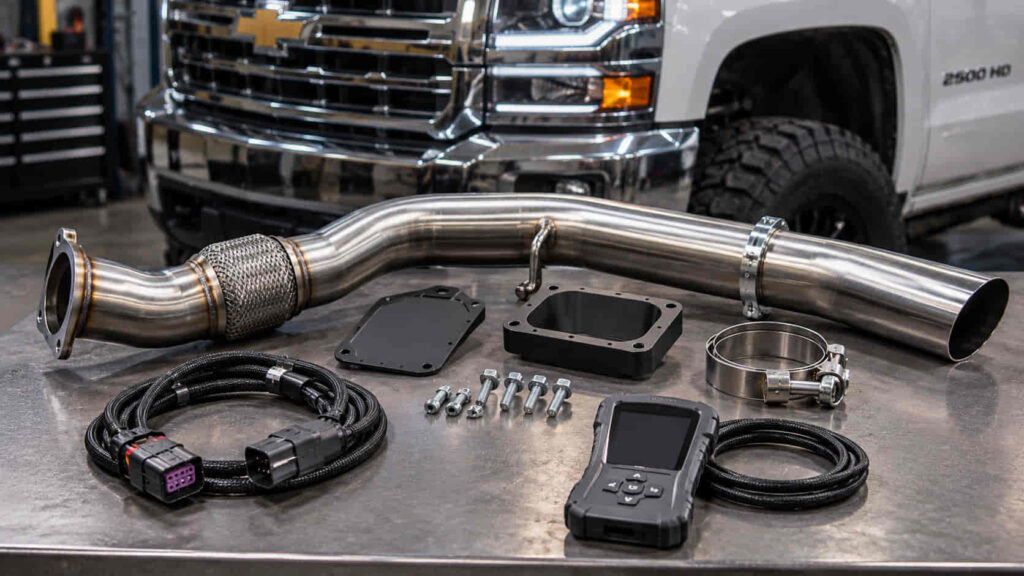
An L5P delete kit refers to aftermarket hardware or software intended to remove, bypass, or disable factory emissions-control systems on the 6.6L Duramax L5P diesel engine. These systems include the diesel particulate filter (DPF), exhaust gas recirculation (EGR), and selective catalytic reduction (SCR) equipment that uses diesel exhaust fluid (DEF).
The L5P Duramax was introduced in the 2017 Chevrolet Silverado HD and GMC Sierra HD. Its original factory rating was 445 horsepower and 910 lb-ft of torque. For the 2024 model year, GM updated the engine to produce 470 horsepower and 975 lb-ft.
Both generations use sophisticated engine management and emissions technology to deliver strong towing performance while meeting applicable exhaust emissions standards.
L5P delete kits are often marketed as solutions for regeneration problems, DEF system faults, exhaust restrictions, and expensive emissions-related repairs. Some sellers also promote potential increases in horsepower, fuel economy, and engine lifespan.
However, these claims require careful evaluation.
Deleting emissions equipment does not automatically increase horsepower, improve fuel economy, or make the L5P more reliable. Results depend on the engine’s original condition, electronic calibration, operating environment, and other mechanical modifications.
More importantly, removing or disabling factory emissions systems on a road vehicle is prohibited under the United States Clean Air Act. Federal law addresses both physical tampering and aftermarket devices designed to defeat emissions controls.
Similar restrictions may apply in other countries, depending on local vehicle approval and emissions laws.
Removing factory emissions equipment can also create warranty complications, diagnostic problems, increased pollution, and difficulties when inspecting or selling the vehicle.
Fortunately, many complaints that lead owners to consider a delete kit can be addressed through proper diagnosis and repair of the original equipment.
This L5P delete kit guide examines seven essential considerations, explains how the emissions systems work, and explores the legal and mechanical alternatives available to Duramax owners.
What Is an L5P Delete Kit?
An L5P delete kit is a general aftermarket term for products intended to bypass or disable some or all of the factory diesel emissions-control equipment on the Duramax 6.6L L5P engine.
The term does not describe one standardized Chevrolet or GMC service product.
Different aftermarket packages target different components.
A DPF delete concerns the diesel particulate filter and related exhaust aftertreatment equipment.
An EGR delete targets the system responsible for recirculating a controlled amount of exhaust gas into the intake.
A DEF or SCR delete refers to disabling the system that uses diesel exhaust fluid to reduce nitrogen oxide emissions.
Certain products also involve changes to engine control module programming.
However, these modifications affect systems designed to work together.
The engine control module monitors exhaust temperatures, pressure readings, regeneration conditions, fuel delivery, and emissions equipment operation.
Consequently, removing one component can create additional diagnostic or operational problems.
An L5P delete kit is therefore not equivalent to an ordinary exhaust replacement or routine maintenance part.
Its purpose is to change the vehicle’s original emissions-control configuration.
For road vehicles in the United States, this raises significant legal issues.
A compliant repair restores the emissions system’s intended function rather than bypassing it.
Which Duramax Trucks Have the L5P Engine?
The L5P engine was introduced for the 2017 Chevrolet Silverado 2500HD and 3500HD and GMC Sierra 2500HD and 3500HD.
It replaced the earlier LML Duramax in these heavy-duty pickup applications.
The L5P belongs to GM’s 6.6-liter V8 Duramax family.
It uses a cast-iron engine block, aluminum cylinder heads, high-pressure common-rail direct injection, and turbocharging.
The engine also incorporates modern electronic controls and exhaust aftertreatment systems.
However, production-year differences are important.
For 2017–2023 heavy-duty pickups, GM published a factory rating of 445 horsepower and 910 lb-ft of torque.
Beginning in 2024, the updated L5P produces 470 horsepower and 975 lb-ft.
The later engine also received significant technical improvements.
Therefore, components associated with one production generation should not automatically be assumed compatible with another.
The vehicle identification number and engine RPO code should be used to confirm the exact powertrain.
This is especially important when researching repair parts, software updates, and service bulletins.
The L5P should also be distinguished from the L5D Duramax used in certain medium-duty Chevrolet applications.
Although the engines are related, their ratings and equipment configurations are not identical.
1. L5P DPF Delete: Understanding the Diesel Particulate Filter
The diesel particulate filter is an essential part of the L5P exhaust aftertreatment system, designed to capture soot and reduce particulate emissions from diesel combustion.
During normal engine operation, diesel combustion can produce solid particles.
The DPF traps much of this material before exhaust gases leave the vehicle.
However, the filter has a limited capacity for accumulated soot.
The engine control system therefore performs regeneration events.
Regeneration raises exhaust temperatures under controlled conditions to oxidize trapped soot.
GM’s 2025 Duramax diesel supplement explains that the engine control module monitors fuel consumption, driving distance, and engine operating hours when determining cleaning requirements.
The manufacturer also notes that regeneration may temporarily change engine sound and idle speed.
A temporary reduction in fuel economy can occur during the cleaning process.
However, these effects do not automatically indicate a mechanical problem.
DPF-delete products are promoted as eliminating the need for filter regeneration.
Nevertheless, removing the filter also eliminates an important emissions-control function.
It does not correct problems with the engine’s fuel system, turbocharger, or combustion efficiency.
If excessive soot originates from another mechanical fault, that underlying condition can remain.
For road vehicles, a properly functioning factory DPF should be maintained rather than bypassed.
2. L5P DEF Delete: What the SCR System Actually Does
The L5P uses diesel exhaust fluid with a selective catalytic reduction system to reduce nitrogen oxide emissions.
DEF is a specially formulated fluid used by modern diesel emissions systems.
It is stored in a separate tank.
The fluid is not mixed with diesel fuel.
The exhaust aftertreatment system uses DEF to support chemical reactions that convert nitrogen oxides into less harmful substances.
The engine computer monitors the system using relevant sensors and operating parameters.
GM requires DEF meeting ISO 22241 or carrying the appropriate API certification.
Incorrect or contaminated fluid can damage components.
The vehicle may also display warnings when the fluid level becomes low or the system detects a malfunction.
If the problem remains unresolved, the truck can eventually limit vehicle speed according to its manufacturer-programmed protection strategy.
A so-called DEF delete is intended to eliminate the original fluid-management requirement.
However, doing so disables part of the vehicle’s emissions-control system.
It also creates potential electronic diagnostic and regulatory problems.
A malfunctioning DEF system should instead be evaluated for fluid quality, sensor faults, dosing problems, wiring damage, and related components.
Replacing a confirmed defective part is different from removing the entire emissions system.
3. L5P EGR Delete: How Exhaust Gas Recirculation Works
The L5P uses a cooled exhaust gas recirculation system to manage combustion conditions and reduce nitrogen oxide formation.
EGR returns a controlled portion of exhaust gas to the engine intake.
This changes the combustion environment.
The system helps lower nitrogen oxide emissions under appropriate operating conditions.
However, exhaust gas also contains combustion byproducts.
Over time, deposits can develop in certain EGR-related components.
The amount and severity of buildup depend on engine condition, operating conditions, and maintenance history.
A malfunctioning EGR valve or cooling component may cause drivability complaints.
Symptoms can include reduced performance, abnormal engine operation, or relevant diagnostic trouble codes.
However, these symptoms do not automatically prove that the EGR system is defective.
Fuel injection problems, intake restrictions, or electrical faults can create similar complaints.
EGR-delete products are marketed as reducing contamination and simplifying the engine’s intake arrangement.
Nevertheless, eliminating EGR changes the engine’s original emissions-control strategy.
The effect on combustion temperature, electronic calibration, and associated systems must be considered.
For a road vehicle, the appropriate response is to diagnose the malfunction and restore the factory equipment.
A properly functioning EGR system should not automatically be considered a mechanical defect.
4. L5P Delete Tuning: Why Engine Software Matters
The L5P engine control module manages fuel injection, turbocharging, emissions monitoring, and multiple engine protection functions, so changes to emissions hardware can affect electronic operation.
Modern diesel engines rely on extensive coordination between mechanical components and software.
The ECM monitors operating parameters through multiple sensors.
It also determines when the DPF requires regeneration.
DEF system operation and EGR control are integrated into the vehicle’s broader engine management strategy.
Aftermarket delete products may be marketed alongside electronic calibration changes.
However, software that defeats factory emissions controls can qualify as an illegal defeat device under United States law.
There are additional mechanical considerations.
An altered calibration may change combustion pressure, exhaust temperature, fuel delivery, or turbocharger operation.
These changes can affect engine durability.
The transmission must also be considered.
An increase in engine torque can place additional load on drivetrain components.
Therefore, an engine advertised as producing more power after modification is not necessarily more dependable.
A malfunctioning emissions system should not be treated as a reason to disable diagnostic monitoring.
The correct approach is to identify the failed component and restore the engine’s intended operation.
5. Does an L5P Delete Increase Horsepower or Torque?
An L5P delete does not guarantee a measurable increase in horsepower or torque, and claims about large performance gains often involve additional engine tuning rather than emissions equipment removal alone.
The factory L5P already produces substantial output.
The original 2017 engine was rated at 445 horsepower and 910 lb-ft.
The updated 2024 engine produces 470 horsepower and 975 lb-ft.
These values demonstrate that the engine is capable of significant performance with its factory emissions systems installed.
An exhaust restriction can reduce performance when a DPF is severely blocked.
However, the appropriate repair is to determine why the restriction occurred.
A failed filter may need professional cleaning or replacement.
A sensor problem may be incorrectly reporting soot accumulation.
A fuel system fault may also be producing excessive soot.
Removing emissions equipment does not automatically repair any of these underlying causes.
Claims about delete-related horsepower gains frequently combine hardware changes with additional tuning.
This makes it difficult to attribute the claimed difference to one component.
Reliable performance comparisons require controlled testing of the same vehicle under comparable conditions.
For owners seeking better towing performance, maintaining the fuel system, turbocharger, cooling system, and factory drivetrain often provides greater practical value than pursuing unverified horsepower claims.
6. Are L5P Delete Kits Legal?
For road-use vehicles in the United States, removing or disabling the L5P’s factory emissions-control systems is prohibited by the federal Clean Air Act.
The U.S. Environmental Protection Agency explains that the law prohibits tampering with emissions-control devices.
It also prohibits manufacturing, selling, or installing certain products designed to defeat those systems.
These restrictions can apply to physical hardware and electronic software.
Therefore, calling a product a racing component does not automatically make its installation lawful on a road vehicle.
The same concern applies when a truck is privately owned.
Private ownership does not create a general exemption from federal emissions requirements.
State and local regulations may impose additional inspection and registration requirements.
A deleted vehicle may also create difficulties during resale.
The legal situation outside the United States varies by country and jurisdiction.
Some regions have different emissions standards and vehicle modification procedures.
However, local rules must be checked before modifying an approved vehicle.
For ordinary road use, maintaining the factory DPF, EGR, and SCR equipment is the appropriate compliance-oriented approach.
This also helps preserve the vehicle’s original emissions certification.
7. Does an L5P Delete Improve Engine Reliability?
There is no reliable manufacturer-backed evidence proving that deleting the L5P’s emissions systems consistently increases overall engine lifespan.
Some owners view emissions equipment as an additional source of potential repair costs.
This concern is understandable because the DPF, DEF system, and EGR components require maintenance and can experience failures.
However, fewer installed components do not automatically mean better overall reliability.
The engine’s internal durability depends on lubrication, cooling, fuel quality, turbocharger operation, combustion conditions, and mechanical loading.
Removing the DPF does not repair a worn injector.
Disabling EGR does not restore a damaged turbocharger.
Changing emissions-related software does not correct low oil pressure.
Certain aftermarket calibrations may also increase engine stress.
Therefore, a modified L5P may introduce different reliability risks rather than simply eliminating problems.
Another consideration is long-term serviceability.
A truck with a nonstandard electronic calibration may be more difficult for an ordinary repair facility to diagnose.
Manufacturer software updates may also create compatibility complications.
The most reliable approach is to maintain the original systems, correct confirmed faults, and follow the appropriate GM service procedures.
L5P Delete Kit vs. Factory Emissions Repair
The main difference between an L5P delete and a factory emissions repair is that a repair restores the original system’s function, while a delete is intended to bypass that function.
This distinction has important technical and financial consequences.
If a DPF becomes restricted, the technician should determine whether the filter contains excessive soot or accumulated noncombustible ash.
Soot can be removed through appropriate regeneration under the correct conditions.
Ash requires a different service approach.
If the filter is physically damaged, replacement may be necessary.
Similarly, a DEF warning does not always mean the complete SCR system must be replaced.
The problem may involve contaminated fluid, a sensor, a dosing component, or an electrical connection.
An EGR fault can also have multiple causes.
A component may be stuck, contaminated, leaking, or incorrectly controlled.
A proper diagnosis targets the specific failure.
Deleting equipment can create regulatory problems while leaving other mechanical faults unresolved.
For owners planning to keep their truck for many years, a correctly documented factory-compatible repair can also simplify later maintenance and resale.
Why Does the L5P DPF Keep Regenerating?
Frequent or incomplete L5P regeneration can result from operating conditions, excessive soot production, sensor faults, or problems preventing the exhaust system from reaching the required cleaning conditions.
GM’s diesel supplement explains that the DPF cannot always complete regeneration during extended idling or very short trips.
The engine must produce appropriate operating conditions to clean the filter.
Repeated interruptions can contribute to increasing soot accumulation.
However, frequent regeneration may also indicate an underlying engine problem.
A fuel injector fault can increase soot formation.
An intake or boost-system problem may change combustion efficiency.
Exhaust temperature and pressure sensors must also provide accurate information.
Therefore, a vehicle that repeatedly requests DPF cleaning should be diagnosed rather than immediately classified as needing a delete.
GM explains that a driving-based cleaning event can take up to approximately 30 minutes under suitable conditions.
However, this is not a guaranteed fix for a severely restricted or physically damaged DPF.
The driver should follow the vehicle’s exact messages and owner’s manual.
If the system cannot complete the necessary cleaning, professional service may be required.
Read more: Are Kohler Engines Good
What Does L5P Trouble Code P2463 Mean?
P2463 is associated with excessive diesel particulate filter soot accumulation, but it does not identify one universal failed component.
The code indicates that the engine management system has detected a relevant DPF soot-loading condition.
However, the reason must be investigated.
The filter may have accumulated excessive soot because regeneration was repeatedly interrupted.
A pressure sensor problem may also affect the system’s interpretation.
An engine fault that increases soot production can contribute to the condition.
GM bulletin 17-NA-374 provides information about DPF soot accumulation and regeneration strategies on relevant Duramax applications.
The bulletin also explains changes to how soot load information is displayed through diagnostic equipment.
For a 2024 L5P application, GM preliminary information PIP5936 distinguishes certain combinations involving P2463 and P24A4.
The recommended repair can differ according to the exact codes present.
This demonstrates why a general recommendation to remove the DPF is not a valid diagnostic strategy.
A professional technician should evaluate the underlying condition and follow the applicable service information.
Replacing or regenerating the DPF should occur only when the diagnostic findings support that repair.
Common L5P DEF and SCR Problems
DEF and SCR problems may involve fluid contamination, inadequate fluid delivery, sensor faults, electrical failures, or catalyst-related performance issues.
The DEF system must maintain the appropriate fluid supply.
GM specifies DEF meeting ISO 22241 or the applicable API certification.
Using incorrect fluids can damage the aftertreatment system.
However, fluid quality is not the only possible issue.
Temperature conditions can also affect DEF operation.
GM notes that DEF freezes below approximately 12°F, equivalent to -11°C.
The vehicle incorporates provisions for operation in cold weather, but the correct service procedures must still be followed.
Electrical faults can also affect system operation.
Sensors may report implausible information.
Dosing equipment may fail to operate correctly.
The vehicle can respond with warning messages and, in unresolved cases, reduced-speed operation.
However, a DEF warning alone does not establish the cause.
A technician should inspect the stored diagnostic trouble codes and relevant operating data.
Replacing a confirmed defective component can restore normal system operation without disabling the original emissions equipment.
Can an L5P DPF Be Cleaned Instead of Replaced?
Some L5P DPF problems can be addressed through an approved regeneration or professional cleaning procedure, while filters that are physically damaged or excessively contaminated may require replacement.
The appropriate repair depends on the material accumulated inside the filter.
Soot is a combustible particulate that can be reduced through controlled regeneration.
However, ash from oil additives and other noncombustible material cannot be removed in the same way.
A filter may also be damaged by overheating or other mechanical problems.
Therefore, a professional assessment is important.
The technician should evaluate soot loading, differential pressure, temperature data, and any related trouble codes.
GM provides specific service procedures for DPF regeneration.
However, these procedures have strict operating prerequisites.
The exhaust system reaches extremely high temperatures during the process.
Attempting an inappropriate stationary regeneration can create a fire or injury hazard.
The manufacturer’s instructions and professional safety requirements must be followed.
A properly completed filter repair may restore exhaust flow and normal regeneration behavior.
However, the root cause must also be corrected.
Cleaning a DPF without repairing an injector or boost problem that caused excessive soot may lead to repeated restrictions.
Can You Regenerate an L5P DPF Without a Shop?
The L5P can perform automatic DPF regeneration during normal driving when the required conditions are satisfied, but manually commanded stationary regeneration is not universally available on every Silverado or Sierra HD.
The engine control module manages automatic regeneration.
The vehicle may notify the driver when continued driving is required.
GM’s 2025 diesel supplement explains that interrupted regeneration can occur during extended idling, short trips, and stop-and-go operation.
The manual advises following the vehicle’s displayed instructions and operating the truck safely under suitable driving conditions.
However, manually commanded stationary regeneration is different.
GM identifies the feature for certain fleet and commercial configurations.
The relevant equipment code is FPF.
A conventional privately owned pickup should not automatically be assumed to have this function.
GM bulletin 20-NA-203 also describes the available manual-regeneration system and its limitations.
The process involves high exhaust temperatures.
It must not be attempted in an enclosed space or near combustible materials.
A severely restricted filter may also require professional service rather than ordinary driving.
The correct approach is to follow the specific owner’s manual and diagnostic instructions.
Does an L5P Delete Improve Fuel Economy?
Claims that an L5P delete consistently improves fuel economy are not supported by a universal, manufacturer-verified mileage improvement figure.
Diesel fuel consumption depends on many variables.
These include vehicle weight, towing load, road speed, driving style, tire size, axle ratio, terrain, and weather.
Regeneration can also temporarily influence consumption.
GM acknowledges that a reduction in fuel economy may be noticeable during DPF self-cleaning.
However, this does not establish the overall fuel economy of a deleted truck.
Some aftermarket performance claims combine emissions modifications with changes to engine calibration.
The resulting comparison may therefore involve several variables.
A modified truck may also be driven differently.
Increased horsepower can encourage harder acceleration.
This can increase fuel use rather than reduce it.
The most meaningful comparison would use controlled measurements over comparable routes and workloads.
Even if a particular modification changed fuel consumption, the legal, environmental, and mechanical consequences would still need to be considered.
For owners seeking better fuel economy, correcting a malfunctioning DPF, maintaining correct tire pressure, and following approved engine maintenance practices are more straightforward alternatives.
Does an L5P Delete Affect the Transmission?
An L5P delete does not directly determine transmission reliability, but aftermarket engine calibration changes can alter torque delivery and increase drivetrain stress.
The original L5P was rated at 910 lb-ft of torque.
The updated engine produces 975 lb-ft.
These figures represent substantial output.
The transmission and driveline are engineered around the vehicle’s approved operating characteristics.
Increasing engine torque through aftermarket tuning can place additional load on transmission components.
However, the actual effect depends on the calibration, operating conditions, and transmission model.
The earlier L5P pickups used an Allison-branded six-speed automatic transmission.
For the redesigned 2020 Super Duty-class GM HD pickups, the powertrain moved to an Allison-branded 10-speed automatic transmission.
The transmission generation must therefore be identified before evaluating performance modifications.
A change to emissions hardware does not automatically improve transmission durability.
A truck with harsh shifting, slipping, or abnormal transmission temperature requires a specific drivetrain diagnosis.
The appropriate repair depends on the confirmed condition.
How Much Does an L5P Delete Kit Cost?
The total cost associated with an L5P delete varies by the products and electronic changes involved, but a low advertised kit price does not represent the complete financial risk.
Aftermarket listings may separate hardware from related software products.
However, pricing and compatibility change over time.
A modification may also create additional costs involving troubleshooting, inspection compliance, and future repair work.
A vehicle with nonstandard engine software may require more specialized support.
Returning a modified truck to a compliant original configuration can also become expensive.
For these reasons, the advertised price should not be treated as the complete ownership cost.
A better comparison is the cost of correcting the actual mechanical complaint.
For example, a malfunctioning pressure sensor may be far less expensive to repair than replacing an entire DPF assembly.
A damaged filter can require a more substantial investment.
A DEF system problem may involve a specific component rather than the complete aftertreatment system.
Therefore, owners should obtain an itemized diagnostic report before making an expensive decision.
The correct estimate should identify the fault, the required parts, labor, and applicable warranty coverage.
Are L5P Delete Kits Worth It for Off-Road Use?
Describing an L5P delete kit as an off-road product does not automatically make the modification lawful under every emissions regulation.
The important distinction is between a vehicle’s actual regulatory classification and the wording used in aftermarket advertising.
A factory-certified road vehicle remains subject to applicable emissions requirements.
Simply operating it on private property does not necessarily change its legal status.
Likewise, a racing-related product description does not automatically create a legal exemption.
United States federal law addresses emissions tampering and defeat devices.
Other jurisdictions may have different rules, but their requirements must be checked independently.
There may be specialized equipment or genuine competition applications subject to different regulatory frameworks.
However, those circumstances require careful legal evaluation.
They should not be assumed to apply to an ordinary Silverado or Sierra HD.
For owners using a truck on public roads, retaining the manufacturer-approved emissions equipment is the appropriate approach.
This also supports inspection compliance and future vehicle resale.
L5P Delete Kit Compatibility: 2017–2023 vs. 2024 and Newer
L5P engines from 2017–2023 and the updated 2024-onward generation differ in factory performance and certain supporting systems, so their aftermarket compatibility should not be assumed identical.
The original L5P was introduced in 2017.
It produced 445 horsepower and 910 lb-ft of torque.
For 2024, GM increased output to 470 horsepower and 975 lb-ft.
The updated engine features changes intended to improve performance and efficiency.
However, both generations retain factory emissions equipment.
The exact aftertreatment architecture, electronic calibration, sensors, and components can vary by production period.
This matters when selecting legitimate replacement parts.
A DPF assembly or sensor from one model year should not automatically be considered interchangeable with another.
The same principle applies to EGR and SCR components.
The correct GM service parts catalog uses vehicle and engine identification information to establish compatibility.
Owners should therefore prioritize VIN-specific parts.
For repairs involving software updates, the authorized calibration must match the installed ECM and engine configuration.
The engine’s manufacturing year and the vehicle’s registration year are not always the same.
Exact identification helps prevent incorrect repairs.
L5P Delete vs. Emissions-Compliant Performance Upgrades
Emissions-compliant performance improvements can offer a more practical alternative to deleting factory equipment, although compatibility and regulatory approval must be verified for each product.
An engine that has lost power should first be diagnosed.
A clogged fuel filter can reduce performance.
An intake or charge-air leak may affect boost pressure.
A worn sensor can provide incorrect control information.
A malfunctioning DPF may also create a restriction.
Correcting these conditions can restore the engine’s original performance.
However, restoration should not be confused with increasing output beyond factory specifications.
Aftermarket upgrades require separate evaluation.
A product marketed as performance equipment is not automatically emissions compliant.
The buyer should verify whether it has an applicable regulatory approval for the exact vehicle.
In California, certain aftermarket parts may have a California Air Resources Board Executive Order covering specified applications.
Other jurisdictions use different compliance systems.
A properly approved upgrade may offer benefits without disabling the original emissions equipment.
However, an increase in horsepower also does not automatically improve durability or towing capacity.
The complete vehicle’s published ratings must still be respected.
Can an L5P Delete Void the Factory Warranty?
Emissions-related modifications can affect warranty eligibility, particularly when a failure is caused by or connected to an unauthorized alteration.
However, warranty consequences should be described accurately.
It is misleading to claim that every unrelated vehicle warranty automatically disappears after any modification.
The specific warranty terms, applicable laws, and relationship between the modification and the failure matter.
A nonstandard engine calibration may create complications when a manufacturer evaluates an engine or emissions-system problem.
Removing factory DPF, EGR, or SCR equipment also changes the vehicle’s original configuration.
GM’s diesel supplement expressly states that the DPF and other specified exhaust components must not be altered.
The manufacturer also warns that damage caused by incorrect fuel or unsuitable oil may not be covered.
Warranty concerns are particularly important on newer vehicles.
Owners should review their written warranty terms before authorizing modifications.
A properly documented repair using approved components can reduce uncertainty.
For a vehicle still within its emissions warranty period, the first step should be checking whether the original problem is covered.
Should You Buy a Used L5P With Deleted Emissions Equipment?
A used L5P truck with removed emissions equipment should be approached cautiously because the modifications may affect legal compliance, diagnostics, reliability, and resale value.
The first consideration is whether the truck can legally be registered and operated in the intended jurisdiction.
A seller’s statement that the vehicle is intended for off-road use does not automatically resolve this issue.
The original factory equipment should also be evaluated.
A deleted truck may be missing expensive components.
Restoring the vehicle to its compliant configuration can require substantial parts and labor costs.
The engine calibration may also have been modified.
This can complicate diagnosis and future servicing.
Another concern involves mechanical history.
Some owners modify an engine after experiencing repeated DPF or DEF problems.
However, the original reason for those problems may never have been repaired.
A truck that previously produced excessive soot may still have an injector or boost-system issue.
The buyer should request maintenance records and information about all modifications.
A qualified diesel specialist should inspect the engine and electronic systems.
For ordinary road use, a complete factory-compliant L5P is generally the more straightforward and lower-risk purchase.
How to Maintain an L5P Without Deleting Emissions Equipment
Maintaining the L5P’s original emissions systems begins with proper fuel, correct engine oil, routine filtration service, and prompt diagnosis of exhaust-related warning messages.
GM specifies ultra-low-sulfur diesel fuel.
The 2025 diesel supplement warns that unsuitable fuel can damage DPF components.
The correct engine oil is equally important.
GM specifies API CJ-4 or CK-4 oil quality for the documented 2025 6.6L Duramax.
The appropriate viscosity should be selected according to the engine manual.
Oil change timing should follow the vehicle’s maintenance system and operating requirements.
The fuel filter also requires periodic replacement.
Poor fuel quality can damage precision injection components and affect combustion.
The DEF system should receive certified fluid only.
Fuel and DEF must never be mixed.
When a DPF cleaning message appears, the driver should follow the owner’s manual.
Repeated short trips and extended idling can interfere with regeneration.
However, changing driving habits cannot repair a physically damaged filter or defective sensor.
Persistent warnings require professional diagnosis.
This maintenance approach helps preserve engine performance while retaining the vehicle’s original emissions-control systems.
Final Verdict: Is an L5P Delete Kit Worth It?
For an L5P-powered Silverado or Sierra used on public roads, an emissions delete is not a sound solution to DPF, EGR, or DEF problems because it creates legal and compliance issues without guaranteeing better performance or reliability.
The L5P is already a powerful engine in its original configuration.
The 2017–2023 version produces 445 horsepower and 910 lb-ft of torque.
The 2024-onward version increases output to 470 horsepower and 975 lb-ft.
Both generations use factory DPF, EGR, and SCR equipment.
These systems are designed to reduce particulate and nitrogen oxide emissions.
However, they can require maintenance and repair.
A DPF may become restricted.
DEF dosing equipment or sensors may malfunction.
EGR components can also develop mechanical problems.
These issues should be diagnosed individually.
A DPF cleaning or replacement may be appropriate when the filter is confirmed to be the problem.
A DEF warning may require fluid-quality testing, electrical diagnosis, or replacement of a particular component.
An EGR malfunction may also be repairable without removing the complete system.
Claims that deletion guarantees large horsepower gains, better fuel economy, or longer engine life are not supported by one universal set of reliable test results.
There are also important legal restrictions.
In the United States, the Clean Air Act prohibits emissions tampering and certain aftermarket defeat devices.
Warranty, registration, inspection, and resale complications can create additional ownership risks.
The best alternative to an L5P delete kit is to keep the factory emissions system functional, identify the exact cause of any warning or performance loss, and complete an approved repair.
This approach supports the Duramax engine’s intended performance, preserves its emissions-control function, and reduces the likelihood of creating additional mechanical or regulatory problems.