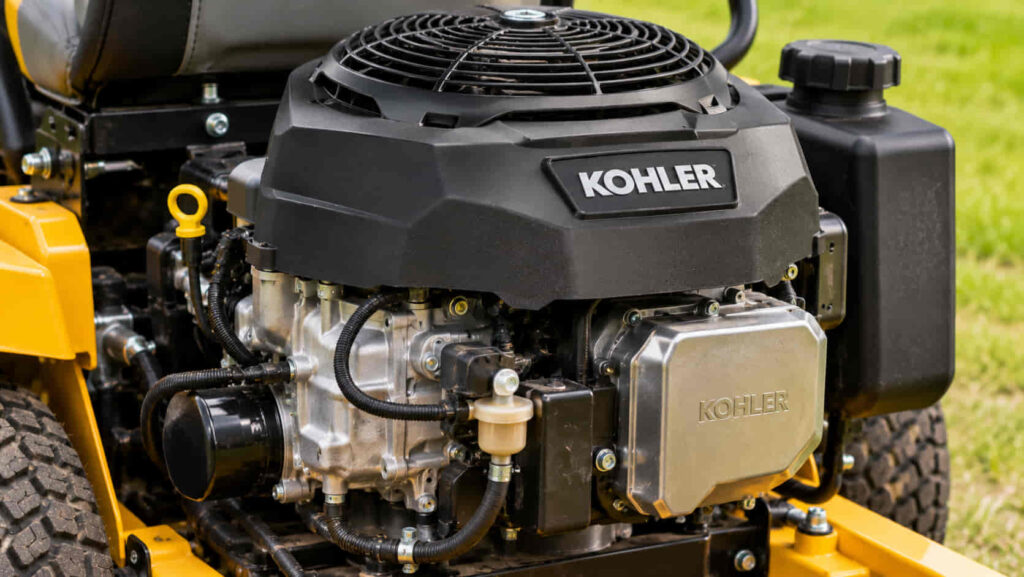
Yes, Kohler engines are generally good, especially the 7000 Series and Command PRO models, which offer dependable performance, serviceable components, and strong support for riding lawn mowers, zero-turn mowers, and commercial equipment. However, Kohler engine reliability varies significantly by product family, operating conditions, and maintenance history.
The Kohler 7000 Series is particularly popular in residential lawn tractors and zero-turn mowers. It uses an air-cooled V-twin design, pressure lubrication, and replaceable oil and air filters. Kohler developed the engine family using design principles from its commercial Command PRO engines.
The Command PRO series is designed for more demanding commercial applications. Depending on the model, these engines offer heavy-duty filtration, full-pressure lubrication, hydraulic valve lifters, and electronic fuel injection.
However, not every engine carrying the Kohler name has the same reputation.
Older Kohler Courage engines, particularly certain single-cylinder configurations, have attracted criticism for mechanical failures and crankcase-related problems. By comparison, the Command PRO family has a stronger reputation among many professional equipment owners.
Kohler engines are best evaluated by their exact engine series rather than the brand name alone.
Another important development concerns the company itself. Kohler’s engine business is now part of Rehlko, the independent energy company established in 2024. The transition to Rehlko branding continued through 2026, although many engines, manuals, and replacement parts still carry the Kohler name.
For buyers considering a new mower, the important factors include engine construction, expected operating hours, warranty coverage, maintenance costs, and the availability of local service.
For owners of older equipment, engine condition is even more important.
A well-maintained Kohler Command engine with several hundred operating hours may remain in excellent condition. A neglected engine with substantially fewer hours may require expensive repairs.
This guide examines seven important facts about Kohler engine reliability, explains the differences between the 7000 Series, Command PRO, Courage, and EFI models, and compares Kohler with Kawasaki, Briggs & Stratton, and Honda engines.
Are Kohler Engines Reliable?
Kohler engines can provide reliable long-term performance when the correct model is matched to the workload and maintained according to the manufacturer’s instructions.
Kohler has produced small gasoline engines for more than a century. Its engines have been widely installed in lawn tractors, zero-turn mowers, landscaping equipment, generators, and other powered machinery.
However, the company has developed several engine families for different purposes.
A residential mower engine is typically designed for intermittent mowing and seasonal use. A commercial engine must operate under more demanding conditions, sometimes for many hours each working day.
These applications place different requirements on lubrication, cooling, filtration, and internal components.
Kohler’s 7000 Series is aimed primarily at residential equipment, although it incorporates design features associated with the Command PRO commercial line.
Command PRO engines are intended for professional and heavy-duty use.
The Confidant series also occupies an important position in the mower engine lineup, with designs evaluated against Command PRO durability standards.
However, reliability cannot be measured solely by manufacturer claims.
Real-world performance depends on fuel quality, engine maintenance, operating temperature, air filtration, and the condition of the complete mower.
There is no comprehensive public failure-rate database establishing that every Kohler engine family is more or less reliable than competing brands.
The most accurate conclusion is that Kohler offers several well-regarded engine families, but their durability should be assessed individually.
1. Kohler Command PRO Engines Are Built for Commercial Use
Kohler Command PRO is one of the brand’s strongest engine families for professional mowing, landscaping, and demanding equipment applications.
The series includes gasoline engines with different displacements, horsepower ratings, and operating configurations.
Popular commercial V-twin engines include models from the CH, CV, ECH, and ECV families.
Certain versions use electronic fuel injection.
Other models use conventional carburetors.
The product family includes both horizontal-shaft and vertical-shaft arrangements.
This allows Command PRO engines to serve a variety of applications.
A commercial zero-turn mower may use a vertical-shaft engine, while another piece of equipment may require a horizontal crankshaft.
Kohler’s technical literature identifies several features intended to support durability.
These include full-pressure lubrication, large air and oil filters, and heavy-duty internal components.
Hydraulic valve lifters are available in relevant models, reducing the need for conventional periodic valve-lash adjustment.
However, the exact features depend on the engine model.
A Command PRO EFI engine may also provide electronic fuel management and diagnostic capabilities.
These features are valuable for professional users, but they introduce additional electronic components.
For contractors who mow frequently, Command PRO is generally a more appropriate choice than a basic residential engine.
Nevertheless, regular maintenance remains essential.
Commercial construction does not make an engine immune to overheating, oil starvation, or contaminated fuel.
2. Kohler 7000 Series Engines Offer Good Residential Value
The Kohler 7000 Series is a good choice for many residential riding lawn mowers and zero-turn mowers because it combines a V-twin design with pressure lubrication and replaceable filtration components.
The series includes popular engines such as the KT715, KT725, KT730, KT735, KT740, and KT745.
Depending on the model, the displacement is approximately 725–747cc.
Published horsepower ratings generally range from 20 to 26 horsepower.
These engines are designed for equipment that requires more power than a small walk-behind mower.
A lawn tractor with a relatively large cutting deck can benefit from the V-twin engine’s torque characteristics.
The 7000 Series also uses pressure lubrication to supply oil to important engine components.
This helps protect internal surfaces during normal operation.
Another advantage is serviceability.
The engine uses replaceable oil and air filters.
Different filtration packages are available, including versions intended to handle more demanding conditions.
Certain models feature Smart-Choke starting technology.
The manufacturer also promotes consistent engine-speed control under changing mowing loads.
However, these features do not mean that every 7000 Series engine is a full commercial engine.
The series is principally positioned for residential lawn tractors and zero-turn applications.
For homeowners mowing regularly throughout the growing season, it can provide a strong balance of price, performance, and maintenance convenience.
3. Kohler EFI Engines Can Improve Starting and Fuel Management
Kohler engines equipped with electronic fuel injection can offer more consistent fuel delivery and easier starting under varying operating conditions compared with some carbureted alternatives.
EFI stands for electronic fuel injection.
Instead of relying exclusively on mechanical carburetor fuel metering, the system controls fuel delivery electronically.
The engine management system adjusts fuel supply according to relevant operating information.
This can improve starting behavior and throttle response.
EFI can also reduce some maintenance problems associated with carburetor fuel passages.
For example, a carburetor left with degraded gasoline may develop deposits that interfere with fuel flow.
However, an EFI engine is not immune to stale fuel or contamination.
Its fuel pump, injectors, electrical connections, and sensors must remain in good condition.
Kohler offers EFI configurations in the Command PRO and 7500 Series families.
The 7500 Series EFI includes models such as the EKT740 and EKT750.
These engines are intended to combine V-twin performance with electronic fuel delivery.
However, the actual benefit depends on the equipment and operating conditions.
EFI is especially attractive for users who value consistent starting and electronically managed performance.
Nevertheless, a carbureted engine may be simpler to diagnose and repair when specialized equipment is unavailable.
The best choice depends on service accessibility as well as technical features.
4. Kohler Engines Have Established Parts and Service Support
One of Kohler’s practical advantages is its established replacement-parts and service network, which continues under the Rehlko engine business.
Small engines require periodic replacement components.
These include air filters, oil filters, spark plugs, fuel filters, gaskets, and ignition parts.
Kohler’s official reference catalog covers a large number of engine families.
It identifies replacement components for Command PRO, Confidant, 7000 Series, Courage, and other models.
However, part compatibility depends on more than the engine’s marketing name.
The same family may contain different displacement and equipment configurations.
A KT725 engine is not automatically identical to a KT745.
Likewise, an older Courage V-twin may require different components from a Command V-twin with a similar horsepower rating.
The correct replacement part should be identified using the engine model, specification number, and serial number.
Rehlko maintains an online engine parts lookup system and authorized service network.
This can make routine maintenance easier.
However, availability varies by region.
An older engine may use components that are more difficult to obtain than those for a current production model.
Before purchasing a used mower, owners should verify the availability of important replacement parts.
A dependable engine is more useful when repairs can be completed without excessive downtime.
5. Kohler Offers Competitive Limited Warranty Coverage
Many Kohler 7000 Series engines are advertised with a three-year limited warranty, but the actual coverage depends on model, purchase date, market, and whether the equipment is used residentially or commercially.
The manufacturer’s current product information for the KT735 identifies a three-year, unlimited-hour limited warranty.
However, this should not be interpreted as unlimited protection against every possible failure.
A limited warranty is governed by specific terms.
The original application and ownership conditions matter.
Commercial use may have different requirements from residential mowing.
For example, Kohler’s 7000 Series brochure describes a three-year limited consumer warranty.
It also identifies a one-year limited commercial warranty for the relevant PRO air-filter configuration.
Therefore, a buyer should not assume that every 7000 Series engine receives the same three-year coverage when used professionally.
Command PRO engines may also have different warranty terms.
The applicable product and official warranty documentation should be checked.
Another distinction involves the mower itself.
The mower manufacturer may provide a separate warranty for the deck, transmission, frame, and electrical components.
An engine warranty does not automatically cover the entire machine.
Owners should retain purchase receipts and maintenance records.
A warranty claim can become more difficult when the engine has been operated without proper maintenance or under conditions excluded by the written warranty.
6. Older Kohler Courage Engines Have a Mixed Reliability Reputation
The Kohler Courage series has a more mixed reputation than the Command PRO and 7000 Series, particularly among owners discussing certain older single-cylinder engines.
The Courage family includes both single-cylinder and V-twin configurations.
These engines should not be treated as mechanically identical.
Certain older single-cylinder Courage models have been criticized for crankcase and cover-related problems.
Owner discussions describe cases involving loosened fasteners, damaged housings, and major mechanical failures.
However, these reports are individual experiences.
They do not establish that every Courage engine contains the same defect or that every model has the same failure rate.
The Courage V-twin family has a different design and may have a different ownership experience.
Some owners report substantial service life from these engines.
Others prefer the older Command series because of its construction and reputation.
For a buyer considering an older Courage-powered mower, the engine should be inspected carefully.
Oil leakage around the crankcase and valve covers is worth checking.
Unusual knocking, loose hardware, low compression, or evidence of previous repairs may require further investigation.
The condition of the equipment also matters.
An inexpensive older mower may be worth repairing if the engine is healthy and parts remain available.
However, an engine with significant crankcase damage may not be economical to restore.
The Courage name alone should not determine the final buying decision.
7. Kohler Engine Lifespan Depends More on Maintenance Than the Badge
Kohler engine longevity depends heavily on lubrication, cooling, filtration, operating conditions, and the specific engine family rather than one universal number of operating hours.
Some residential mower owners report reaching 1,000 hours or more with their engines.
Commercial Command owners also report examples exceeding 2,000 hours.
However, these observations are not statistically representative.
They also do not establish a guaranteed engine lifespan.
A mower engine may accumulate hours under very different conditions.
One homeowner may mow a relatively clean lawn for one hour each week.
A professional landscaper may operate a mower for several hours each day in dusty conditions.
The same number of hours can therefore represent different levels of mechanical stress.
Maintenance also changes the outcome.
Clean oil protects bearings and other internal components.
An effective air filter prevents abrasive dust from entering the engine.
Cooling airflow helps control cylinder head and oil temperatures.
Poor maintenance can reduce engine life even when the equipment is rarely used.
The engine’s age and storage history should also be considered.
A mower that spends long periods unused with stale gasoline may develop problems unrelated to internal engine wear.
Therefore, owners should evaluate engine condition instead of assuming that a certain hour-meter reading proves a Kohler is worn out.
How Long Do Kohler 7000 Series Engines Last?
A Kohler 7000 Series engine can provide many years of residential mowing service, but there is no manufacturer-guaranteed lifespan expressed as a fixed number of operating hours.
Some independent buyer guides use approximately 1,000–1,500 hours as a general planning range for upper-residential V-twin engines.
However, that range should not be interpreted as a verified Kohler fleet average.
Real-world outcomes vary significantly.
A properly maintained engine may exceed that range.
Another engine may require repairs much earlier.
Operating environment is important.
A 7000 Series engine used in dry and dusty conditions requires more attention to air filtration.
An engine operating in high temperatures depends on clean cooling fins and suitable lubrication.
Heavy grass can also create additional load.
However, the condition of the mower’s hydrostatic transmission, deck, and other components may determine whether the equipment remains worth owning.
For a homeowner mowing 50 hours annually, even several hundred hours of engine service can represent many years.
The important goal is not simply to achieve a certain hour reading.
It is to maintain normal oil consumption, stable operating speed, acceptable compression, and reliable starting throughout the engine’s life.
How Long Do Kohler Command PRO Engines Last?
Kohler Command PRO engines are designed for demanding use and can accumulate substantial operating hours, but actual service life depends on the application and maintenance program.
Commercial engines often operate for long periods at relatively steady governed speeds.
This can create different mechanical demands from intermittent residential mowing.
Command PRO engines use heavy-duty features intended to support professional operation.
Relevant models include full-pressure lubrication and substantial air filtration systems.
Some versions also use electronic fuel injection.
However, the exact configuration matters.
A small Command PRO single-cylinder engine should not automatically be compared with a larger EFI V-twin.
Owner reports describe Command engines operating for more than 2,000 hours.
However, these examples are anecdotal and may include repaired or rebuilt components.
They do not provide a manufacturer-certified average lifespan.
Commercial operators should evaluate engine condition through maintenance records, oil consumption, starting performance, and mechanical inspection.
The cost of downtime is another important consideration.
An engine that remains repairable and has readily available parts can offer strong ownership value even after accumulating significant operating hours.
For professional mowing, serviceability may be just as important as theoretical maximum lifespan.
Kohler 7000 Series vs Command PRO: Which Is Better?
Command PRO is generally the better choice for demanding commercial workloads, while the Kohler 7000 Series is often more cost-effective for residential mowing.
Both engine families offer useful performance.
However, they serve different market segments.
The 7000 Series uses design concepts derived from Command PRO engines.
Its pressure-lubrication system and replaceable filtration components are valuable features for residential equipment.
It is commonly installed in lawn tractors and zero-turn mowers.
Command PRO is developed for more intensive applications.
Depending on the model, it offers commercial filtration packages, hydraulic valve lifters, and additional heavy-duty components.
However, the exact hardware should be checked.
A mower equipped with a Command PRO engine may cost more than a similar machine using a 7000 Series engine.
That additional investment can be justified for a professional contractor.
For a homeowner mowing a modest property, it may not provide a meaningful financial advantage.
The complete mower also matters.
A commercial engine installed on a poorly built deck or weak hydrostatic transmission does not automatically make the machine suitable for commercial use.
The engine should be matched to the equipment’s overall design and workload.
Kohler 7000 Series vs Kohler Courage
The Kohler 7000 Series is generally the more attractive choice when comparing newer residential V-twin equipment with older Courage-powered machines of uncertain condition.
The 7000 Series benefits from a more recent engine design and an established pressure-lubrication arrangement.
It also has replaceable filtration components and a current parts-support system.
However, the Courage family is diverse.
A Courage single-cylinder engine and a Courage V-twin should not be treated as identical.
The single-cylinder models have attracted more criticism in certain owner discussions.
Some owners report crankcase-related failures.
The Courage V-twin family has a different construction.
A well-maintained Courage V-twin may remain serviceable for many years.
Therefore, replacing a healthy Courage engine simply because it carries the Courage name is not necessarily economical.
The strongest reason to choose a 7000 Series engine is its suitability for the mower and the availability of newer equipment with documented maintenance.
A used engine’s condition remains essential.
An abused 7000 Series engine may require more work than a carefully maintained Courage.
Kohler vs Kawasaki Engines: Which Is More Reliable?
Kawasaki and Kohler both produce respected mower engines, but the correct comparison depends on the specific engine series rather than the manufacturer alone.
Kawasaki’s FR series is commonly used in residential and upper-residential lawn equipment.
Its FS and FX families are associated with more demanding applications.
Kohler offers the 7000 Series for residential equipment and Command PRO for commercial use.
Therefore, comparing a Kohler 7000 Series engine with a Kawasaki FX commercial engine is not necessarily an equal comparison.
Likewise, comparing a Kohler Command PRO commercial V-twin with a basic residential Kawasaki engine may produce a different result.
Community discussions frequently express strong preferences for Kawasaki.
However, other owners report positive experiences with Kohler Command PRO and 7000 Series engines.
These opinions reflect individual ownership and repair experiences.
They do not prove a universal reliability ranking.
The complete mower should be considered.
Deck durability, transmission quality, local dealer support, and parts pricing can affect ownership more than a modest difference in engine reputation.
For a homeowner, a well-supported Kohler-powered mower may be preferable to a Kawasaki-equipped model with poor local service availability.
For commercial users, both brands deserve comparison at the appropriate engine tier.
Kohler vs Briggs & Stratton: Which Engine Is Better?
Kohler and Briggs & Stratton offer several engine families with different durability targets, so choosing the better manufacturer requires comparing equivalent engine classes.
Briggs & Stratton is well known for residential small engines.
It also offers more advanced products, including professional V-twin configurations and Vanguard commercial engines.
Kohler’s 7000 Series competes in the residential riding mower market.
Command PRO serves more demanding commercial applications.
Therefore, a Briggs & Stratton Intek engine should not automatically be compared with a Kohler Command PRO as if both were designed for the same workload.
The correct comparison includes lubrication design, filtration, displacement, warranty, maintenance requirements, and local service support.
Both manufacturers offer replacement parts and service networks.
However, actual parts prices and availability vary.
A particular engine may also have application-specific reliability concerns.
The most important buying consideration is the engine model, not simply whether the mower carries a Kohler or Briggs & Stratton badge.
For residential use, either brand may provide satisfactory service when matched to the mower and maintained correctly.
Kohler vs Honda Engines
Kohler and Honda produce engines for different applications, making direct reliability comparisons difficult without identifying the exact models.
Honda is particularly well known for small single-cylinder gasoline engines used in walk-behind lawn mowers and general-purpose equipment.
Kohler produces both small single-cylinder engines and larger V-twin configurations commonly used in riding and zero-turn mowers.
Therefore, a Honda GCV-series walk-behind mower engine should not be directly compared with a Kohler 747cc V-twin.
The two engines serve different workloads.
Honda’s small engines are valued by many owners for straightforward operation and fuel efficiency.
Kohler’s larger engines offer the displacement and torque characteristics required by heavier mowing equipment.
Both require correct maintenance.
A small Honda engine can fail after oil starvation or overheating.
A Kohler V-twin can also experience problems when its oil level, cooling system, or filtration is neglected.
The best choice depends on the mower category and intended use.
For a residential walk-behind mower, a suitable Honda engine may be attractive.
For a larger riding mower, a Kohler 7000 Series or Command PRO may be more appropriate.
Read more: GM 5.3 AFM Years to Avoid
What Are the Most Common Kohler Engine Problems?
Common Kohler engine complaints include hard starting, rough running, carburetor problems, oil leaks, ignition failures, and overheating, although the frequency and causes vary by model.
A hard-starting engine may have stale gasoline.
A dirty carburetor can also restrict fuel flow.
Ignition coils, spark plugs, and weak batteries can create similar symptoms.
An engine that surges may be experiencing unstable fuel delivery.
However, the governor, intake system, and electrical components should also be considered.
Oil leakage is another maintenance concern.
Gaskets and seals can deteriorate over time.
Some owner reports involving 7000 Series engines mention leaking valve covers.
However, those reports do not establish that every engine in the family has the same defect.
Overheating can result from blocked cooling fins or an improperly maintained air-cooled system.
Grass clippings and debris can accumulate around the engine.
Low oil level can also create serious lubrication problems.
The manufacturer recommends a systematic troubleshooting approach rather than replacing parts based on symptoms alone.
The correct diagnosis should identify whether the problem involves fuel, ignition, cooling, lubrication, or mechanical wear.
Are Kohler Courage Engines Bad?
Certain older Kohler Courage engines have earned a negative reputation among some owners, but it would be inaccurate to describe every Courage model as inherently unreliable.
The Courage name covers more than one engine design.
Single-cylinder versions have attracted criticism for specific mechanical problems.
Community discussions describe crankcase-related failures on some older units.
However, individual reports should not be treated as controlled reliability statistics.
The Courage V-twin family has a different construction.
Some owners report dependable service from these engines.
Others prefer the Command series.
For an older Courage-powered mower, the most useful approach is mechanical inspection.
The engine should start normally.
It should maintain appropriate oil level and avoid excessive smoke.
External leakage should be checked.
The crankcase should be inspected for cracks, damaged fasteners, and evidence of improper repairs.
Unusual mechanical noise may require further investigation.
The condition of the complete mower also matters.
A very old residential tractor may have transmission, deck, or electrical problems that make major engine repairs uneconomical.
A healthy Courage engine does not necessarily need replacement.
However, a mower with serious crankcase damage may be better replaced than rebuilt.
Are Kohler 7000 Series Engines Prone to Oil Leaks?
Some Kohler 7000 Series owners report oil leaks around valve covers or other sealing areas, but these reports do not establish a universal manufacturing defect affecting the entire engine family.
Oil leakage can develop for several reasons.
A gasket may deteriorate.
Fasteners may loosen or be installed incorrectly.
A crankcase ventilation problem may also affect pressure inside the engine.
However, the source of the leak must be identified.
Oil visible on the outside of the engine may originate from another location and travel along the housing before dripping.
A mechanic should clean the affected area and inspect the engine during operation when safe.
The oil level should also be checked.
A small external leak may be repairable.
However, continued operation with insufficient oil can cause substantial internal damage.
Replacing a valve cover gasket may not correct a leak caused by excessive crankcase pressure.
The crankcase ventilation system and other mechanical components should be evaluated when necessary.
Proper diagnosis can prevent repeated gasket replacements and unnecessary expenses.
Why Does a Kohler Engine Surge or Run Rough?
A Kohler engine that surges or runs unevenly may have a fuel delivery problem, contaminated carburetor, intake restriction, or another operating fault.
Surging occurs when engine speed repeatedly rises and falls.
The governor attempts to maintain a target operating speed as the engine load changes.
If fuel delivery becomes unstable, the governor may repeatedly adjust throttle position.
This can create an oscillating engine speed.
Old gasoline is a common concern in seasonal equipment.
Fuel can degrade while the mower remains unused.
Deposits may form inside carburetor passages.
However, carburetor contamination is not the only possible cause.
A restricted fuel filter or damaged fuel line can also limit delivery.
An air leak may affect the fuel mixture.
An ignition problem can create rough operation.
EFI engines require a different diagnostic approach.
Fuel injectors, sensors, and electronic controls may need evaluation.
Owners should avoid adjusting the governor to compensate for an unresolved engine problem.
The correct repair should restore normal fuel, air, and ignition operation.
Can Kohler Engines Overheat?
Yes. Kohler air-cooled engines can overheat when cooling airflow is restricted, oil level is incorrect, or the engine is subjected to abnormal operating conditions.
Air-cooled engines rely on airflow over the cylinder heads and cooling fins.
The engine’s cooling fan and shrouds direct air toward hot components.
During mowing, grass clippings and dust can accumulate around the cooling passages.
If the debris becomes excessive, heat removal may be reduced.
The engine can then operate at an abnormally high temperature.
However, overheating can also involve incorrect lubrication.
Engine oil helps carry heat away from internal components.
A low oil level may increase mechanical friction and temperature.
A restricted air intake or improper fuel mixture can also affect operation.
The manufacturer’s service schedule includes removing shrouds and cleaning cooling areas.
This is particularly important in dusty environments.
If an engine loses power or develops severe mechanical noise while running hot, it should be stopped and inspected.
Continuing to operate an overheating engine can damage the cylinder head, piston, or other internal components.
What Oil Does a Kohler Engine Use?
Kohler engine oil requirements vary by model and ambient temperature, with SAE 10W-30, SAE 30, and other manufacturer-approved grades appearing in the company’s gasoline engine guidance.
The correct viscosity should be determined from the engine operator’s manual.
The manufacturer recommends its own formulated engine oils.
However, many Kohler manuals also permit other high-quality detergent oils meeting the applicable API classification.
For example, the 7000 Series service literature identifies API SJ or higher for the documented engines.
However, the correct viscosity remains temperature-dependent.
Rehlko currently offers gasoline engine oils including SAE 30, SAE 10W-30, SAE 20W-50, and an extended-life SAE 10W-50 formulation.
This does not mean every viscosity is suitable for every engine.
An engine designed for 10W-30 should not automatically receive 20W-50 simply because the weather is hot.
The oil must be compatible with the engine’s design and intended operating conditions.
The oil level should also be checked regularly.
The proper lubricant cannot provide reliable protection when the crankcase is underfilled.
How Much Oil Does a Kohler 7000 Series Engine Take?
The Kohler 7000 Series KT715–KT745 family has a published reference oil capacity of approximately 2.0 US quarts, equivalent to 1.9 liters.
This figure appears in Kohler’s official genuine parts reference guide.
However, the guide notes that its listed quantities are based on dry engines with standard equipment.
Therefore, they should be treated as reference values.
The actual amount required during an oil and filter change may differ from a completely dry fill.
The correct procedure is to fill according to the owner’s manual and verify the final oil level with the dipstick.
Kohler also publishes different capacities for other engine families.
For example, the Courage single-cylinder family is listed at approximately 1.6 quarts.
Certain Courage V-twin configurations have reference capacities around 1.7–1.9 quarts.
Command PRO engines have different quantities according to displacement and configuration.
Therefore, oil capacity should never be selected solely from the Kohler brand name.
The exact engine model and specification number must be checked.
Overfilling or underfilling can cause mechanical problems.
Correct oil quantity is essential for reliable lubrication.
How Often Should You Change Kohler Engine Oil?
Many Kohler 7000 Series engines require an oil and filter change every 100 operating hours under their standard maintenance schedule, with more frequent service under severe conditions.
The manufacturer’s owner documentation also includes maintenance for air filters, cooling areas, fuel filters, spark plugs, and other components.
However, intervals depend on the engine and service conditions.
Kohler’s 7000 Series service literature identifies a 100-hour oil and filter interval for conventional approved oil and filter combinations.
Certain updated configurations permit an extended interval of up to 300 hours when the specified Kohler PRO 10W-50 lubricant and matching extended-life filter are used.
However, that extended interval is not automatically available on every engine.
It must be authorized by the appropriate service documentation.
Using synthetic oil alone does not justify assuming a longer interval.
Commercial maintenance can also follow different schedules.
Owners should check the manual for annual service limits as well as operating-hour requirements.
For equipment used in dusty or hot environments, inspecting the oil and air filter more frequently is important.
Oil should also be checked before operation.
A mower can develop a low oil level before reaching its scheduled oil change interval.
Does Kohler Have a Good Warranty?
Kohler offers competitive limited warranty coverage on several engine families, but the correct terms depend on the product and intended use.
The 7000 Series is commonly advertised with three-year limited consumer coverage.
Current Rehlko product information also refers to three-year limited coverage for several KT-series engines.
However, the manufacturer’s historical 7000 Series literature distinguishes residential and commercial use.
Certain commercial configurations have shorter coverage periods.
Command PRO and other commercial engine families may have different warranty arrangements.
The original purchaser, location, and service conditions can influence eligibility.
Warranty coverage should therefore be verified before purchase.
The correct written terms are more important than a general advertising statement.
Another important distinction involves maintenance.
A limited warranty does not automatically cover damage caused by improper lubrication, contaminated fuel, or neglected service.
Owners should retain maintenance records.
These records may be useful if a warranty claim becomes necessary.
The mower’s own warranty should also be reviewed separately.
A manufacturer may cover the engine differently from the deck or transmission.
Are Kohler Engines Expensive to Repair?
Kohler engine repair costs depend on the failed component, engine family, labor rates, and availability of replacement parts.
Routine maintenance is generally more affordable than internal engine repair.
Oil filters, spark plugs, and air filters are normal service components.
Ignition coil replacement may also be relatively straightforward on certain engines.
However, carburetor repair can vary significantly according to the installed model.
EFI systems may require more specialized diagnosis.
A leaking gasket is often repairable without replacing the engine.
However, extensive crankcase damage or severe cylinder wear can make repair more expensive.
The age of the engine also matters.
Some older models may have limited replacement-parts availability.
A repair becomes less attractive when the complete mower has other major problems.
For example, a residential lawn tractor with a worn hydrostatic transmission and damaged deck may not justify a costly engine rebuild.
A commercial mower with a sound chassis and drive system may justify a larger repair investment.
The correct decision compares repair cost with remaining equipment value and expected future operating hours.
Are Kohler Engines Easy to Maintain?
Many Kohler engines are relatively straightforward to maintain because they provide accessible oil service points, replaceable filters, and model-specific operator manuals.
However, maintenance difficulty varies by engine.
A carbureted 7000 Series V-twin can often be serviced using ordinary small-engine maintenance procedures.
Oil and filter replacement, spark plug service, and air filter cleaning are familiar operations.
However, some tasks require specialized tools or experience.
Valve adjustments may be required on certain engine families.
Other engines use hydraulic valve lifters that reduce routine adjustment requirements.
EFI models introduce electronic diagnostic considerations.
The mower’s installation can also affect accessibility.
An engine mounted inside a tightly packaged zero-turn mower may be harder to service than the same engine installed on an open lawn tractor.
Therefore, maintenance convenience depends on the complete machine.
Owners should identify the correct model and specification numbers before ordering parts.
The manufacturer’s manual should guide maintenance intervals and procedures.
This helps prevent incorrect oil quantities, unsuitable filters, and unnecessary repairs.
Are Kohler Engines Good for Zero-Turn Mowers?
Kohler engines can be good choices for zero-turn mowers, provided the engine family is suitable for the mower’s intended workload.
Zero-turn mowers are available in residential and commercial configurations.
A residential model may use a Kohler 7000 Series V-twin.
A more demanding commercial mower may use a Command PRO engine.
Both can provide suitable performance within their intended applications.
However, the engine is only one part of a zero-turn mower.
Hydrostatic transmissions control wheel movement.
The mowing deck determines cutting performance and durability.
The frame and suspension components also influence ownership value.
A commercial engine installed in a mower with weak drive components does not automatically make the complete machine commercially durable.
Likewise, a residential engine may provide many years of dependable service when used on an appropriate property.
The correct choice depends on mowing area, terrain, cutting frequency, and expected annual hours.
Dealer support is also important.
A locally supported Kohler-equipped mower may be more practical than another engine brand with limited service availability.
Are Kohler Engines Good for Riding Lawn Mowers?
Kohler engines are a strong option for many riding lawn mowers, particularly when the machine uses a properly matched 7000 Series or other suitable V-twin engine.
Riding mowers often operate with larger cutting decks than walk-behind machines.
They require enough torque to maintain blade speed while moving through grass.
The 7000 Series is designed for this type of residential equipment.
Its V-twin layout provides a smooth power delivery compared with some single-cylinder arrangements.
The engine also has pressure lubrication and serviceable filters.
However, a riding mower should be evaluated as a complete machine.
The transmission must be capable of handling the expected terrain and load.
The deck should be suitable for the owner’s mowing conditions.
Regular towing of heavy attachments may place additional stress on the drivetrain.
Therefore, engine horsepower alone is not sufficient for selecting a mower.
An adequately powered Kohler engine can deliver good performance, but the machine’s overall construction determines how well it handles long-term use.
How to Choose the Best Kohler Engine
The best Kohler engine depends on the intended equipment, required horsepower, operating hours, maintenance expectations, and local availability of service and parts.
For residential riding mowers, the 7000 Series is often an appropriate choice.
It offers V-twin performance and familiar maintenance requirements.
For commercial mowing, Command PRO is generally more suitable.
The series is designed for demanding operation and includes additional commercial-oriented features in relevant models.
EFI may be desirable when consistent fuel delivery and starting performance are priorities.
However, the buyer should also consider diagnostic support.
An EFI engine may require specialized equipment for certain repairs.
For a used mower, mechanical condition should take priority.
The owner should verify the engine identification.
Maintenance records are valuable.
An engine that has been serviced regularly is generally easier to evaluate than one with an unknown history.
The complete mower’s condition also matters.
A reliable engine cannot compensate for a severely worn transmission or damaged cutting deck.
The best purchase balances engine suitability, overall equipment quality, repair support, and total ownership cost.
How to Inspect a Used Kohler Engine Before Buying
A used Kohler engine should be inspected for cold-start behavior, abnormal smoke, oil leaks, unusual mechanical noise, unstable engine speed, and evidence of neglected maintenance.
The engine model should be identified first.
A Command PRO engine and a Courage single-cylinder engine require different reliability considerations.
A cold start can reveal problems that are less noticeable after the engine warms.
The engine should start without excessive cranking.
It should run smoothly at the proper governed speed.
However, an engine that runs unevenly may have a carburetor or ignition fault rather than serious internal damage.
The oil level and condition should be checked.
External leaks should be investigated.
A wet engine housing can indicate a gasket or seal problem.
The cooling fins and shrouds should be inspected for debris.
Excessive dirt can restrict airflow.
Compression testing may also be useful when mechanical wear is suspected.
The fuel system should be evaluated, especially on equipment stored for long periods.
Finally, the mower should be tested under a normal cutting load when safe and practical.
An engine that idles correctly but loses power under load may require additional diagnosis.
Is It Still Worth Buying a Kohler Engine in 2026?
Yes. Kohler engines remain worth considering in 2026, especially the 7000 Series and Command PRO families, although buyers should understand the ongoing transition to the Rehlko brand.
The engine business no longer operates under the original Kohler corporate structure.
In May 2024, Kohler Energy became a separate company following a transaction involving Platinum Equity.
The business adopted the Rehlko name in September 2024.
The engine product branding continued transitioning through 2025 and 2026.
As a result, buyers may encounter new engines labeled Rehlko alongside older inventory labeled Kohler.
However, a different brand label does not automatically mean that a completely different engine design has been introduced.
Rehlko continues to provide official engine manuals, parts information, and product support.
The company also continues developing commercial gasoline engines.
For example, its 2026 product announcements include updated Command PRO offerings.
However, buyers should still verify local service availability.
An engine’s long-term ownership value depends on replacement parts, knowledgeable technicians, and warranty support.
A Kohler or Rehlko engine remains a reasonable option when its specifications and service network match the intended application.
Final Verdict: Are Kohler Engines Good?
Yes, Kohler engines are generally good, with Command PRO standing out for commercial applications and the 7000 Series offering a strong balance of reliability, performance, and serviceability for residential riding and zero-turn mowers.
However, the Kohler name covers several engine families with different designs and maintenance requirements.
Command PRO engines are intended for demanding use.
Their commercial-oriented features include pressure lubrication, substantial filtration, and electronic fuel injection on selected models.
The 7000 Series uses design principles derived from the Command PRO platform.
Its air-cooled V-twin construction, replaceable filters, and competitive limited warranty make it attractive for homeowners.
The Confidant and 7500 Series EFI families provide additional choices depending on the required features.
Older Courage engines deserve more careful inspection.
Certain single-cylinder versions have attracted criticism in owner discussions, although not every Courage engine experiences the same problems.
Engine lifespan also varies.
Some owners report 1,000 hours or more from residential Kohler engines and over 2,000 hours from Command models.
However, these are individual examples rather than manufacturer-certified average lifespans.
The most important maintenance priorities are correct engine oil, appropriate filters, clean cooling passages, reliable fuel delivery, and regular inspection.
Warranty terms should also be checked carefully because residential and commercial applications can have different coverage.
For buyers comparing Kohler with Kawasaki or Briggs & Stratton, engine series and equipment quality matter more than brand loyalty.
A well-maintained Kohler Command PRO can be an excellent commercial engine.
A properly serviced Kohler 7000 Series can provide dependable residential operation.
For most homeowners, the Kohler 7000 Series is a sensible choice. For professional landscaping and intensive workloads, Command PRO is generally the stronger option.
The best engine is ultimately the one that matches the mower’s intended use, receives consistent maintenance, and has reliable parts and service support.