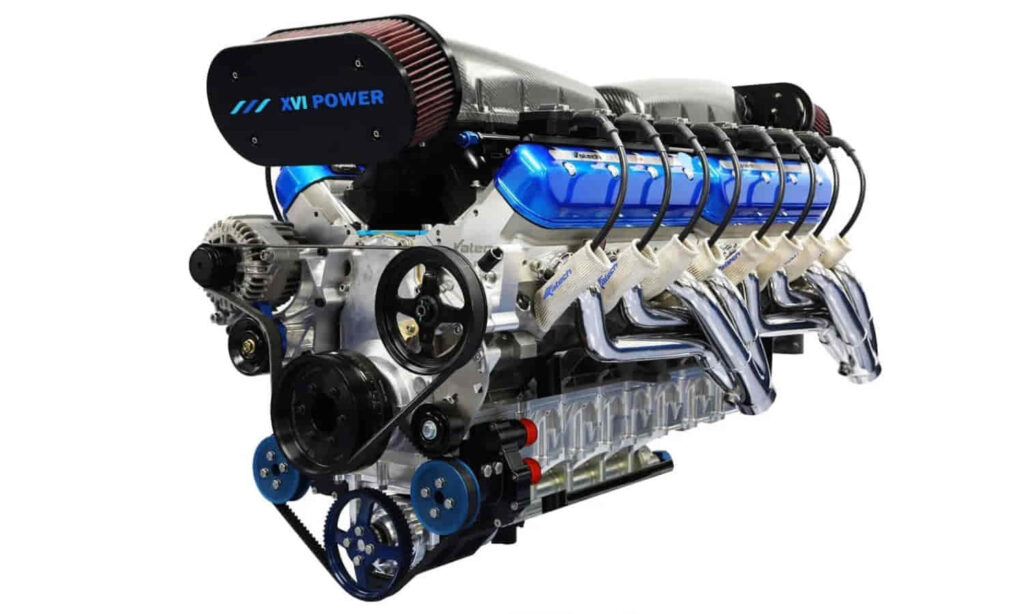
Cars with V16 engines are among the rarest vehicles in automotive history. Notable examples include the classic Cadillac V-16 models introduced in 1930, the limited-production Cizeta-Moroder V16T supercar, and the Bugatti Tourbillon, which combines a naturally aspirated V16 engine with a hybrid powertrain. These vehicles demonstrate how manufacturers have used 16-cylinder engines to achieve smooth power delivery, distinctive engineering layouts, and exceptional performance.
The Cadillac V-16 established the configuration as a symbol of American luxury during the early 1930s. Decades later, the Cizeta V16T introduced a radically different application by placing a transverse V16 engine in a high-performance Italian supercar. Bugatti has brought the V16 concept into the modern hypercar segment through the Tourbillon, pairing a large-displacement combustion engine with electric motors to deliver a combined output of 1,800 horsepower.
However, not every car associated with a V16 engine reached the production stage. Some vehicles were manufactured in limited numbers, while others remained concepts or experimental projects. Understanding these distinctions is essential when identifying cars with genuine V16 engines. This guide examines the most notable examples, explains their engine configurations, and explores why V16 engines remain uncommon compared with V8 and V12 powertrains.
What Cars Have V16 Engines?
Several notable cars have used V16 engines, but they belong to different periods of automotive history and serve different purposes. The most significant examples are the Cadillac V-16, the Cizeta-Moroder V16T, and the Bugatti Tourbillon. Cadillac represents the early luxury-car era, Cizeta demonstrates the use of a 16-cylinder engine in an exotic supercar, and Bugatti applies the configuration to a modern hybrid hypercar. Their differences show that a V16 engine is not tied to a single vehicle category.
The Cadillac V-16, introduced in 1930, was developed to deliver exceptional refinement and prestige in high-end automobiles. Its 16-cylinder engine provided smooth power delivery, making it suitable for large, luxurious cars at a time when engine configuration was an important marker of engineering sophistication. Cadillac’s V16 models are now primarily significant as historic luxury vehicles rather than examples of contemporary production engineering.
The Cizeta-Moroder V16T took a different approach. Developed in Italy during the late 1980s and introduced around the turn of the 1990s, it used a 6.0-liter V16 powertrain mounted transversely behind the passenger compartment. Its unusual layout distinguished it from conventional V8- and V12-powered supercars. Production numbers were extremely limited, so the Cizeta remains a rare example of a road-going supercar built around a V16 engine.
The Bugatti Tourbillon brings the V16 configuration into the modern hypercar era. Unlike the W16 engine used in the Bugatti Chiron, the Tourbillon features a naturally aspirated 8.3-liter V16 engine combined with three electric motors. Bugatti states that the combustion engine produces 1,000 horsepower, while the complete hybrid powertrain delivers a combined 1,800 horsepower. This configuration demonstrates how electrification can complement a large combustion engine to achieve high output without relying on the same engine architecture as previous Bugatti hypercars.
These examples also highlight an important distinction: a car featuring a V16 engine is not necessarily a mass-produced vehicle. Cadillac built V16 luxury cars historically, Cizeta produced its supercar in very limited numbers, and the Bugatti Tourbillon represents a modern hybrid hypercar developed for a new generation. Concept cars and experimental projects require separate classification because an announced engine configuration does not establish that a vehicle entered customer production.
Read more: What Engines Do F1 Cars Use
Which Cadillac Models Used V16 Engines?
Cadillac introduced its V16 engine in 1930 with the Cadillac Sixteen-cylinder models, establishing a new level of mechanical sophistication in the American luxury-car market. The original Cadillac V-16 combined a 7.4-liter engine with a refined chassis and bespoke coachwork, allowing buyers to choose from a wide range of prestigious body styles. Rather than focusing solely on speed, Cadillac designed these cars to deliver smooth power, quiet operation, and effortless performance for affluent customers.
The first-generation Cadillac V-16, produced from 1930 to 1937, used a 45-degree V16 engine with overhead valves. Its 452-cubic-inch displacement, equivalent to approximately 7.4 liters, helped it produce substantial torque at relatively low engine speeds. The engine’s 16 cylinders also contributed to smooth power delivery because more combustion events occurred during each crankshaft revolution than in engines with fewer cylinders. This refinement was particularly valuable in large luxury cars, where minimizing vibration and mechanical harshness was a major engineering priority.
Cadillac introduced a redesigned V16 engine for the 1938 model year. This second-generation engine had a narrower 135-degree cylinder-bank angle and a more compact design than its predecessor. Its displacement was approximately 7.1 liters, or 431 cubic inches. The redesign reflected the need to improve packaging and engineering efficiency while retaining the smoothness and prestige associated with a 16-cylinder engine. Cadillac continued producing V16 cars through 1940, after which the company discontinued the configuration.
The historical significance of Cadillac’s V16 models extends beyond their cylinder count. During the Great Depression, these cars represented the upper end of the luxury market, with extensive customization and coachbuilt bodywork contributing to their exclusivity. Their high production costs and limited customer base made them fundamentally different from mainstream automobiles. Today, Cadillac V-16 models are recognized as landmark examples of early American automotive engineering, demonstrating how manufacturers once used large, complex engines to distinguish their most prestigious vehicles.
Does the Cizeta V16T Have a Real V16 Engine?
Yes, the Cizeta-Moroder V16T is a real road-going supercar powered by a 6.0-liter V16 engine. Developed in Italy during the late 1980s, the car was designed to compete in the exclusive supercar market with an unusual powertrain layout and an angular body designed by Marcello Gandini. Unlike conventional supercars powered by V8 or V12 engines, the Cizeta V16T used a 16-cylinder engine assembled from two banks of eight cylinders, creating a distinctive configuration that set it apart from its contemporaries.
The defining feature of the Cizeta V16T is its transverse-mounted engine behind the passenger compartment. Its V16 powerplant was developed using two cylinder banks and connected to a transmission arrangement that allowed the engine to fit within the car’s rear architecture. The “T” in V16T refers to this transverse layout rather than indicating a turbocharged engine. This configuration made the Cizeta technically unusual because most high-performance cars of its era used longitudinally mounted engines that aligned more directly with the vehicle’s transmission.
The Cizeta V16T was intended to deliver the performance and exclusivity expected from an Italian supercar. Its 6.0-liter naturally aspirated engine was rated at approximately 540 horsepower, depending on the specification cited. That output placed it among the most powerful road cars of its period, although its real-world performance also depended on its substantial mechanical complexity and vehicle weight. The car’s engineering demonstrated that a V16 could be adapted for a road-going supercar, but the design required considerable space, specialized components, and a high level of manufacturing effort.
Production remained extremely limited, making the Cizeta V16T a rare collector’s car rather than a widely available supercar. Financial and commercial challenges prevented the project from achieving the production scale originally envisioned. Nevertheless, it remains one of the clearest examples of a purpose-built V16 road car outside Cadillac’s historical luxury-car range. Its significance lies not only in the number of cylinders but also in the unusual transverse engine arrangement that distinguished it from more conventional supercar designs.
Does the Bugatti Tourbillon Use a V16 Engine?
Yes. The Bugatti Tourbillon uses a naturally aspirated 8.3-liter V16 engine paired with three electric motors. Unveiled in June 2024 as the successor to the Bugatti Chiron, the Tourbillon represents a major change in the brand’s powertrain strategy. Instead of continuing with the Chiron’s quad-turbocharged W16 engine, Bugatti developed a new V16 combustion engine and combined it with electrification to deliver high performance while creating a different driving experience.
The Tourbillon’s V16 engine was developed with Cosworth and produces a claimed 1,000 metric horsepower on its own. The hybrid system adds three electric motors, bringing the total system output to a manufacturer-claimed 1,800 metric horsepower. Two electric motors drive the front wheels, while another supports the rear powertrain. This arrangement provides electric torque delivery across the drivetrain and enables all-wheel drive. The result is a hypercar that combines the high-revving character of a naturally aspirated engine with the immediate torque response of electric propulsion.
The Tourbillon also illustrates why the V16 configuration remains relevant despite the industry’s shift toward electrification. A naturally aspirated engine can deliver power across a broad rev range without turbochargers, while electric motors provide additional torque during acceleration. Bugatti has announced a production run limited to 250 cars, with customer deliveries planned for 2026. This makes the Tourbillon a modern example of a V16-powered hypercar, although its announced specifications and production plans should be distinguished from independently verified customer-delivery figures.
Are There Other Cars With V16 Engines?
Beyond the Cadillac V-16, Cizeta-Moroder V16T, and Bugatti Tourbillon, several automotive projects have explored 16-cylinder engines, but not every project resulted in a production car. To identify cars that genuinely have V16 engines, it is important to distinguish vehicles with functioning engines from concept cars, experimental powertrains, and designs that were never developed into road-going models. This distinction matters because manufacturers sometimes use advanced engine concepts to demonstrate engineering capabilities without committing to commercial production.
One notable example is the Rolls-Royce 100EX concept, introduced in 2004 to celebrate the company’s centenary. Although it featured a distinctive luxury-car design and a powerful 9.0-liter V16 engine, the 100EX remained a concept vehicle rather than a production model. Rolls-Royce later developed the production Phantom Drophead Coupé from the broader design direction represented by the concept, but that production car used a V12 engine instead. The 100EX therefore illustrates how a V16 engine can appear in a functioning prototype without reaching customers in a production vehicle.
Another frequently discussed example is the Cadillac Sixteen concept, unveiled in 2003. This large luxury coupe featured a 13.6-liter naturally aspirated V16 engine designed to demonstrate Cadillac’s vision for an ultra-luxury flagship. Its engine was rated at approximately 1,000 horsepower, emphasizing the concept’s focus on power, refinement, and technological ambition. However, Cadillac never put the Sixteen into series production, so it should be classified as a concept car rather than a commercially available V16 model.
These projects show that the V16 configuration has appealed to manufacturers seeking to explore extreme luxury, high output, and unusual engineering solutions. However, concept vehicles do not prove that a manufacturer has sold a production car with that engine. When comparing V16-powered cars, the most useful classification separates historic production models, limited-production road cars, modern vehicles developed for production, and concepts that remained experimental.
Why Are V16 Engines So Rare in Modern Cars?
V16 engines are rare in modern cars because their engineering complexity, physical size, manufacturing cost, and fuel consumption make them difficult to justify for most production vehicles. Although adding cylinders can improve power delivery and engine smoothness, it does not automatically make an engine more efficient or more powerful than a smaller, modern alternative. Manufacturers must balance performance with vehicle weight, emissions regulations, production costs, and customer demand. For most luxury cars and performance vehicles, V8 and V12 engines provide a more practical balance.
One major challenge is packaging. A V16 engine requires 16 cylinders, a crankshaft designed to accommodate the engine’s combustion cycles, extensive cylinder-head components, and supporting systems for cooling and lubrication. Depending on its configuration, the engine can also require substantial installation space and additional structural support. These requirements affect the vehicle’s overall weight distribution, passenger compartment, and serviceability. In a supercar, where designers must carefully manage aerodynamics and chassis balance, accommodating a large V16 can create significant engineering trade-offs.
Manufacturing and maintenance costs present another obstacle. A V16 generally requires more complex components and assembly processes than an engine with fewer cylinders. More cylinders also mean more pistons, connecting rods, valves, and related parts that require precise manufacturing and maintenance. These costs become particularly difficult to justify when relatively few customers are willing to pay for the resulting vehicle. Cadillac’s historic V16 cars and the limited-production Cizeta V16T demonstrate that this configuration has traditionally been associated with specialized, expensive automobiles rather than mass-market transportation.
Fuel consumption and emissions further limit the appeal of V16 engines. A large-displacement engine can consume substantial fuel when producing high power, while manufacturers must also meet increasingly demanding emissions standards. Turbocharging, hybrid systems, and advanced engine management can improve performance or efficiency, but these technologies add further complexity. The Bugatti Tourbillon illustrates one modern approach: combining a naturally aspirated V16 with electric motors to achieve a manufacturer-claimed total output of 1,800 metric horsepower rather than relying exclusively on combustion-engine power.
Ultimately, V16 engines survive as specialized engineering choices rather than mainstream automotive powertrains. Their appeal lies in exceptional performance, mechanical character, exclusivity, and the prestige associated with an uncommon engine configuration. However, a V16 is not inherently superior to a V8 or V12 in every measurable category. Modern engine technology allows manufacturers to extract substantial power from smaller engines, while hybridization can deliver rapid acceleration without requiring additional cylinders. These practical considerations explain why the V16 remains an unusual feature of historic luxury cars and a small number of exclusive modern hypercars.
How Is a V16 Engine Different From a V12 Engine?
A V16 engine differs from a V12 engine primarily in its cylinder count, mechanical complexity, and potential for smooth power delivery. A V16 has 16 cylinders arranged in two banks, while a V12 has 12 cylinders in two banks. Both configurations can deliver smooth operation and high power, but a V16 requires additional cylinders and associated components. Whether those extra cylinders provide a meaningful performance advantage depends on engine displacement, combustion design, operating speed, intake system, and powertrain calibration.
The additional cylinders in a V16 create more combustion events over a given number of crankshaft revolutions than in a comparable four-stroke V12. In an evenly firing four-stroke V16, there are eight combustion events per crankshaft revolution, compared with six in a V12. This can contribute to smooth power delivery, although actual vibration characteristics also depend on crankshaft design, cylinder-bank angle, firing order, and engine balancing. Cylinder count alone does not determine how refined an engine feels.
The two configurations also differ in packaging and manufacturing requirements. A V16 generally needs more internal components and may require a longer or wider installation space, depending on its design. That can increase engine weight, cooling demands, maintenance complexity, and production costs. A V12 often offers a more practical compromise between smoothness, power, and packaging, which helps explain its use in luxury cars and high-performance vehicles. A V16 is more likely to make sense when exclusivity and exceptional output justify the additional engineering effort.
However, a V16 does not automatically produce more horsepower than every V12. Engine displacement, air intake, compression ratio, fuel delivery, and engine speed all affect power output. For example, the Bugatti Tourbillon’s naturally aspirated 8.3-liter V16 is paired with electric motors to produce a manufacturer-claimed combined 1,800 metric horsepower, while other V12 engines use turbocharging or hybrid assistance to achieve high output. Comparing the engine alone with an entire hybrid powertrain would therefore be misleading. The key distinction is that a V16 provides a different engineering platform, not a guaranteed advantage in every performance measure.