Mercon LV and Mercon V are two Ford automatic transmission fluid (ATF) specifications that differ primarily in viscosity, friction characteristics, and transmission compatibility. Mercon LV is a low-viscosity transmission fluid designed for specific Ford automatic transmissions, while Mercon V is a separate specification used in various older Ford transmissions. These fluids are not generally interchangeable because each specification establishes different performance requirements for transmission operation.
The main difference between Mercon LV and Mercon V is their viscosity. Mercon LV has a lower operating viscosity, while Mercon V is formulated to meet the requirements of transmissions designed for its specification. These differences affect fluid flow, hydraulic operation, and the friction behavior of internal components such as clutch packs and torque converter clutches.
Using Mercon LV instead of Mercon V, or vice versa, can cause shifting problems and potentially accelerate transmission wear when the fluid does not meet the manufacturer’s requirements. The correct choice depends on the transmission specification rather than the vehicle brand or model alone.
This article compares Mercon LV vs Mercon V in terms of viscosity, friction properties, Ford transmission compatibility, interchangeability, and mixing risks. It also explains how to identify the correct transmission fluid and what to do if the wrong specification has been used.
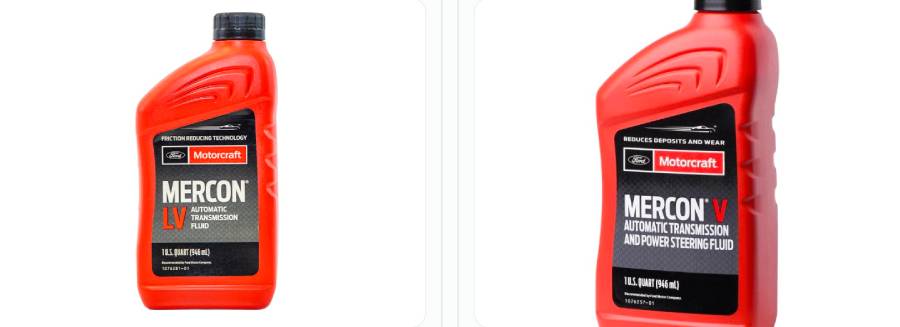
What Is the Difference Between Mercon LV and Mercon V?
The main difference between Mercon LV and Mercon V is viscosity, followed by friction characteristics and transmission compatibility. Mercon LV is a low-viscosity automatic transmission fluid specification developed for Ford transmissions requiring reduced fluid resistance. Mercon V is a separate specification designed for transmissions with different hydraulic and friction requirements. Both fluids lubricate transmission components, transfer hydraulic pressure, and support clutch engagement, but they are not interchangeable.
The following table compares the main characteristics of Mercon LV and Mercon V.
| Characteristic | Mercon LV | Mercon V |
|---|---|---|
| Fluid type | Low-viscosity ATF | Conventional-viscosity ATF |
| Kinematic viscosity at 100°C | Approximately 6 cSt | Approximately 7.5 cSt |
| Viscosity at operating temperature | Lower | Higher |
| Friction characteristics | Designed for MERCON LV applications | Designed for MERCON V applications |
| Typical applications | Selected newer Ford automatic transmissions | Various older Ford automatic transmissions |
| Transmission compatibility | Transmissions specifying MERCON LV | Transmissions specifying MERCON V |
| Interchangeability | Not generally interchangeable with MERCON V | Not generally interchangeable with MERCON LV |
Viscosity values are approximate and vary by product formulation. Consult the fluid manufacturer’s technical data sheet for exact specifications.
Mercon LV has a lower kinematic viscosity at operating temperature, allowing it to flow with less resistance through transmission passages. This characteristic supports the hydraulic and lubrication requirements of transmissions engineered for low-viscosity ATF. However, lower viscosity does not automatically provide better protection or performance in a transmission designed for Mercon V.
Mercon V has a higher operating viscosity and different friction characteristics. Its formulation supports the clutch engagement and hydraulic behavior required by transmissions specifying MERCON V. Using a fluid with different friction properties can change how transmission clutches engage and release, potentially affecting shift timing and smoothness.
Another important difference is the intended application. Mercon LV is specified for selected Ford automatic transmissions, including certain six-speed units, while Mercon V is associated with various earlier four-speed and five-speed transmissions. The exact requirement depends on the transmission model, vehicle model year, and Ford service specifications.
Can You Use Mercon LV Instead of Mercon V?
No, Mercon LV should not be used instead of Mercon V unless the vehicle or transmission manufacturer explicitly approves the substitution. Although both fluids are Ford automatic transmission fluid specifications, their viscosity and friction characteristics are different. A transmission designed for Mercon V requires fluid that meets its specified performance requirements.
Mercon LV has a lower operating viscosity than Mercon V. Using it in a transmission designed for Mercon V can change hydraulic behavior and clutch engagement characteristics. Depending on the transmission design and operating conditions, these differences may contribute to shift hesitation, clutch slippage, or increased component wear. The risks arise from using a fluid outside the required specification rather than from low viscosity alone.
Mercon V should not replace Mercon LV either. Its higher viscosity and different friction characteristics may affect fluid flow, hydraulic response, and clutch operation in transmissions engineered for MERCON LV fluid. Using a thicker ATF does not necessarily improve lubrication or extend transmission life because automatic transmissions depend on specific fluid properties to operate correctly.
The age of the transmission fluid specification also does not determine backward compatibility. Mercon LV is not a universal upgrade for Mercon V, and the two specifications should be treated separately unless an applicable manufacturer approval states otherwise.
For example, a Ford transmission requiring MERCON V should receive an ATF that meets the MERCON V specification, even when MERCON LV is available. The same principle applies to transmissions requiring MERCON LV. The manufacturer’s specified ATF requirement, not the availability or perceived quality of another fluid, determines the correct choice.
Which Ford Transmissions Require Mercon LV or Mercon V?
Ford transmissions requiring Mercon LV include the 6R80, 6F35, and 6F50, while transmissions using Mercon V include the 4R70W, 4R75E, and certain 5R55 variants. However, fluid requirements depend on the transmission model, production year, and manufacturer specifications. Two Ford vehicles with the same model name can require different transmission fluids because they use different transmission designs.
Ford introduced MERCON LV for automatic transmissions engineered around lower-viscosity fluid and specific friction characteristics. MERCON V remains applicable to various earlier transmissions that require its distinct hydraulic and clutch-friction properties. Transmission identification is therefore more reliable than selecting fluid based only on vehicle age or engine size.
Which Ford Transmissions Use Mercon LV?
Ford transmissions that commonly require Mercon LV include the 6R80, 6F35, 6F50, and 6F55 automatic transmissions. These units were used in various Ford and Lincoln vehicles, including the F-150, Mustang, Fusion, Escape, Edge, and Explorer, depending on the model year and powertrain configuration.
The 6R80 six-speed automatic transmission is a representative MERCON LV application. It was installed in numerous Ford F-150 and Mustang models. Its hydraulic control system, torque converter clutch, and internal clutch assemblies are designed to operate with fluid meeting the specified MERCON LV requirements.
The 6F35 six-speed automatic transmission is another common example. It appears in selected Ford Fusion and Escape models, while the 6F50 and 6F55 were used in several Ford and Lincoln vehicles. These transmissions require fluid characteristics compatible with their hydraulic control and clutch systems.
Which Ford Transmissions Use Mercon V?
Ford transmissions associated with Mercon V include the 4R70W, 4R75W, 4R75E, and certain 5R55-series automatic transmissions. These transmissions were installed in vehicles such as the Ford Crown Victoria, Expedition, Explorer, Mustang, and F-150 across different production years.
The 4R70W four-speed automatic transmission is a well-known MERCON V application. It was used in several rear-wheel-drive Ford vehicles, including the Crown Victoria and earlier F-150 models. Its clutch engagement and hydraulic operating characteristics require transmission fluid meeting the applicable Ford specification.
The 4R75W and 4R75E are related four-speed automatic transmissions used in selected Ford trucks and passenger vehicles. Certain 5R55-series transmissions also specify MERCON V, although requirements vary across individual transmission versions and model years. The 5R55 designation alone is not sufficient to determine the correct fluid.
The following table summarizes representative Ford transmission applications.
| Transmission | Common Ford applications | Fluid specification |
|---|---|---|
| 6R80 | F-150, Mustang | MERCON LV |
| 6F35 | Fusion, Escape | MERCON LV |
| 6F50 / 6F55 | Edge, Explorer | MERCON LV |
| 4R70W | Crown Victoria, F-150 | MERCON V in applicable model years |
| 4R75W / 4R75E | F-150, Expedition | MERCON V in applicable model years |
| Certain 5R55 variants | Explorer, Mustang | MERCON V where specified |
These are representative applications, not a complete compatibility chart. Confirm the required fluid using the vehicle’s model year, transmission designation, and official Ford service information.
Transmission families can span multiple model years, and Ford has used different fluid specifications across related transmission designs. For example, a Ford F-150 equipped with a 6R80 does not necessarily require the same fluid as an older F-150 equipped with a 4R70W. The transmission’s documented fluid specification is the deciding factor when choosing between Mercon LV and Mercon V.
What Happens if You Use the Wrong Mercon Transmission Fluid?
Using the wrong Mercon transmission fluid can cause harsh shifting, delayed gear engagement, clutch slippage, and accelerated transmission wear. These problems occur when the fluid’s viscosity or friction characteristics do not match the transmission’s hydraulic and clutch-control requirements. However, an incorrect fluid fill does not guarantee immediate damage. The consequences depend on the transmission design, the amount of incorrect fluid, operating conditions, and how long the vehicle is driven.
Automatic transmissions use pressurized fluid to operate clutch packs, control gear changes, and lubricate moving components. Transmission pumps circulate ATF through hydraulic passages, while the valve body and electronic controls regulate fluid pressure during shifting. A fluid with unsuitable viscosity can change hydraulic response, particularly during cold starts or when operating temperatures increase. For example, using a lower-viscosity fluid in a transmission designed for a different specification may affect pressure regulation and clutch engagement under certain operating conditions.
Friction characteristics are equally important because automatic transmission clutches depend on controlled friction to engage smoothly. Mercon LV and Mercon V have different friction-performance requirements, so substituting one for the other can alter clutch engagement behavior. Harsh shifting occurs when gear changes feel unusually abrupt, while delayed engagement occurs when the transmission takes longer than expected to engage Drive or Reverse. These symptoms can also result from mechanical or electronic faults, so they do not independently confirm that the wrong fluid is responsible.
Clutch slippage is another potential consequence of using an incompatible ATF. Slippage occurs when clutch components fail to maintain the intended frictional engagement while transmitting engine torque. Continued slipping generates heat and can accelerate friction-material wear. For example, a transmission that repeatedly slips during acceleration may experience increased internal temperatures and deterioration of its clutch surfaces. Nevertheless, the severity of damage cannot be determined from fluid specification alone.
Using the wrong Mercon fluid can also affect torque converter clutch operation. The torque converter clutch relies on controlled friction to connect the engine and transmission efficiently under specified driving conditions. An unsuitable ATF may contribute to torque converter shudder, which drivers can experience as vibration during steady-speed driving. Because similar symptoms have other causes, proper diagnosis should include fluid identification, transmission fault codes, and the manufacturer’s diagnostic procedures.
Can You Mix Mercon LV and Mercon V?
Mercon LV and Mercon V should not be intentionally mixed because the resulting fluid mixture is not guaranteed to meet either Ford transmission fluid specification. Although both are automatic transmission fluids, they have different viscosity and friction-performance requirements. Mixing them changes the proportions of their respective formulations without establishing that the mixture satisfies the transmission manufacturer’s specifications.
Automatic transmission fluids contain base oils and additive systems designed to provide oxidation resistance, wear protection, friction control, and appropriate viscosity behavior. Mercon LV and Mercon V are formulated to meet different performance standards. Combining them does not necessarily cause an immediate chemical reaction or visible fluid separation, but it can produce friction and viscosity characteristics that have not been validated for the transmission.
The potential consequences of mixing Mercon LV and Mercon V include inconsistent shift quality, torque converter clutch shudder, and increased clutch wear. These effects are not inevitable, and their likelihood depends on the transmission and mixture composition. For example, adding a small amount of Mercon V to a transmission requiring Mercon LV does not automatically cause mechanical failure, but the resulting mixture should not be assumed to meet the MERCON LV specification.
What Should You Do if You Accidentally Mix Mercon LV and Mercon V?
If you accidentally mix Mercon LV and Mercon V, stop adding fluid, verify the required specification, and arrange an appropriate corrective service before continuing normal driving. The response should account for how much incorrect fluid entered the transmission, whether the engine has been operated, and whether shifting symptoms have appeared.
First, identify the transmission and confirm its required ATF specification using the owner’s manual or Ford service information. Next, determine the approximate quantity of incorrect fluid added. For example, adding a small amount during a top-up presents a different contamination situation from filling an entire transmission with the wrong ATF, although neither situation establishes that the mixture is approved.
A transmission service professional can determine whether a fluid drain and refill, a more comprehensive fluid exchange, or additional inspection is appropriate. A single drain may not remove all the existing fluid because some remains inside the torque converter, hydraulic passages, and other internal components. The correct procedure depends on the transmission design and Ford’s applicable service instructions.
Avoid continued driving if the transmission develops severe slipping, delayed engagement, unusual noises, or significant shifting problems. These symptoms require diagnosis rather than repeated fluid top-ups. Correcting the fluid specification promptly reduces unnecessary exposure to an unapproved ATF mixture, but it does not establish whether internal damage has already occurred.
Read more: Who Accepts Synchrony Car Care? Stores & Locations
How Do You Know Whether Your Vehicle Needs Mercon LV or Mercon V?
The most reliable way to determine whether your vehicle needs Mercon LV or Mercon V is to check the transmission fluid specification in the owner’s manual or official Ford service documentation. The required fluid depends on the transmission design, model year, and manufacturer specifications rather than the vehicle’s name or engine size alone.
Start by locating the automatic transmission fluid requirements in the vehicle’s owner’s manual. Ford typically identifies the recommended fluid by its MERCON designation and may also provide a Ford engineering specification. For example, MERCON LV is associated with Ford specification WSS-M2C938-A, while MERCON V is associated with WSS-M2C202-B. These specification identifiers help distinguish the required fluid when comparing transmission fluid products.
Next, identify the transmission model installed in the vehicle. Ford has used multiple automatic transmissions across the same vehicle nameplate, and their fluid requirements are not necessarily identical. For example, a Ford F-150 equipped with a 6R80 transmission generally requires MERCON LV, while an older F-150 equipped with a 4R70W may require MERCON V. The transmission designation and applicable service information provide a more accurate basis for fluid selection than the F-150 model name alone.
The transmission can be identified through vehicle documentation, manufacturer service records, or transmission identification information. A Ford dealership or qualified transmission specialist can also use the vehicle identification number (VIN) to help determine the installed transmission and its required fluid specification. This is particularly useful when the vehicle has undergone a transmission replacement or when its service history is incomplete.
Finally, compare the required specification with the transmission fluid container’s labeling and technical documentation. A product marketed as suitable for Ford vehicles does not automatically meet every Ford transmission fluid requirement. Choose an ATF that explicitly meets the specification required for your transmission, and verify any alternative fluid against the applicable manufacturer guidance.
Are Mercon LV and Mercon V Compatible With Universal Transmission Fluids?
Some multi-vehicle automatic transmission fluids are marketed as suitable for Mercon LV or Mercon V applications, but compatibility depends on the individual product and the transmission manufacturer’s requirements. A universal ATF label does not establish that a fluid meets every automatic transmission specification.
Multi-vehicle transmission fluids are formulated to serve several transmission applications through selected viscosity characteristics, friction modifiers, and additive systems. However, MERCON LV and MERCON V have different performance requirements, making it important to distinguish between a fluid manufacturer’s compatibility recommendation and formal specification approval. A product may claim suitability for a particular application without carrying an official manufacturer approval.
When evaluating a multi-vehicle ATF, examine its product data sheet and the specifications listed by the fluid manufacturer. Confirm whether MERCON LV or MERCON V is explicitly identified and determine whether the claim represents an approval, a licensing statement, or a suitability recommendation. For example, a fluid advertised for MERCON V applications should not be assumed suitable for a transmission requiring MERCON LV unless the manufacturer specifically documents that application.
Viscosity alone is not enough to establish compatibility. Two transmission fluids can have similar kinematic viscosity values while differing in friction characteristics, oxidation resistance, or other performance properties. Automatic transmissions depend on the combined behavior of these properties to maintain appropriate hydraulic operation and clutch engagement.
The safest selection is a transmission fluid that meets the exact Ford specification required by the vehicle. When considering a multi-vehicle alternative, verify its documented compatibility with the transmission and follow applicable Ford service guidance rather than relying on broad universal ATF claims.