An Audi A4 oil leak commonly comes from a worn gasket or seal, a leaking oil-system component, or excessive crankcase pressure. Common leak points include the valve cover gasket, oil filter housing area, oil pan, drain plug, crankshaft seals, and camshaft seals, although the exact source depends on the Audi A4 model year and engine.
Visible oil underneath the car is not the only sign of a leak. An Audi A4 may also develop a burning oil smell, smoke from the engine bay, a falling engine oil level, or an oil-related warning on the dashboard. Some leaks remain minor seepages for a period, while faster leaks can reduce the available engine oil and put internal components at risk from inadequate lubrication.
Finding the source requires more than identifying where oil eventually drips onto the ground. Oil can travel across engine components before reaching the lowest point, so diagnosis should trace the residue back to its origin. This guide explains the common symptoms and causes of Audi A4 oil leaks, where leaks develop, how serious they can become, how to diagnose the source, and which repairs are used to correct the underlying problem.
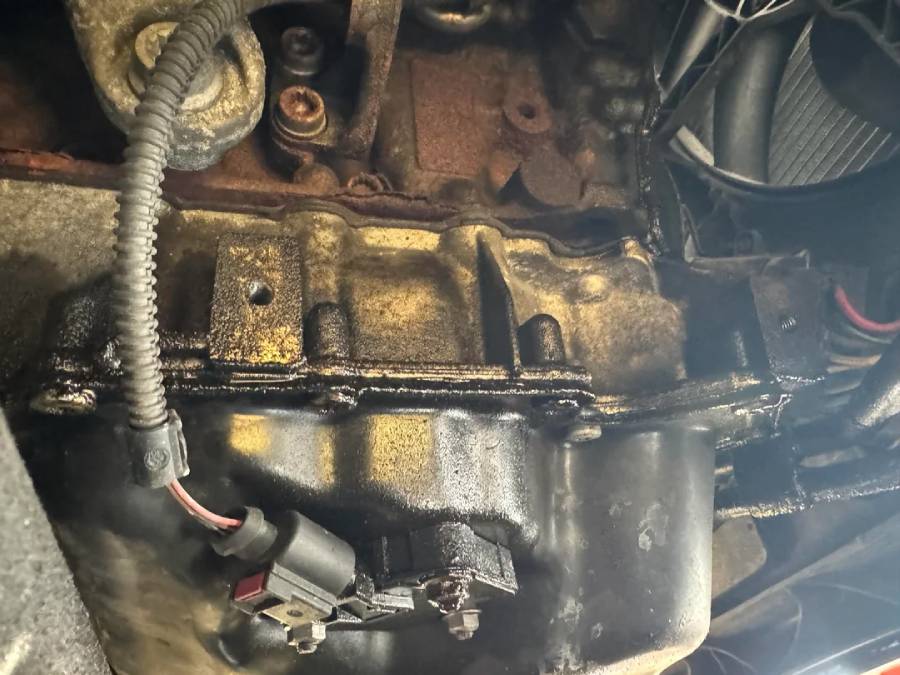
What Are the Most Common Symptoms of an Audi A4 Oil Leak?
The most common symptoms of an Audi A4 oil leak are oil spots under the vehicle, a falling engine oil level, a burning oil smell, smoke from the engine bay, and oil-related dashboard warnings. The symptoms depend on the leak location and the amount of oil escaping. A small seep around a gasket may leave oily residue without producing a puddle, while an active leak can leave visible drops on the ground after the vehicle has been parked.
Oil spots underneath an Audi A4 provide visible evidence of an external fluid leak, but the location of the spot does not always identify the failed component. Engine oil can run along covers, brackets, the engine block, or the undertray before reaching the ground. Fresh engine oil typically appears amber to brown, while used engine oil is usually darker. The fluid should still be identified before assuming every dark spot underneath the vehicle is engine oil.
A burning oil smell can indicate that leaking oil has reached a hot engine or exhaust component. This type of leak may produce little or no oil on the ground because part of the escaping oil remains in the engine bay or burns after contacting a hot surface. Smoke from the engine compartment alongside a strong oil smell makes inspection more urgent because it indicates that oil is reaching an area exposed to substantial heat.
A falling oil level is another important sign, but oil loss alone does not prove that an Audi A4 has an external leak. Engines can also consume oil internally. An external leak normally leaves wet oil residue somewhere on the engine, underbody, or parking surface, whereas internal oil consumption occurs when engine oil enters the combustion process. Diagnosis should therefore distinguish oil leakage from oil consumption before replacing gaskets or seals.
Oil-related dashboard warnings require particular attention because oil level and oil pressure are not the same condition. A low oil level indicates that the available quantity of oil needs attention, while an oil-pressure warning can indicate that the lubrication system is not maintaining adequate pressure. An oil-pressure warning should not be treated as a routine symptom that can be addressed simply by continuing to drive and adding oil later.
Where Does an Audi A4 Commonly Leak Oil From?
An Audi A4 can commonly develop oil leaks around sealing points and oil-containing components such as the valve cover, oil filter housing area, oil pan, drain plug, crankshaft seals, and camshaft seals. The exact leak points vary by engine and model year, so diagnosis should identify the source on the specific vehicle rather than assuming every Audi A4 develops the same leak.
The position of the oil provides an initial diagnostic clue. Oil concentrated near the upper part of the engine suggests an upper-engine sealing point, while fresh oil around the oil filter assembly directs attention toward the filter, housing, or associated seals. Oil accumulating around the bottom of the engine can originate from the oil pan or drain plug, but it can also have traveled downward from a higher leak.
Can the Valve Cover Gasket Cause an Audi A4 Oil Leak?
Yes. A failed valve cover gasket can allow engine oil to escape from the upper part of an Audi A4 engine. The gasket seals the joint between the valve cover and cylinder head. Heat cycles, age, and deterioration of the sealing material can eventually prevent the gasket from maintaining an oil-tight joint.
Oil from this area may collect around the upper engine before moving downward. When the escaping oil reaches a sufficiently hot surface, the driver may notice a burning oil smell or smoke from the engine bay. This explains why an upper-engine leak can produce a noticeable smell without immediately creating a large puddle underneath the car.
The gasket should not be diagnosed from the presence of oil near the valve cover alone. Oil can spread from another source, and residue from previous service work can remain on engine surfaces. The area should be inspected for the point where fresh oil first appears before the valve cover gasket is identified as the source.
Can the Oil Filter Housing Leak on an Audi A4?
Yes. Oil can leak from the oil filter housing area when a seal, gasket, filter connection, or related component no longer maintains a proper seal. Because engine oil circulates through this area, a sealing failure can leave fresh oil around the filter assembly and nearby engine components.
The diagnostic clue is the origin of the wet oil rather than the lowest point where it accumulates. Oil originating around the housing can move downward and make a lower part of the engine appear to be leaking. Cleaning existing residue and checking where fresh oil returns helps separate a housing-area leak from an oil pan or other lower-engine leak.
The exact filter housing design differs between Audi A4 engines. Component identification should therefore be based on the engine fitted to the vehicle rather than applying one repair procedure to every A4 generation.
Can the Oil Pan or Drain Plug Leak on an Audi A4?
Yes. The oil pan and drain plug can both produce leaks from the lower part of an Audi A4 engine. An oil pan leak can develop at its sealing surface or from physical damage to the pan itself. A drain plug leak can result from a sealing problem involving the plug, sealing washer, threads, or installation during an oil service.
A drain plug leak is especially relevant when oil appears shortly after an oil change. Fresh oil concentrated directly around the drain point makes the plug and its sealing surface logical areas to inspect. However, oil reaching the pan from higher on the engine can create a similar appearance, so the upper engine should still be checked before concluding that the pan is the source.
Damage should also be distinguished from a sealing failure. Replacing a seal will not correct a damaged pan or compromised threads. The repair must address the component actually allowing oil to escape.
Can Crankshaft or Camshaft Seals Leak Oil on an Audi A4?
Yes. Worn or damaged crankshaft and camshaft seals can cause an Audi A4 engine to leak oil where rotating shafts pass through sealed areas of the engine. These seals must retain oil while allowing the shafts to rotate, making their condition important for controlling external oil leakage.
Seal leaks can be more difficult to identify than an exposed valve cover or drain plug leak because the source may be partially obscured by surrounding components. Oil can also spread from the original sealing point before it becomes visible during an inspection. A technician may therefore need to clean the affected area and trace fresh oil back toward the seal rather than diagnosing the problem solely from oil found underneath the engine.
Timing-cover areas and turbocharger oil supply or return components can also become relevant on Audi A4 engines equipped with those systems. These sources should be investigated when the oil pattern and engine configuration support them rather than being treated as universal Audi A4 failure points.
What Causes an Audi A4 to Leak Oil?
The main causes of an Audi A4 oil leak are deteriorated gaskets or seals, abnormal crankcase pressure, oil filter or drain plug sealing problems, physical damage to oil-containing components, and oil-service issues. The specific cause depends on where fresh oil first appears and which engine is fitted to the vehicle. Identifying the failure mechanism is important because replacing a visibly leaking seal may not provide a lasting repair when another problem is creating the leak.
Worn gaskets and seals are a direct mechanical cause of external oil leakage. These components create sealed joints between engine parts while the engine experiences repeated heating and cooling cycles. As a sealing material deteriorates, hardens, becomes damaged, or loses its ability to conform to the mating surfaces, engine oil can pass through the weakened sealing point. Valve cover gaskets and shaft seals are examples of components where this type of failure can result in visible oil residue.
Abnormal crankcase pressure can contribute to oil leaks by placing additional pressure on engine seals and gaskets. The crankcase ventilation system manages gases and pressure inside the engine crankcase. A PCV-related fault that disrupts this process can change crankcase pressure and place additional stress on sealing points. In this situation, repairing only the leaking gasket may leave the underlying pressure problem unresolved, increasing the possibility that leakage will return or appear at another weak sealing point.
Oil leaks can also appear after maintenance. An incorrectly seated oil filter seal, a drain plug sealing problem, damaged threads, or an unsuitable sealing washer can allow oil to escape after an oil change. The timing of the symptom provides useful diagnostic context: when an Audi A4 begins leaking immediately after an oil service, the components disturbed during that service should be inspected before unrelated engine seals are replaced.
Physical component damage creates another leak mechanism. An oil pan that has been damaged by an impact, for example, cannot necessarily be repaired by replacing its sealing material. Diagnosis must distinguish a damaged component from a failed gasket because the required repairs are different. The same principle applies to sealing surfaces and threaded connections that can no longer maintain the required seal.
Incorrect oil level should also be investigated when it coincides with leakage, particularly following service. However, excess oil should not automatically be identified as the cause of every Audi A4 oil leak. The leak source, oil level, crankcase ventilation system, and recently serviced components should be evaluated together to establish the actual failure rather than relying on a single symptom.
Is an Audi A4 Oil Leak Serious?
An Audi A4 oil leak can range from minor seepage to a problem that requires the engine to be stopped, depending on the leak rate, remaining oil level, oil pressure, and location of the escaping oil. A small amount of surface seepage does not carry the same immediate risk as rapid oil loss, but even a minor leak should be diagnosed because its rate can increase and oil can contaminate surrounding components.
A minor leak generally develops slowly and does not cause a rapid change in oil level. The vehicle may show dampness around a gasket or occasional small spots where it is parked. This provides time to arrange an inspection, but it does not mean the leak should be ignored indefinitely. Monitoring the oil level and the rate of leakage helps determine whether the condition is stable or becoming worse.
Visible dripping, repeated oil-level loss, a persistent burning oil smell, or smoke from the engine bay increases the urgency of repair. These signs indicate either that more oil is escaping or that the location of the leak creates an additional concern. For example, oil leaking onto a hot component can generate smoke and odor even before enough oil has escaped to produce a large puddle underneath the vehicle.
Rapid oil loss presents a more direct risk to the engine. Engine oil forms a lubricating film between moving components and also contributes to heat management and contamination control. The mechanical progression is straightforward: oil leakage can reduce the available oil supply; insufficient lubrication increases friction and heat; continued operation can then damage lubricated engine components. The seriousness of the leak therefore depends not only on how much oil is visible outside the engine but also on whether the lubrication system can continue operating correctly.
An oil-pressure warning represents a different level of concern from finding a few drops of oil on the parking surface. Low oil pressure can mean that critical engine components are not receiving adequate lubrication. The warning should therefore not be treated simply as a reminder to schedule leak repair at a convenient time.
Oil reaching sufficiently hot surfaces can also create smoke and increase fire risk. This does not mean that every Audi A4 oil leak will cause a fire. The risk depends on the amount of escaping oil, where it travels, and the temperature of the components it contacts. A leak accompanied by smoke or a strong burning-oil odor warrants prompt inspection rather than continued monitoring alone.
Can You Drive an Audi A4 With an Oil Leak?
You should only continue driving an Audi A4 with an oil leak when the leak is minor, the engine has an adequate oil level, no oil-pressure warning is present, and there are no signs of rapid oil loss or oil contacting hot components. Even under these conditions, continued driving should not replace diagnosis and repair.
A small seep with a stable oil level generally provides more time to arrange an inspection than an active drip. Check the oil level using the procedure specified for the particular Audi A4 model before deciding whether to drive. Audi A4 generations differ in their oil-level monitoring arrangements, so the vehicle’s specified procedure should be followed rather than assuming every model uses the same method.
Driving becomes a poor choice when the leak is actively losing enough oil to require repeated topping up. A growing puddle, rapidly falling oil level, substantial burning smell, or visible smoke indicates that the problem has progressed beyond simple monitoring. Continuing to operate the engine can increase both oil loss and the possibility of secondary problems.
Stop the engine when an oil-pressure warning appears or when severe oil loss suggests that adequate lubrication cannot be maintained. Adding oil is not a substitute for diagnosing an oil-pressure problem because oil quantity and oil pressure describe different conditions. Continuing to drive with inadequate oil pressure can expose bearings and other lubricated components to accelerated wear or failure.
The safest decision should therefore be based on measurable conditions rather than the presence of a leak alone. A minor seep, correct oil level, and absence of warning signs create a different situation from rapid leakage, smoke, or an oil-pressure warning. Identifying which condition applies allows the repair urgency to match the actual mechanical risk.
How Do You Diagnose an Audi A4 Oil Leak?
To diagnose an Audi A4 oil leak, confirm that the leaking fluid is engine oil, check the oil level, inspect the engine for fresh residue, trace the oil to its highest visible source, clean contaminated areas, and reinspect the engine for new leakage. Diagnosis should identify the component where the oil originates rather than the location where it eventually collects.
Start by confirming the fluid type. Used engine oil is commonly brown to dark brown or black, but color alone is not sufficient because other automotive fluids and road contamination can alter its appearance. Check the engine oil level at the same time. A declining oil level combined with fresh oily residue provides stronger evidence of an external engine oil leak than a stain on the ground alone.
The next step is to inspect the engine from the top downward. The highest point containing fresh oil is often more diagnostically useful than the lowest wet area. Gravity, airflow, vibration, and vehicle movement can spread leaking oil across the engine and underbody. For example, oil originating around an upper-engine gasket can travel downward and collect near the oil pan, making the pan appear to be the source when it is not.
Existing contamination can make this process difficult. Old oil from a previous leak or maintenance work may remain on engine surfaces long after the original event. Cleaning the affected area and reinspecting it after the engine has operated allows fresh leakage to be separated from old residue. The first location where new oil appears provides a more reliable basis for identifying the failed gasket, seal, housing, or connection.
Diagnosis should also consider when the leak started. An Audi A4 that begins leaking immediately after an oil change should have the recently serviced areas inspected, including the oil filter and drain plug. A leak accompanied by abnormal crankcase-pressure symptoms requires investigation of the crankcase ventilation system. Matching the leak pattern with recent maintenance and related symptoms reduces unnecessary parts replacement.
External leakage must also be distinguished from engine oil consumption. An Audi A4 can lose engine oil without leaving an external leak if oil is being consumed internally. When the oil level falls but the engine, underbody, and parking surface remain free of fresh leakage, diagnosis should not automatically focus on gaskets and seals.
How Do You Find Where an Audi A4 Is Leaking Oil?
Find the source of an Audi A4 oil leak by tracing fresh oil residue against the direction in which it has traveled until the first wet component or sealing point is identified. Begin with accessible upper-engine areas before inspecting lower components because oil naturally moves downward and can contaminate several parts below the actual leak.
Inspect around likely sealing and oil-containing areas such as the valve cover, oil filter housing area, oil pan, drain plug, and visible engine seals. The goal is not to replace the first component that looks oily. Instead, determine whether oil begins at that component or arrives there from somewhere higher.
Leak rate also provides diagnostic information. A slow seep may produce only a film of oil and accumulated dirt, whereas an active leak can produce fresh droplets shortly after the engine operates. Observing where fresh oil reappears after cleaning can therefore help distinguish an active source from surfaces contaminated by an older leak.
Can UV Dye Help Find an Audi A4 Oil Leak?
UV dye can help locate an Audi A4 oil leak when the source cannot be identified reliably through visual inspection alone. A compatible fluorescent dye is introduced into the oil system and allowed to circulate. The engine is then inspected with the appropriate ultraviolet light to identify where dye-containing oil first escapes.
This method is particularly useful when several engine areas are oily or when the leak is small enough that its path cannot be followed visually. Instead of relying solely on accumulated residue, the technician can look for fresh fluorescent traces originating from a specific sealing point.
UV dye does not determine why the component failed. Once the leak source is located, the underlying cause still needs to be evaluated. For example, identifying oil escaping from a gasket does not rule out abnormal crankcase pressure as a contributing cause. Leak detection and root-cause diagnosis are therefore separate parts of the repair process.
How Do You Fix an Audi A4 Oil Leak?
Fixing an Audi A4 oil leak requires repairing or replacing the component, gasket, seal, or connection that allows engine oil to escape and correcting any underlying condition that caused the failure. Cleaning the engine or repeatedly topping up the oil does not repair the leak because neither action restores the failed sealing point.
The repair procedure depends on the source. A deteriorated gasket requires replacement and proper preparation of its sealing surfaces. A leaking drain plug may require a new sealing component or repair of damaged threads. A damaged oil pan must be evaluated for physical repair or replacement. A PCV-related problem requires correction of the crankcase ventilation fault in addition to any gasket or seal that has already begun leaking.
The repaired area should be cleaned before the final inspection. This makes it possible to identify new oil rather than confusing residual contamination with continued leakage. After repair, the oil level and repaired sealing point should be checked again to confirm that the original source has been corrected.
How Are Leaking Audi A4 Gaskets and Seals Repaired?
A leaking Audi A4 gasket or seal is repaired by accessing the failed sealing point, removing the affected component as required, replacing the damaged sealing material, preparing the mating surfaces correctly, and reassembling the components to the specified procedure. The exact process and labor requirement depend on the location of the gasket or seal.
A valve cover gasket, for example, requires access to the valve cover and its sealing surface. The old gasket is removed, the mating surfaces are prepared, and the replacement seal is installed correctly before the assembly is secured again. A crankshaft or camshaft seal can require substantially more disassembly because surrounding components may restrict access.
Replacing the seal should not end the diagnosis when evidence indicates another mechanical cause. A new gasket can leak again if excessive crankcase pressure that contributed to the original failure remains unresolved. This is why the repair should address both the failed sealing point and any verified condition responsible for placing abnormal stress on it.
How Are Oil Pan, Oil Filter, and Drain Plug Leaks Repaired?
Oil pan, oil filter, and drain plug leaks are repaired by identifying whether the failure comes from a sealing surface, replaceable seal, connection, threads, or physical component damage. These sources are grouped together because they involve oil-containing or service-related components, but they do not all require the same repair.
An oil filter-area leak requires inspection of the filter, its seal, housing, and related connections applicable to the engine. A damaged or incorrectly positioned seal must be corrected rather than simply tightening components without identifying the failure. This is particularly important when the leak begins immediately after an oil service.
A drain plug leak requires inspection of the plug, sealing washer or sealing surface, and threads. Replacing a washer can correct a sealing problem when the remaining components are undamaged, but it cannot restore compromised threads. Likewise, an oil pan that is physically cracked or damaged requires a different repair from a pan that leaks only at its sealing surface.
How Are PCV-Related Audi A4 Oil Leaks Repaired?
A PCV-related Audi A4 oil leak requires correction of the crankcase ventilation fault and repair of any gasket or seal that has been damaged or is actively leaking. Addressing only the visible leak can leave the pressure condition that contributed to the sealing failure in place.
The crankcase ventilation system controls the movement of crankcase gases and helps manage pressure inside the engine. A fault within this system can alter the pressure acting on seals and gaskets. Diagnosis must establish whether abnormal crankcase pressure is actually present rather than automatically replacing the PCV system whenever an oil leak occurs.
Once a PCV-related fault is confirmed, the failed ventilation component is repaired or replaced as appropriate for the specific engine. Any sealing points already leaking must then be evaluated separately. The objective is to correct both the oil escape path and its verified root cause, reducing the likelihood that a replacement gasket or seal will develop another leak.
How Much Does It Cost to Fix an Audi A4 Oil Leak?
The cost to fix an Audi A4 oil leak depends on the leaking component, replacement parts, required labor, engine configuration, model year, and whether the leak has caused secondary problems. A drain plug sealing problem can require a relatively simple repair, while a crankshaft or camshaft seal leak may involve substantial disassembly before the failed seal can even be accessed.
Diagnosis is the first cost factor because the visible oil does not always identify the component that needs replacement. Oil originating near the top of the engine can travel downward and make an oil pan or another lower component appear to be leaking. Paying for an accurate diagnosis can therefore prevent unnecessary replacement of parts that are oily but are not the actual source.
Parts cost also varies considerably by repair type. A sealing washer, gasket, or individual seal is fundamentally different from replacing a damaged oil pan, housing, ventilation component, or another complete assembly. However, the price of the replacement part alone does not determine the total repair cost. A relatively inexpensive seal can produce a costly repair when several components must be removed to reach it.
Labor is often the largest variable. Oil filter or drain plug problems can be accessible during routine service, whereas some engine seals require substantially more disassembly. Engine configuration also affects access, meaning two Audi A4 oil leaks involving different engines can require different amounts of labor even when the general type of failure is similar.
Repair costs can be grouped by relative complexity:
| Repair type | Parts complexity | Labor complexity | Relative cost |
|---|---|---|---|
| Drain plug or sealing washer | Low | Low | $ |
| Oil filter or accessible seal | Low to moderate | Low to moderate | $–$$ |
| Valve cover gasket | Moderate | Moderate | $$ |
| Oil pan leak | Moderate | Moderate to high | $$–$$$ |
| Crankshaft or camshaft seal | Moderate | High | $$$ |
These categories describe repair complexity rather than fixed prices. A specific Audi A4 oil leak should be priced using the vehicle’s model year, engine, confirmed leak source, required parts, and local labor rate. Providing one universal repair price would be misleading because an oil leak describes a symptom category rather than one specific repair.
Early diagnosis can also limit additional expense. A small sealing leak may initially require only correction of the failed component, whereas continued oil loss can contaminate nearby parts or eventually reduce the available engine oil. Repairing the source before these secondary effects develop prevents the original leak from becoming a broader mechanical problem.
Are Audi A4 Oil Leaks Different by Model Year and Engine?
Yes. Audi A4 oil leak locations, causes, and repair procedures can differ by model year and engine because the A4 has been produced with multiple engine configurations and component layouts. A leak point associated with one engine should therefore not automatically be treated as a common failure on every Audi A4.
Engine configuration determines where components such as the valve cover, crankcase ventilation system, oil filter assembly, turbocharger oil connections, oil pan, and engine seals are located and how technicians access them. Changes in component design can also alter the gasket, seal, or assembly used to contain engine oil. These differences directly affect both diagnosis and repair labor.
Model year is therefore an important qualifier when troubleshooting an Audi A4 oil leak. Advice such as “replace the valve cover gasket” is incomplete until inspection confirms that the valve cover area is actually the source on that particular vehicle. The same principle applies to oil filter housings, PCV-related problems, turbocharger oil lines, timing-cover areas, and shaft seals.
The engine fitted to the vehicle provides an even more precise diagnostic context. When identifying replacement parts or following a repair procedure, use information that matches the specific engine and vehicle configuration rather than relying only on the Audi A4 nameplate. This reduces the risk of applying a known leak pattern from one A4 engine to a mechanically different version.
For the same reason, lists of “common Audi A4 oil leaks” should be treated as starting points for inspection rather than diagnoses. A known failure pattern can tell a technician where to look first, but fresh oil at the component remains stronger evidence than the frequency with which that component fails on other vehicles.
How Can You Prevent Oil Leaks on an Audi A4?
The most effective ways to reduce Audi A4 oil leak problems are to use the correct service specifications, maintain the engine at the required intervals, monitor the oil level, inspect early signs of seepage, and repair verified crankcase ventilation or sealing problems promptly. Maintenance cannot prevent every gasket or seal from aging, but it can help identify leakage before substantial oil loss occurs.
Use engine oil and service components that meet the specifications required for the particular Audi A4. Oil specification, filter selection, drain plug sealing components, and service procedures should match the vehicle and engine. This is especially important because an incorrectly installed filter seal or drain plug can create a new leak immediately after maintenance.
Check the engine oil level regularly and pay attention to changes rather than waiting for a severe warning. A level that repeatedly falls between checks requires investigation even when no puddle is visible. The cause may be an external leak or internal oil consumption, and distinguishing between the two determines what should be inspected next.
Inspect small oil seepages before they develop into active leaks. Dampness around a sealing point provides an opportunity to monitor the location and determine whether fresh oil continues to appear. Once oil spreads across several engine surfaces, identifying the original source becomes more difficult and contamination can make unrelated components appear to be leaking.
Crankcase ventilation problems should also be corrected when diagnosis confirms them. A gasket replacement addresses the physical escape path for oil, but it does not correct abnormal crankcase pressure that contributed to the failure. Repairing the underlying ventilation fault and the affected seal together provides a more complete solution than repeatedly replacing leaking gaskets.
Oil leaks should also be checked during routine maintenance because early inspection provides a reference point for future changes. A technician who identifies minor seepage can document its location, clean the area if necessary, and determine whether the leak progresses. The objective of preventive inspection is not to replace every gasket showing surface residue; it is to identify active leakage early enough to prevent avoidable oil loss and secondary problems.
Read more: Audi Side Assist System Fault – Common Causes And Fixes
What Should You Do After Repairing an Audi A4 Oil Leak?
After repairing an Audi A4 oil leak, verify the engine oil level, inspect the repaired area for fresh oil, check underneath the vehicle, monitor dashboard warnings, and watch for the return of burning-oil smells or smoke. Repair verification confirms that the diagnosed source was correct and helps identify a second leak that may have been hidden by the original contamination.
Start with a clean repaired area. Residual oil left on the engine can make a successful repair appear to be leaking and may continue producing an odor when the engine becomes hot. Cleaning accessible contamination makes fresh oil easier to distinguish from residue that escaped before the repair.
Check the oil level using the procedure specified for the vehicle and monitor it during subsequent use. The level should not continue falling because of the repaired external leak. A continuing reduction with no fresh external leakage requires further diagnosis because another leak or internal oil consumption may be present.
Inspect the original repair point again after the engine has operated. A successful repair should remain dry at the sealing point rather than simply reducing the amount of oil reaching the ground. Fresh residue at the same location suggests that the repair, sealing surface, component, or underlying cause requires further investigation.
The parking area underneath the Audi A4 provides another simple monitoring point. New drops after the repair indicate that leakage remains somewhere on the vehicle, although their position still should not be used alone to identify the source. Trace any fresh oil back through the engine or underbody before deciding which component is responsible.
Finally, monitor the symptoms that existed before the repair. A burning oil smell should diminish once residual contamination is removed and no new oil reaches hot components. Oil-related warnings, continued oil loss, fresh smoke, or recurring leakage indicate that the problem has not been fully resolved and requires another inspection.